








TBI Corn sets up Sharjah unit as Gulf freight costs soar
Max Plan at ₹4,999/yr₹8,999

Find your next multibaggerBe a Pro Investor
Research stocks and track your picks on the go. Download the app.
Key highlights
- TBI Corn said Dubai container freight rose to US$2,500-US$3,000 from US$200-US$300.
- TBI Corn reported H1 FY27 standalone revenue of Rs 165.16 crore and profit after tax of Rs 11.59 crore.
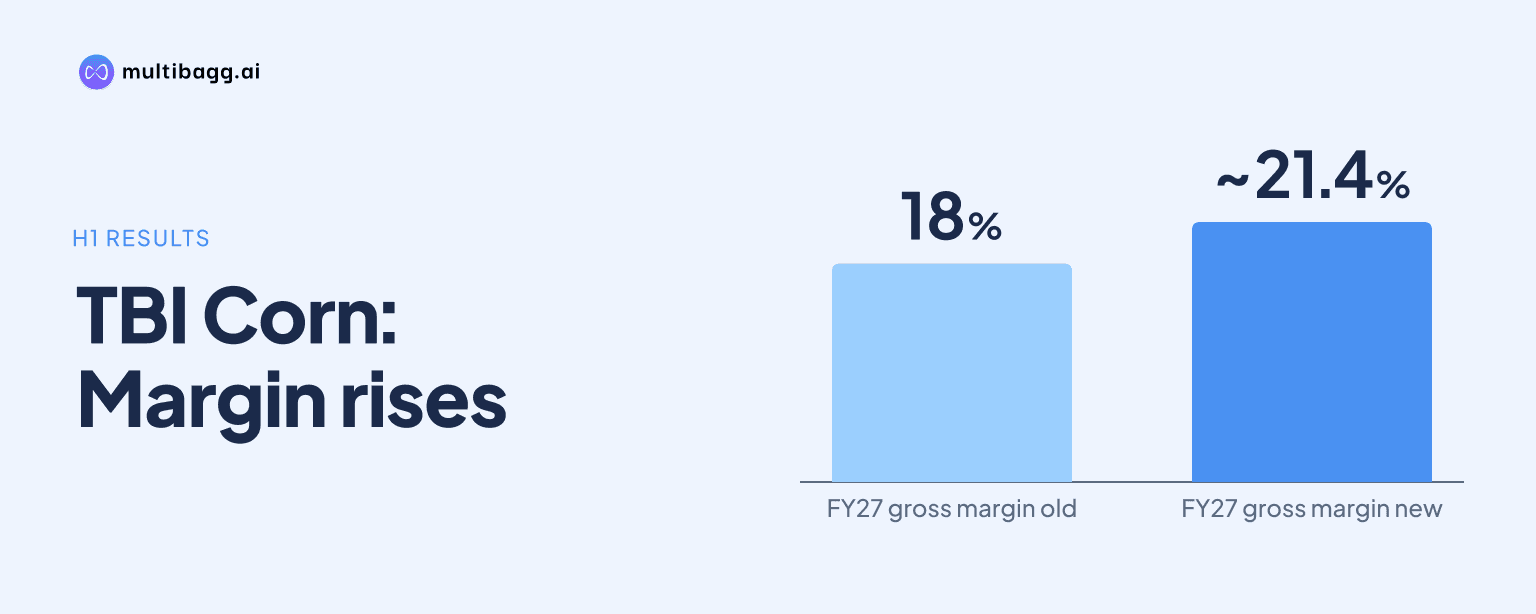
- TBI Corn’s standalone gross margin rose from 18% to about 21.4% in H1 FY27.
- TBI Corn plans UAE warehouse deliveries in 2-tonne, 5-tonne and 10-tonne lots.
powered by IRIS
TBI Corn Limited is setting up a Sharjah-based Gulf distribution model after container freight to Dubai rose to US$2,500-US$3,000 from US$200-US$300 and transit schedules became unreliable. For H1 FY27, TBI Corn reported standalone revenue of Rs 165.16 crore, while management said UAE warehousing could support smaller road-delivered orders across Gulf markets.
Know TBI Corn inside out
Results, valuation, peers and who's buying, in one view.
How will TBI Corn use its Sharjah subsidiary?
TBI Corn will use TBICL (FZE), its wholly owned subsidiary in Sharjah Free Zone, as the base for a warehouse-led Gulf distribution model. Management said the entity was registered before Diwali and has an office in the free zone, where warehousing, digitalisation and online systems are available.
The operating plan is to place inventory in a Dubai godown and distribute it by road through Dubai and Sharjah to buyers in Gulf countries. TBI Corn said the model is intended to serve business-to-business requirements of 2 tonnes, 5 tonnes and 10 tonnes from warehouse stock, rather than relying on a separate ocean shipment for every small order.
Management identified customers in animal feed and the Bakra Mandi trade as part of the opportunity, alongside smaller cash-and-carry buyers. TBI Corn said it has worked with Gulf buyers for many years, but did not disclose the number of customers, the countries covered, warehouse capacity or the date on which inventory will first be placed in the UAE.
TBI Corn has prepared a one-year quantity projection for the UAE initiative, according to management. Management said it expects the structure to improve profitability and margin, but gave no separate revenue, volume, cost or margin target for TBICL (FZE).
Why is TBI Corn changing its Gulf freight model?
TBI Corn is changing the model because freight to Dubai has increased from US$200-US$300 per container to US$2,500-US$3,000, while the delivery period is no longer assured. Management linked the disruption to Hormuz, saying delayed vessels can prevent goods from reaching customers within the expected order schedule.
The increase represents a substantially different cost and service environment from the earlier Dubai freight range. TBI Corn did not provide a freight-cost figure in rupees, a container size, an export-volume exposure or the proportion of its sales that travels through the affected Gulf route.
The UAE inventory model would not eliminate ocean freight into the region. Instead, it is designed to separate regional fulfilment from the arrival of an individual customer shipment: once goods reach the Dubai warehouse, TBI Corn plans to dispatch smaller available quantities by road to Gulf buyers.
This mechanism matters most for orders that are too small to warrant a dedicated container. Management gave examples of 2-tonne, 5-tonne and 10-tonne deliveries, but it did not say whether customers will carry any part of the higher freight cost or whether road delivery will reduce total logistics spending.
What did TBI Corn report in H1 FY27?
TBI Corn reported standalone revenue of Rs 165.16 crore, profit after tax of Rs 11.59 crore and sales volume of 55,724 tonnes for the six months from April to September 2026. Management described profit after tax as 24% growth, although it did not state the corresponding prior-period profit figure on the call.
Standalone revenue was up about 21% year on year, according to the chief financial officer. Consolidated revenue reached about Rs 196 crore, up 43% to 44% year on year and about 18% sequentially, with the difference from standalone revenue including subsidiary and non-corn activities.
TBI Corn’s standalone gross margin rose sequentially by about 330 basis points, or 3.30 percentage points, from 18% to about 21.4%. Earnings before interest, tax, depreciation and amortisation, or EBITDA, rose about 30% sequentially to Rs 21 crore, taking standalone EBITDA margin up about 306 basis points to 12.8%.
The financial comparison shows consolidated revenue exceeded standalone revenue by about Rs 30.84 crore in H1 FY27. Management said this reflected revenue from activities other than corn through subsidiary companies, including Agripivot, rather than a disclosed contribution from the Sharjah subsidiary.
Got a follow-up? Ask IRIS
How is TBI Corn managing maize-price volatility?
TBI Corn manages maize-price volatility by generally signing customer contracts for only three months and ensuring the maize needed for each contract is already available in its godowns. Management said this fixes the company’s input cost for that particular order even if market prices increase during the delivery period.
Management said it cannot easily pass higher maize costs to corporate customers during an active contract. It cited ITC as an example of a customer relationship where pricing had been lower than the prevailing maize price, while noting that the company still had to fulfil contracts at the pre-agreed rate.
The contract approach was tested when management said maize prices in Sangli reached a historical high of Rs 34 during September, October and November. TBI Corn said drought conditions, especially in Maharashtra and Karnataka, had reduced crop yields and pushed commodity prices higher.
After contracts expired, the company shifted some supplies to spot-rate orders. Management cited an example of a 75-tonne requirement in Guwahati, equivalent to three vehicles, where TBI Corn could quote a price, receive acceptance and dispatch the goods in the same week.
Management said that after Diwali, buyers had started accepting what it described as a new price environment for the coming months. It also said drought had increased rates in several commodities by 20% to 30%, although it did not provide an H2 FY27 maize-price forecast or a commodity-cost sensitivity.
What other businesses are included in TBI Corn’s revenue?
TBI Corn’s consolidated revenue includes activities beyond corn, including subsidiary revenue and contract processing in Sangli. Management said the Sangli facilities can clean, sort and grade turmeric and tur, as well as process chilli into powder under contract-manufacturing arrangements.
Management also said the company stocked turmeric and other commodities before the drought and expects that inventory position to support future profitability. No H1 FY27 revenue, profit, stock quantity or margin was separately disclosed for turmeric, tur or chilli processing.
Agripivot contributed revenue to the consolidated six-month result, according to management, but its individual financial contribution was not specified. The reported consolidated revenue of about Rs 196 crore should therefore not be read as a corn-only or UAE-distribution measure.
The Sharjah initiative was described as a future revenue support mechanism, not as a contributor to H1 FY27 results ended September 30, 2026. Its eventual effect will depend on inventory deployment, road-delivery execution, customer orders and the freight and transit conditions that prompted the new model.
Conclusion
TBI Corn is responding to a sharp rise in Dubai container freight and uncertain transit timing by establishing TBICL (FZE) in Sharjah and planning UAE inventory backed by road distribution. The strategy is aimed at smaller 2-tonne to 10-tonne Gulf orders, while H1 FY27 performance included Rs 165.16 crore of standalone revenue, Rs 11.59 crore of profit after tax and a standalone gross margin of about 21.4%.
The next disclosed milestones are the start of work from the Sharjah base and the outcome of management’s one-year quantity projection. Investors can also watch whether UAE warehousing produces separately disclosed revenue or margins, whether Gulf freight and transit reliability improve, and whether three-month contracts continue to protect TBI Corn if maize prices remain elevated after Sangli reached Rs 34.

