








TBI Corn's Rs 32 crore H1 non-corn sales had little profit
Max Plan at ₹4,999/yr₹8,999

Find your next multibaggerBe a Pro Investor
Research stocks and track your picks on the go. Download the app.
Key highlights
- TBI Corn generated about Rs 32 crore of entirely non-corn revenue in H1.
- Turmeric, chilli and toor were the main contributors to TBI Corn's H1 non-corn sales.
- TBI Corn said H1 supply-chain and customer-building work produced revenue with little profit.
- Management expects some non-corn profit contribution in H2 and more meaningful support next financial year.
powered by IRIS
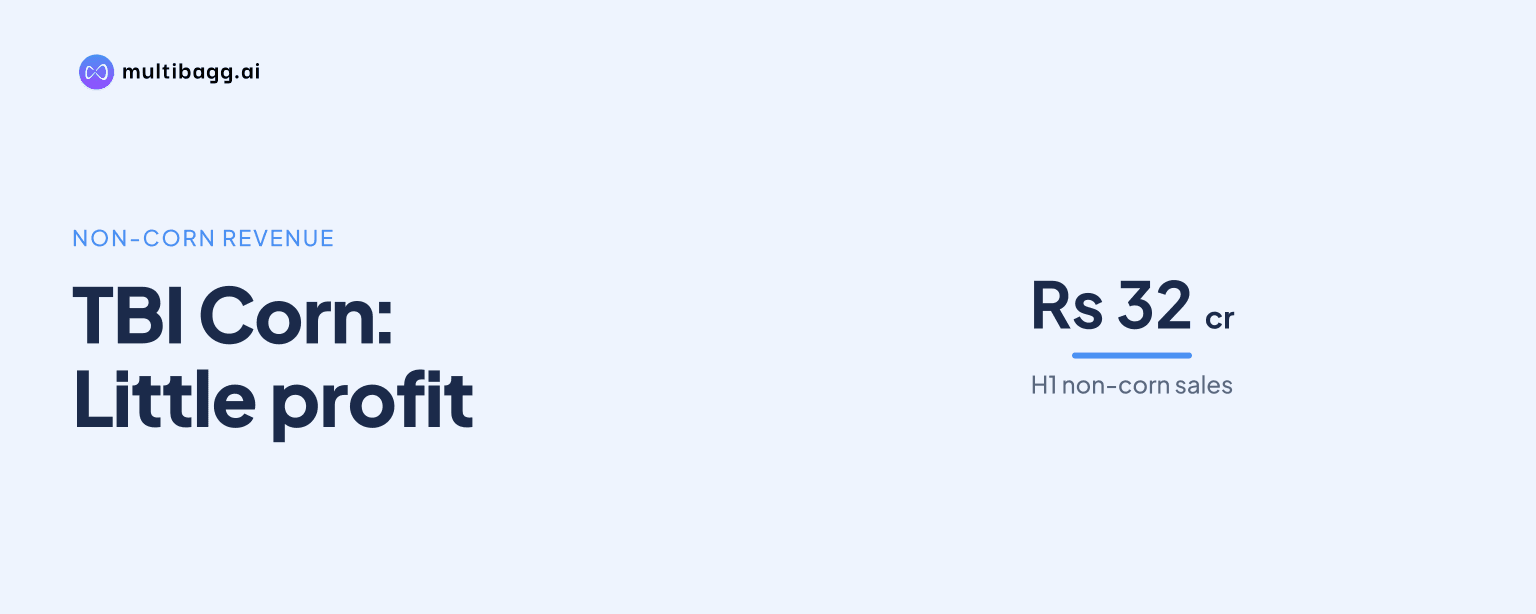
TBI Corn Ltd generated about Rs 32 crore of entirely non-corn revenue in H1 from turmeric, chilli and toor, but these businesses added little profit as the company built supply chains, inventory and customer relationships. Management said the October-November period had already shown improvement and expected a profit contribution in H2.
Know TBI Corn inside out
Results, valuation, peers and who's buying, in one view.
How much non-corn revenue did TBI Corn generate in H1?
TBI Corn generated about Rs 32 crore of H1 revenue from non-corn operations. Management said the amount was recorded through subsidiaries and was entirely outside its core corn business, making it the first year in which the newer commodity lines had moved into meaningful commercial volumes.
The company identified turmeric, chilli and toor as the main contributors to the Rs 32 crore result. It also named soya among the commodities being developed, but did not disclose sales, volumes or margins for any individual product. An investor referred to Rs 31 crore of other-product business in a separate question, while management consistently described the contribution as about Rs 32 crore.
TBI Corn had been experimenting with turmeric, chilli, soya and toor for roughly one to one-and-a-half years before the current financial year. Those earlier transactions involved smaller quantities and were intended to establish internal know-how, whereas the H1 contribution reflected a shift from trial-scale activity to larger volumes.
The Rs 32 crore addition also explains why management said consolidated revenue had risen significantly during the six months without a comparable rise in profit. TBI Corn described its corn operation as stable and capacity-led, while characterising the newer non-corn portfolio as more unpredictable because its supply and sales systems were still being established.
Why did TBI Corn's non-corn sales add little profit?
TBI Corn said its Rs 32 crore of non-corn sales added little profit in H1 because management prioritised supply-chain development and customer building over near-term profitability. It described the first-half position as one of revenue without profits, with start-up expenses also affecting the difference between standalone and consolidated profitability.
The company was establishing procurement channels, sourcing inventory and testing demand across turmeric, chilli, toor and soya. Management also said it held stock acquired at better prices, which it expects to begin contributing as it is sold. These activities meant the new lines required investment beyond simply distributing products through the established corn operation.
TBI Corn initially sold all H1 non-corn volumes only to customers that already bought corn products from it. Many of these buyers are snack makers that also require the new agricultural commodities. Management said it had only gradually begun exploring other customer options and avenues after building this initial base.
Management said the non-corn businesses could weigh on consolidated profitability for the next couple of months, even though it did not expect major further contraction in the underlying corn operation from H1 to H2. This separates the established corn business from the early cost and margin profile of the subsidiary-led non-corn operations.
Got a follow-up? Ask IRIS
Which products and customers support TBI Corn's diversification?
Turmeric, chilli and toor supported TBI Corn's Rs 32 crore H1 non-corn revenue, while soya remained among the commodities the company was testing. Management said turmeric, chilli and toor had delivered good results, but did not provide commodity-level revenue, procurement volumes, inventory or profitability.
The customer model initially overlaps with the corn business because all H1 non-corn sales went to existing corn customers. TBI Corn said many of those customers are snack makers that use these commodities, allowing the company to begin selling new products through relationships already built in its core business.
Management did not give a revenue target for turmeric, chilli, toor or soya. When asked whether the roughly Rs 31 crore to Rs 32 crore H1 run rate would increase in the following half-year or next financial year, it said a jump was visible after September but declined to quantify it because the business remained unpredictable.
That uncertainty differs from management's stated outlook for corn. TBI Corn said its core business had capacity available and that its disclosed 35% compound annual growth rate, or CAGR, did not appear difficult to achieve. Management did not apply that 35% CAGR expectation to the non-corn portfolio.
What does TBI Corn expect from non-corn operations in H2?
TBI Corn expects its non-corn operations to contribute profit in H2, with more meaningful support expected in the next financial year. Management said it had already started seeing improvement in October-November and that the H1 pattern of revenue without profits would not continue through the second half.
Management linked this expected improvement to stock bought at better prices, more established supply chains and a widening search for customers beyond the initial corn-client base. It said some contribution should emerge in H2, while stating more firmly that non-corn businesses would start “putting in their weight” in the next financial year.
The core corn market remains relevant to the consolidated result. TBI Corn said maize prices in Sangli reached a historical high of Rs 34 during September, while its corn contracts are generally limited to three months and backed by maize already held in its godowns. It did not disclose comparable contract terms, pricing protections or inventory levels for turmeric, chilli, toor or soya.
Management also expects H2 corn volumes to exceed H1 volumes, though by a smaller gap than in previous years because higher input costs affected smaller snack makers. It supplied no H2 non-corn revenue target and no product-level margin target, so the expected improvement is a management outlook rather than quantified guidance.
Conclusion
TBI Corn's Rs 32 crore H1 non-corn revenue establishes turmeric, chilli and toor as a meaningful additional sales stream alongside corn. However, the six-month result did not produce proportionate profit because management concentrated on creating procurement networks, inventory positions and customer relationships for the newer businesses.
The next result to watch is whether the October-November improvement cited by management translates into an H2 profit contribution. Management has also indicated that more significant non-corn earnings support should begin in the next financial year, while acknowledging that this portfolio has less predictable economics than the core corn business.

