








TBI Corn broadens sourcing after Sangli maize hits Rs 34
Max Plan at ₹4,999/yr₹8,999

Find your next multibaggerBe a Pro Investor
Research stocks and track your picks on the go. Download the app.
Key highlights
- TBI Corn said Sangli maize prices reached a historical Rs 34 after September 10.
- TBI Corn added southern Karnataka, Andhra, Bihar and Madhya Pradesh to its procurement network.
- TBI Corn reported standalone revenue of Rs 165.16 crore and EBITDA of Rs 21 crore for April to September.
- TBI Corn generally uses three-month contracts and pre-stocks maize for each customer agreement.
powered by IRIS
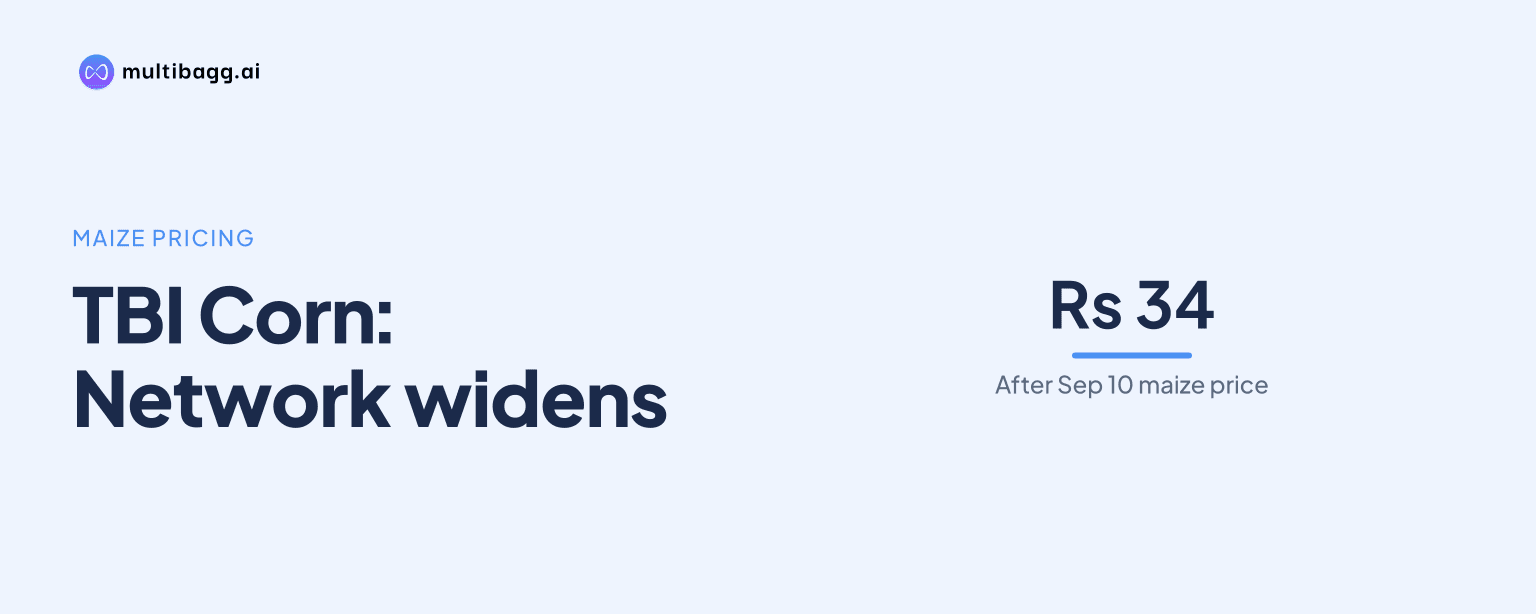
TBI Corn broadened maize purchases to southern Karnataka, Andhra, Bihar and Madhya Pradesh after Sangli maize prices reached a historical Rs 34 from September onwards. Management said three-month customer contracts and maize inventory held at its godowns limited the immediate profit effect of the drought-linked rise, although buyers initially delayed fresh orders.
Know TBI Corn inside out
Results, valuation, peers and who's buying, in one view.
Why did TBI Corn expand maize procurement beyond its usual regions?
TBI Corn expanded procurement because maize prices began rising abnormally after September 10, following a relatively normal period through August. Management said El Nino’s effects were visible in Maharashtra and Karnataka, the company’s usual supplying regions, requiring a broader network during October and November.
TBI Corn had focused on north Karnataka until August and September, but then entered mandis, or wholesale markets, in southern Karnataka and Andhra. Bihar and Madhya Pradesh also contributed to supply, management said, helping offset shortages from its established regions. The company did not disclose procurement tonnage or purchase prices by state.
The sourcing change came as Sangli maize reached Rs 34, which management described as the historical highest price seen in that market. Prices had been slightly higher in the first half, but management said the increase from September was far sharper than the seasonal movement experienced in earlier years.
TBI Corn also relied on farmer relationships built over 15 to 25 years. Management said direct procurement from farmers increased by about one basis point in the April-to-September period, despite growers having more options to sell maize at higher prices. A basis point equals one-hundredth of a percentage point.
Can TBI Corn pass higher maize costs to customers?
TBI Corn said it cannot easily pass higher maize costs to customers during an active contract, particularly with multinational corporations and other large corporate buyers. If maize rises after the agreed price is set, the company must still deliver corn grit at the contracted rate, even when market maize costs are higher.
The company’s main protection is its three-month contract model and matched inventory. TBI Corn said it generally avoids long-duration contracts and ensures that maize for a new customer agreement is already held in its godowns. This locks the input cost for that particular order and contract period.
Management cited ITC as an example of this mechanism. During the price surge, TBI Corn’s contracted price for ITC was below the prevailing market price of maize, but the company could fulfil the order because it had procured the required maize in advance. Management did not quantify the margin on that contract.
Fresh demand slowed near the end of September and beginning of October as customers hesitated to buy at higher prices. After existing contracts ended, TBI Corn shifted some deliveries to spot pricing, including an example of a 75-tonne Guwahati order, equivalent to three vehicles, priced and delivered in the same week.
Which end markets were buying maize at higher prices?
TBI Corn said starch, animal feed and food were the main active maize-consuming markets after the maize-based ethanol industry moved out of the market following a 30% hike. Management did not disclose sales exposure to these markets, so the call does not establish the revenue effect of the changed end-market mix.
Management said rising input costs were also affecting small snack and extruded-snack producers, alongside increases in plastic, oil and other materials. It assessed that some smaller producers were losing sustenance, while multinational consumer companies were regaining the ability to raise market prices amid reduced smaller-scale competition.
The company also pointed to milk-price increases of Rs 4, Rs 5 and Rs 7 across Karnataka, Maharashtra and other areas. Management presented these dairy-price moves as evidence that higher commodity costs were being accepted in downstream markets, rather than as a direct measure of TBI Corn’s pricing power.
In the 10 days following Diwali, management said customers were gradually accepting that maize prices would remain high for at least some months. Discussions over renewed three-month contracts had restarted, following a period when corporates preferred individual spot-rate orders instead of committing to longer supply arrangements.
Got a follow-up? Ask IRIS
How did TBI Corn perform before maize inflation intensified?
TBI Corn reported standalone revenue of Rs 165.16 crore and profit after tax of Rs 11.59 crore for the April-to-September six-month period. Management said standalone revenue was about 21% higher year on year, while another speaker referred to 24% growth without specifying the relevant measure. Maize volume was 55,724 tonnes.
Standalone gross margin expanded by about 330 basis points sequentially, from 18% to about 21.4% in the first half. Earnings before interest, tax, depreciation and amortisation, or EBITDA, rose about 30% sequentially to Rs 21 crore, while EBITDA margin increased about 306 basis points to 12.8%.
Consolidated revenue was about Rs 196 crore, rising 43% to 44% year on year and about 18% sequentially, according to management. The total included non-corn revenue from subsidiary businesses, including Agripivot, which were focused during the six months on establishing supply chains and customer bases.
Management said consolidated profit had not increased in line with consolidated revenue because non-corn operations were still being developed. That differs from the standalone corn business, where first-half revenue, gross margin and EBITDA all increased before the sharp maize-price escalation that began after September 10.
What does TBI Corn expect in the second half?
TBI Corn expects second-half volume to exceed the 55,724 tonnes reported for the first half, although management said the gap between the two halves should be narrower than in previous years. Historically, second-half volume was much higher and profitability lower, but management said the seasonal patterns are now moving closer together.
Management said it did not expect a major change in core corn-business performance between the first and second halves. Consolidated margins could be affected temporarily by other businesses over the next couple of months, while procurement conditions in October and November required sourcing from southern Karnataka, Andhra, Bihar and Madhya Pradesh.
For the core corn business, management said the 35% compound annual growth rate, or CAGR, cited in its investor presentation did not appear difficult to achieve because capacity was available and volume was continuing to grow. This was management’s outlook, not a numerical revenue or profit target for the current year.
Non-corn businesses had not contributed to profit margins in the first six months, management said. It expected some contribution during the following six months and a clearer contribution in the next financial year, after the supply-chain and customer-base work that supported the Rs 196 crore consolidated revenue figure.
Conclusion
TBI Corn responded to Sangli maize reaching Rs 34 by widening sourcing rather than attempting to reopen prices under existing customer contracts. Procurement from southern Karnataka, Andhra, Bihar and Madhya Pradesh, combined with farmer relationships and maize held against three-month contracts, was intended to maintain supply continuity through higher costs and temporarily slower buying.
The next issue is whether corporate buyers return to regular three-month contracts after their post-Diwali acceptance of elevated maize prices. Management also expects second-half volume to exceed the April-to-September period and expects non-corn businesses to begin contributing to margins over the next six months, with a more definite contribution in the next financial year.

