








TBI Corn says JNPT occupancy certificate delays merger process
Max Plan at ₹4,999/yr₹8,999

Find your next multibaggerBe a Pro Investor
Research stocks and track your picks on the go. Download the app.
Key highlights
- TBI Corn said the full occupancy certificate for its five-floor JNPT SEZ plant remains the merger-process requirement.
- Management said the JNPT plant is the only SEZ unit there with a lift, which required separate approvals.
- TBI Corn reported H1 FY27 standalone revenue of Rs 165.16 crore, up about 21% year on year.
- Standalone EBITDA was Rs 21 crore in H1 FY27, with an EBITDA margin of about 12.8%.
powered by IRIS
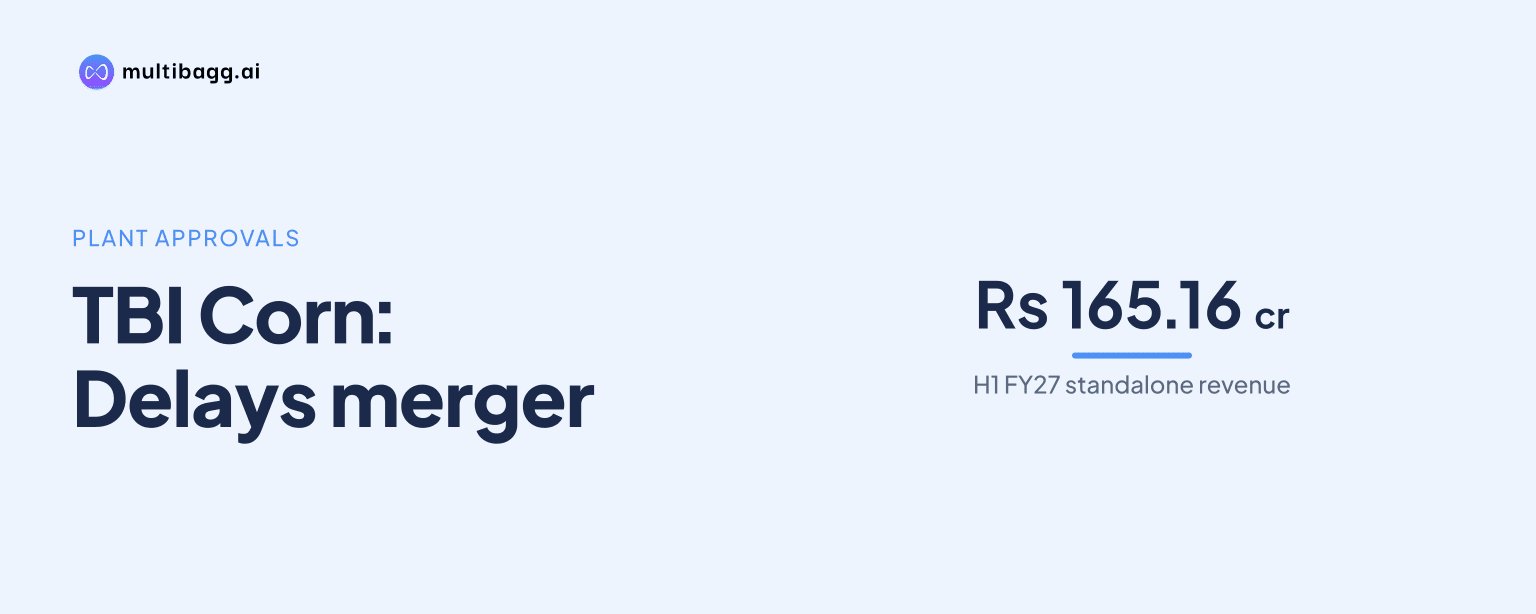
TBI Corn Limited said its merger process was delayed in H1 FY27 because it was awaiting a full occupancy certificate for its five-floor JNPT Special Economic Zone plant, where lift approvals required separate permissions. Management said it expected to obtain the certificate and begin merger proceedings within the calendar year, while standalone revenue reached Rs 165.16 crore.
Know TBI Corn inside out
Results, valuation, peers and who's buying, in one view.
Why has TBI Corn's merger process been delayed?
TBI Corn's merger process has been delayed by the full occupancy certificate, or OC, required for its building at the JNPT Special Economic Zone, or SEZ. Chief Financial Officer Ninad Yedurkar said the company had expected the merger to occur in the first half of the financial year, but the certification process took longer than anticipated.
The immediate issue is the plant's five-floor design and the lift installed in it. Management said TBI Corn's facility is the only JNPT SEZ unit requiring a lift, and that separate permissions for the lift had to be obtained before the full OC could be issued. It also said the JNPT SEZ office within the zone does not have a lift.
What is the current status of the JNPT occupancy certificate?
TBI Corn said it had applied for the full OC and was answering queries from the relevant authorities. Management said the company had reworked the required process, established the lift and pursued the separate permissions needed for the JNPT plant.
The company described JNPT SEZ as a relatively new zone with few operational plants, and said its unit was the second manufacturing facility established there. Management said authorities were helpful and that there was no stalling from their side, but it did not disclose a date for clearance of the remaining OC queries.
The company did not disclose a March completion target during the call. It said the expected calendar-year milestone was the OC and the start of merger proceedings, rather than confirming legal completion of the merger by a specified date.
How did TBI Corn perform while the certificate remained pending?
TBI Corn reported standalone revenue of Rs 165.16 crore for H1 FY27, up about 21% year on year, and profit after tax of Rs 11.59 crore. Management said the company handled 55,724 tonnes of maize from April to September despite domestic crop disruption and international shipping difficulties.
Standalone gross margin expanded sequentially to about 21.4% in H1 FY27 from 18%, an increase of about 330 basis points. Earnings before interest, tax, depreciation and amortisation, or EBITDA, rose about 30% sequentially to Rs 21 crore, taking the standalone EBITDA margin to about 12.8%.
Consolidated revenue of about Rs 196 crore grew faster than standalone revenue because subsidiaries contributed non-corn activities. Management said profit did not rise at the same pace because the first six months included work to establish supply chains and customer bases for those activities.
Got a follow-up? Ask IRIS
How are maize prices affecting TBI Corn's operations?
TBI Corn said maize prices in Sangli reached a historical high of Rs 34 during September, October and November after drought conditions affected crop yields, particularly in Maharashtra and Karnataka. Management linked the conditions to El Nino and said higher raw-material prices created buyer hesitation near the end of September and at the beginning of October.
The company said it generally cannot easily pass on higher maize costs during an existing customer contract, including contracts with corporate buyers. Its stated protection mechanism is to use three-month contracts and ensure the maize needed for each signed order is already available in its godowns, locking the input price for that order period.
After some contracts ended, TBI Corn supplied corporate customers on spot-rate terms rather than immediately renewing longer supply arrangements. Management cited an example of a 75-tonne order for Guwahati, equivalent to three vehicles in its description, and said discussions on three-month contracts were beginning again after Diwali.
What growth plans has TBI Corn disclosed beyond the merger process?
TBI Corn management said its core corn business has capacity available and that volume growth should continue at the pace outlined in its investor presentation. It referred to a 35% compound annual growth rate, or CAGR, for the core corn business, describing that outcome as achievable rather than issuing new financial guidance in the call.
The company is developing non-corn activity through subsidiaries and Sangli processing capabilities, including cleaning, sorting, grading and powdering of turmeric, tur and chilli under contract-manufacturing arrangements. Management said FY27 was the first year in which it expected to see results from these activities, while also describing them as less predictable than the core corn business.
TBI Corn has also registered its 100% subsidiary, TBICL (FZE), in Sharjah Free Zone. Management said it aims to use offices and warehouses to serve Gulf buyers in lots of 2 tonnes, 5 tonnes and 10 tonnes, after container costs to Dubai rose from $200-$300 to $2,500-$3,000 amid shipping disruption.
Conclusion
The merger delay stems from a specific regulatory requirement at TBI Corn's five-floor JNPT SEZ facility, not from a disclosed withdrawal of the transaction. The required full OC became more complex because the plant's lift needed separate permissions, while the company continued to report H1 FY27 standalone revenue of Rs 165.16 crore and EBITDA of Rs 21 crore.
The next disclosed milestone is the resolution of OC queries and issuance of the occupancy certificate, after which management said it would begin merger proceedings within the calendar year. Investors can also watch the return of three-month customer contracts, the effect of elevated maize prices and the contribution from Sharjah and non-corn subsidiary operations.

