










TBI Maize-Processors discloses automated JNPA export unit
Key highlights
- TBI Maize-Processors is an associate company incorporated in 2022.
- TBI Maize-Processors is described as a 100% Export Oriented Unit at JNPA SEZ.
- The planned TBI Maize-Processors plant is described as completely automated for premium clients and markets.
- The presentation gives no capacity, project-cost or commissioning-date figure for TBI Maize-Processors.
powered by IRIS
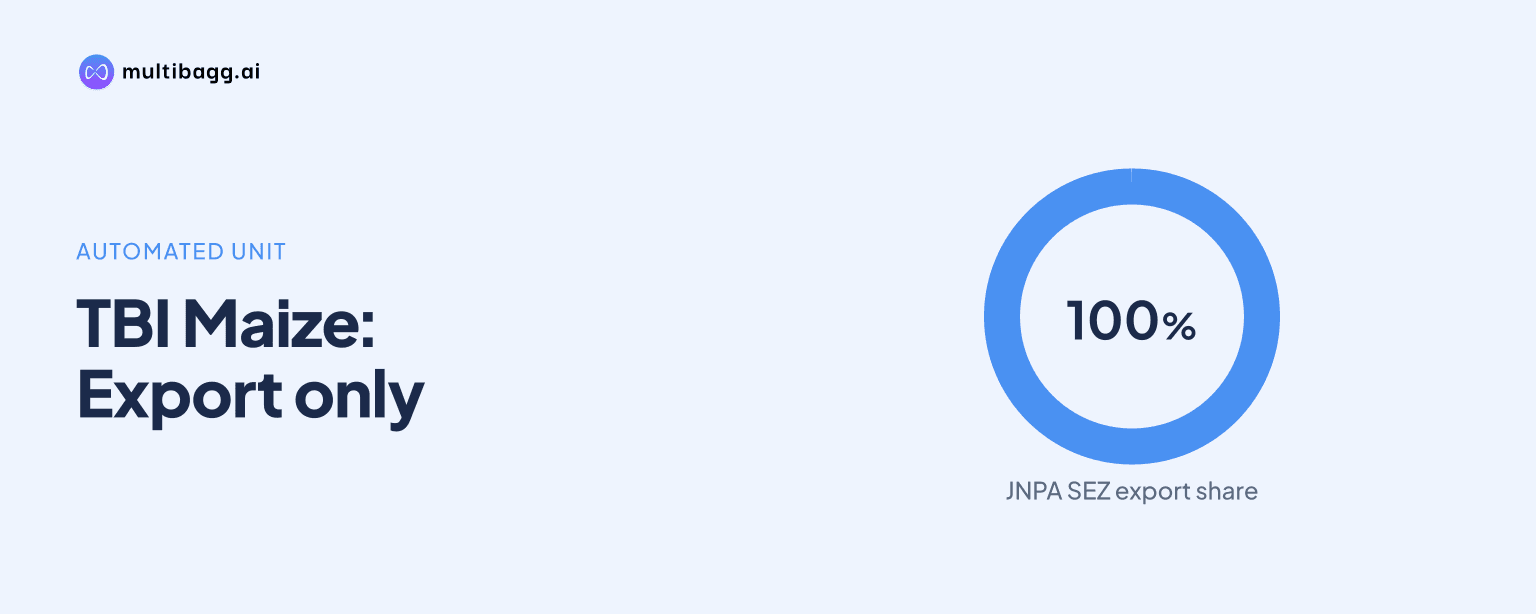
TBI Maize-Processors Pvt Ltd., a 2022-incorporated associate company, says its 100% Export Oriented Unit at JNPA SEZ will run a completely automated plant for premium clients and premium markets, but the presentation gives no 150-tonnes-per-day capacity figure, cost, commissioning date or construction milestone.
Know TBI Corn inside out
Results, valuation, peers and who's buying, in one view.
What does TBI Maize-Processors disclose about the JNPA SEZ unit?
TBI Maize-Processors discloses an export-oriented automated plant at JNPA SEZ, with premium clients and premium markets as its stated focus. The entity is listed as an associate company incorporated in 2022, rather than as a wholly owned subsidiary, within the current group structure.
The presentation identifies the unit as a 100% Export Oriented Unit and says it will run a completely automated plant. It does not name export countries, customers, product grades, contracts, shipment volumes or annual sales targets. The disclosed position is therefore an intended premium-market export operation, not a quantified export-revenue plan.
The presentation does not disclose daily processing capacity, including a 150-tonnes-per-day figure, for TBI Maize-Processors. It also gives no project cost, land area, number of production lines, construction status, commissioning milestone or commercial-production date for the JNPA SEZ unit.
How much automation is specified for TBI Maize-Processors?
TBI Maize-Processors is described as completely automated, but the presentation does not specify the equipment, processing lines, packaging equipment, warehouse capacity or staffing model for its JNPA SEZ operation. The 100% Export Oriented Unit description does not itself establish which dry-milling stages will be installed at the associate company.
Elsewhere, the presentation describes a fully automated dry-milling process that produces broken maize, corn grits, corn flour and corn flakes under hygienic, touch-free conditions. It says magnets are used during milling and packaging to prevent metal contamination, but it does not state that this equipment is installed at TBI Maize-Processors.
The wider process description also states that finished goods can be packed in 25 kilogram, 30 kilogram or 50 kilogram bags to buyer specifications. Raw-material and finished-product lots are assigned unique batch codes, and raw corn is quality-tested before unloading; however, the presentation does not confirm that TBI Maize-Processors will use those bag sizes or traceability procedures.
Which products could the JNPA SEZ unit export?
TBI Maize-Processors does not identify products assigned to its JNPA SEZ unit. The presentation lists eight broader corn-product categories, including Indian yellow maize, corn germ, broken maize, corn grits, raw corn flakes, corn meal, corn bran and corn flour, without allocating any category to the 2022-incorporated associate company.
Corn germ accounts for 6% to 8% of a corn kernel’s total weight and contains about 50% of its overall oil content, according to the presentation. It is described as a raw material for corn-oil extraction and as a component in animal feed or fodder, but this product information is not a TBI Maize-Processors production commitment.
The presentation names Karnataka, Maharashtra and Madhya Pradesh among the origins for the corn portfolio. It describes Indian yellow maize as non-genetically modified whole corn and corn grits as de-germinated coarse meal without flour, yet it does not specify which source region, quality standard or product line will be exported through JNPA SEZ.
Got a follow-up? Ask IRIS
How does TBI Maize-Processors fit within the group structure?
TBI Maize-Processors differs from the group entities classified as wholly owned subsidiaries because it is labelled an associate company incorporated in 2022. Revita Starch Pvt Ltd. was incorporated on 28 January 2025 and TBI Foundation on 3 February 2025, with both identified as wholly owned subsidiaries.
Revita Starch is identified as the route for a possible wet-milling entry if and when management proceeds with starch. The presentation says wet milling can produce starch, maltodextrin, liquid glucose, sorbitol and dextrose, separating that potential activity from TBI Maize-Processors’ disclosed export-oriented positioning.
Agripivot Ventures Pvt Ltd., incorporated on 23 July 2024, is described as a wholly owned subsidiary intended to pursue partnerships for newer verticals and markets. Its step-down subsidiary Dhar Ventures Pvt Ltd. is identified as the possible route for ethanol, ethyl alcohol and biofuels if and when that business is entered.
The structure also includes TBICL (FZE), a wholly owned marketing subsidiary incorporated on 2 November 2026 to facilitate operations and expansion in the United Arab Emirates and other relevant markets. TBICL (FZE) had not commenced commercial operations as of the disclosure date, and the presentation does not say it will work with TBI Maize-Processors.
Conclusion
TBI Maize-Processors adds a distinct JNPA SEZ-based export vehicle to a group structure that includes potential wet milling, partnerships and ethanol routes. Its disclosed attributes are its 2022 incorporation, associate-company status, 100% Export Oriented Unit designation and planned completely automated plant for premium markets; product allocations and operating metrics remain unspecified.
The next disclosures to watch are capacity, investment, construction or commissioning status, export products, customer markets and commercial-production timing for the JNPA SEZ unit. Management also states that TBICL (FZE), incorporated on 2 November 2026, had not begun commercial operations, leaving the relationship between its overseas-market role and the export unit unresolved.