










Vertis Infrastructure Trust holds borrowing cost at 7.3%
Key highlights
- Vertis refinanced about Rs 1,425 crore of floating-rate debt through fixed-rate NCDs and interest-rate swaps in Q2 FY27.
- Vertis maintained a 7.3% effective borrowing cost after an October 2026 repo-rate increase of 25 basis points.
- Floating-rate borrowings were 73% of Vertis’s debt, including 47% linked to the repo rate.
- Vertis reported Rs 11,300 crore of outstanding debt and a largest scheduled maturity of Rs 1,860 crore in FY33.
powered by IRIS
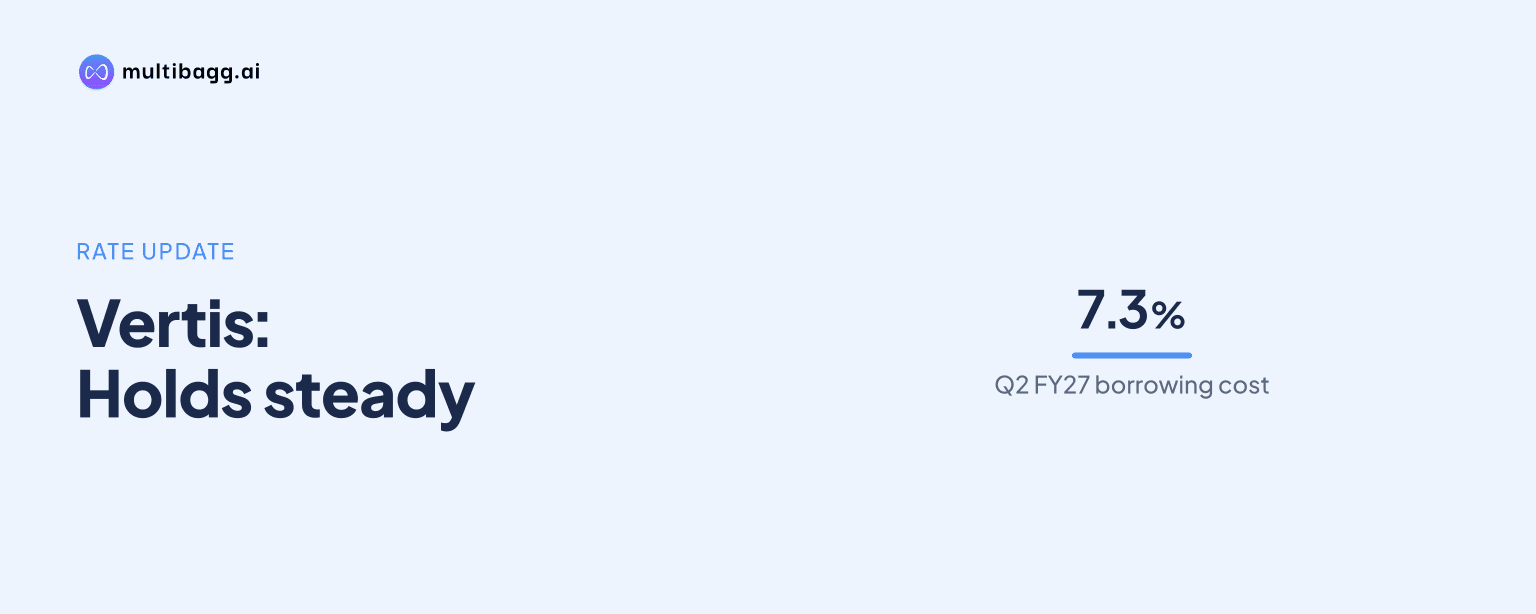
Vertis Infrastructure Trust maintained an effective borrowing cost of 7.3% after refinancing about Rs 1,425 crore of floating-rate debt through fixed-rate non-convertible debentures and interest-rate swaps in Q2 FY27. The transaction reduced portfolio borrowing cost by about 13 basis points, partly offsetting a 25-basis-point repo-rate increase announced in October 2026.
Know Vertis Infrastructure Trust inside out
Results, valuation, peers and who's buying, in one view.
What debt did Vertis refinance in Q2 FY27?
Vertis refinanced approximately Rs 1,425 crore of floating-rate debt through fixed-rate non-convertible debentures, or NCDs, coupled with interest-rate swaps, or IRS. The Q2 FY27 presentation describes this as the InvIT segment’s largest IRS transaction, but does not disclose the individual NCD coupon, swap tenor, counterparties or transaction date.
The refinancing was undertaken within a reported outstanding debt base of Rs 11,300 crore as at 30 September 2026. That debt figure is stake-adjusted for GICL, includes commercial paper of Rs 625 crore, and excludes outstanding bank guarantees. Based on the disclosed figures, the refinanced amount was about 13% of the reported outstanding debt base.
Vertis reported net debt to assets under management, or AUM, of 40.3% in its debt profile. The portfolio snapshot separately put AUM at about Rs 27,100 crore as at 30 September 2026, including cash and cash equivalents, while the valuation summary reported Rs 27,063.8 crore of AUM based on an independent valuation report. The presentation reports these values under separate portfolio and valuation disclosures.
How did the refinancing affect Vertis’s borrowing cost?
Vertis said the refinancing reduced portfolio borrowing cost by about 13 basis points, helping it maintain an effective interest rate of 7.3% per year despite the 25-basis-point repo-rate increase announced in October 2026. One basis point equals one-hundredth of a percentage point. The presentation does not state the cost of debt before the refinancing, so the disclosed reduction does not provide a full before-and-after cost comparison.
The 7.3% metric includes the October 2026 repo increase, according to the debt-profile footnote. The independent valuation summary gives a closely related 7.33% actual cost of debt for Vertis, excluding short-term commercial paper. The 0.03-percentage-point difference reflects the source’s separate definitions: the debt-profile figure is the stated effective interest rate, while the valuation input excludes short-term commercial paper.
The borrowing-cost disclosure is relevant to cash available for distribution because trust-level debt servicing was Rs 372.5 crore in Q2 FY27 and Rs 669.7 crore in H1 FY27. After debt servicing and other items, Vertis reported distributions to unitholders of Rs 490.7 crore in Q2 FY27 and Rs 981.5 crore in H1 FY27, equal to distribution per unit of Rs 3.25 and Rs 6.50, respectively. The presentation does not attribute those distributions solely to the refinancing.
Got a follow-up? Ask IRIS
How is Vertis exposed to floating and fixed interest rates?
Vertis retained a predominantly floating-rate debt book, with 73% of borrowings floating-rate and 27% fixed-rate. Its presentation characterises the funding approach as rate-cycle agnostic and says it does not take a single directional rate bet. The source also identifies a capital-structure linkage between 73% floating-rate debt and hybrid annuity model, or HAM, interest income linked to the repo rate.
By benchmark, 47% of borrowings were linked to the repo rate, 17% to the Mumbai Interbank Offered Rate, or MIBOR, overnight indexed swap, or OIS, and 8% to Treasury bills. The remaining 27% was fixed rate. Repo-linked debt was the largest disclosed benchmark exposure, at 30 percentage points more than MIBOR-OIS-linked debt and 20 percentage points more than fixed-rate debt.
Vertis had 15 lending partners, with commercial banks accounting for 60% of funding, followed by development finance institutions at 19%. Capital markets supplied 13%, international banks 5% and multilateral lenders 4%. These stated shares total 101% because of rounding in the source, and Vertis does not identify individual lenders or their respective maturities.
When does Vertis’s outstanding debt mature?
Vertis reported residual maturity of about 10 years and a maturity schedule extending from FY27 through FY42. Its disclosed schedule shows Rs 650 crore maturing in FY27, excluding Rs 625 crore of commercial paper, followed by Rs 410 crore in FY28. The debt profile therefore separates the FY27 scheduled maturity from commercial paper for the stated maturity analysis.
FY33 is the largest single disclosed maturity year at Rs 1,860 crore, exceeding FY29’s Rs 1,170 crore by Rs 690 crore. The five-year FY38-FY42 period totals Rs 1,880 crore, including Rs 270 crore each in FY41 and FY42. Vertis says the staggered schedule limits refinancing risk, although the presentation does not provide future refinancing rates, committed facilities or a specific plan for the FY33 maturity concentration.
The debt schedule should also be read alongside the valuation summary, which excludes Rs 1,411.3 crore of cash and corresponding term debt because it was repaid in October 2026. That valuation table reports consolidated borrowings of Rs 11,183.9 crore after this treatment. It is therefore not directly identical to the Rs 11,300 crore outstanding-debt figure in the debt profile as at 30 September 2026.
Conclusion
Vertis used a Rs 1,425 crore refinancing, fixed-rate NCDs and interest-rate swaps to lower portfolio borrowing cost by about 13 basis points and retain a 7.3% effective rate after the October 2026 repo increase. The result sits alongside a 73% floating-rate debt share, a 40.3% net debt-to-AUM ratio and approximately 10-year residual debt maturity, showing that the lower reported cost did not eliminate floating-rate exposure.
The next disclosed items to watch are the maturity ladder, particularly the Rs 1,860 crore due in FY33, and the effect of future movements in repo-linked borrowing, which makes up 47% of the mix. Vertis has also identified a natural linkage between floating-rate debt and repo-linked HAM interest income, but the presentation does not quantify how changes in either would affect future distributions or borrowing costs.