










Tejas Cargo India Limited borrowings rise to Rs 257 crore in H1 FY27
Key highlights
- Tejas Cargo’s current and non-current borrowings totalled Rs 257 crore in H1 FY27, up from Rs 180.5 crore in H1 FY26.
- Tejas Cargo generated Rs 22.8 crore of operating cash flow in H1 FY27, down from Rs 27.8 crore a year earlier.
- Tejas Cargo reported a Rs 48.1 crore investing cash outflow and a Rs 26.4 crore financing cash inflow in H1 FY27.
- Tejas Cargo added 43 vehicles and completed 71,585 trips in H1 FY27, with trips up approximately 27.89% year on year.
powered by IRIS
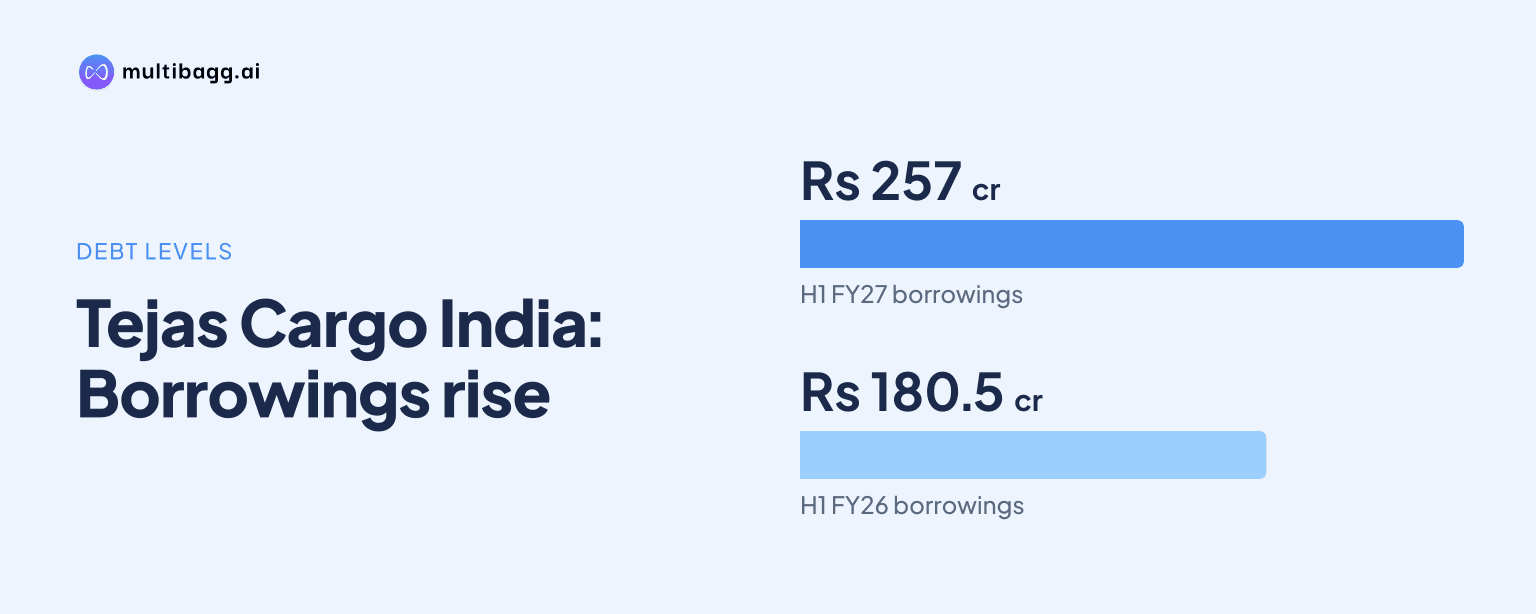
Tejas Cargo India Limited reported Rs 257 crore of current and non-current borrowings in H1 FY27, up from Rs 180.5 crore in H1 FY26, while cash flow from operations declined to Rs 22.8 crore and investment cash outflow was Rs 48.1 crore. The higher funding coincided with fleet additions and a Rs 499.3 crore consolidated balance sheet.
Know Tejas Cargo India inside out
Results, valuation, peers and who's buying, in one view.
How did Tejas Cargo fund expansion in H1 FY27?
Tejas Cargo increased reported borrowings to Rs 257 crore in H1 FY27, comprising Rs 143.8 crore of current borrowings and Rs 113.2 crore of non-current borrowings. This compares with Rs 180.5 crore in H1 FY26, when current borrowings were Rs 92.6 crore and non-current borrowings were Rs 87.9 crore. Current borrowings therefore accounted for Rs 51.2 crore of the Rs 76.5 crore year-on-year increase.
The rise occurred alongside growth in both assets and net worth. Total assets reached Rs 499.3 crore in H1 FY27 from Rs 402.4 crore in H1 FY26, while net worth increased to Rs 207.1 crore from Rs 185.8 crore. Fixed assets rose to Rs 217.1 crore from Rs 204.2 crore, and capital work in progress increased to Rs 16 crore from Rs 13.1 crore. The presentation does not disclose the terms, maturity profile or utilisation of individual borrowing facilities.
Tejas Cargo also disclosed Rs 301 crore of rated banking facilities and an ICRA BBB+ rating with a Stable outlook. Rated facilities are not the same as borrowings outstanding, and the presentation does not state how much of the Rs 301 crore facility amount had been drawn at H1 FY27. Total equity and liabilities were Rs 499.3 crore, compared with Rs 447.5 crore at FY26.
Why did Tejas Cargo’s cash flow lag investment spending?
Tejas Cargo generated Rs 22.8 crore of cash flow from operations in H1 FY27, while cash flow from investments was an outflow of Rs 48.1 crore. Operating cash flow fell by Rs 5 crore from Rs 27.8 crore in H1 FY26, even as the investment outflow reduced from Rs 74 crore. The H1 FY27 investment outflow remained more than twice the cash generated from operations during the same period.
Financing activities generated an inflow of Rs 26.4 crore in H1 FY27, up from Rs 15.2 crore a year earlier. Together with operating and investment cash flows, this produced net cash flow of Rs 1.1 crore, compared with a net outflow of Rs 32 crore in H1 FY26. Cash and bank balances stood at Rs 20.2 crore at H1 FY27, versus Rs 10.4 crore at H1 FY26.
Cash conversion relative to earnings also changed. Tejas Cargo reported operating cash flow to earnings before interest, tax, depreciation and amortisation, or OCF/EBITDA, of 0.4x in H1 FY27 on a trailing-12-month basis, down from 0.6x in H1 FY26. EBITDA rose to Rs 54.3 crore from Rs 47.8 crore while operating cash flow declined. The company notes that its EBITDA and margin calculations include other income.
What changed in Tejas Cargo’s leverage and liquidity ratios?
Tejas Cargo’s debt-to-equity ratio rose to 1.2x in H1 FY27 from 1.0x in H1 FY26, while net debt to EBITDA was unchanged at 1.9x. The debt-to-equity reading was also above 1.1x in FY26 and 0.9x in FY25. These ratios are shown by the company on a consolidated basis, while half-year figures are stated to be on a trailing-12-month basis.
Interest coverage declined to 2.8x in H1 FY27 from 3.4x in H1 FY26. Interest expense increased to Rs 10.3 crore from Rs 7.1 crore, whereas EBITDA increased by Rs 6.5 crore to Rs 54.3 crore. The company’s FY26 interest coverage was 2.7x, placing the H1 FY27 ratio above that annual reading but below the prior-year half-year figure.
The current ratio rose to 1.3x from 1.2x. Current assets increased to Rs 229.3 crore from Rs 158.6 crore, while current liabilities rose to Rs 176.4 crore from Rs 127.7 crore. Trade receivables were Rs 114.6 crore in H1 FY27, lower than Rs 118.4 crore at FY26 but higher than Rs 91.9 crore in H1 FY26; other current assets rose to Rs 76.5 crore from Rs 50.4 crore.
Got a follow-up? Ask IRIS
How did Tejas Cargo’s fleet expansion affect operating performance?
Tejas Cargo added 43 vehicles in H1 FY27, including 20 electric vehicles, 10 car carriers, three tippers and 10 32-foot single-axle vehicles. It completed 71,585 trips, approximately 27.89% more than a year earlier. Revenue per trip declined approximately 17.30% year on year to Rs 44,570, showing that higher trip volume was accompanied by lower revenue per trip.
Revenue from operations rose to Rs 342.5 crore in H1 FY27 from Rs 301.6 crore in H1 FY26. EBITDA increased to Rs 54.3 crore from Rs 47.8 crore and the EBITDA margin edged up to 15.7% from 15.6%. Profit after tax increased to Rs 13.8 crore from Rs 12.6 crore, although the profit-after-tax margin decreased to 4.0% from 4.1%.
The expanded asset base was accompanied by a higher fixed-asset turnover ratio of 2.91x, compared with 2.6x in H1 FY26. Diluted earnings per share rose to Rs 5.78 from Rs 5.27. Return on equity declined to 11.1% from 12.8%, and return on capital employed declined to 16.4% from 17.6%, based on the presentation’s trailing-12-month treatment of half-year ratios.
What are Tejas Cargo’s next disclosed expansion milestones?
Tejas Cargo said it had 22 electric vehicles after the H1 FY27 additions, with another 30 vehicles in the pipeline and a target to deploy 80 electric vehicles by year-end. Management said the electric-vehicle deployment is under long-term engagement. The presentation does not disclose the capital cost, financing structure or expected revenue contribution associated with the remaining planned deployment.
The company said its enterprise resource planning system covering operations, maintenance and human-resource management was live, with complete deployment planned by Q1 FY28. Tejas Cargo also identified coal, fly ash, mining logistics, bauxite mining and car carriers as diversification areas. Future disclosures can show whether these programmes affect operating cash flow, investment outflows, borrowing levels and interest expense.
Conclusion
Tejas Cargo’s H1 FY27 figures show that an enlarged fleet and asset base were financed alongside higher borrowings: total borrowings reached Rs 257 crore as operating cash flow fell to Rs 22.8 crore and investment outflow was Rs 48.1 crore. Revenue from operations, EBITDA and profit after tax nonetheless increased year on year, while the debt-to-equity ratio and interest expense also rose.
The next disclosed markers are management’s target of 80 electric vehicles by year-end and full enterprise resource planning deployment by Q1 FY28. The presentation leaves unresolved the cost and funding mix of the electric-vehicle programme, so subsequent disclosures on financing inflows, capital spending, operating cash flow and interest coverage will indicate how the plan progresses.