










Tejas Cargo India Limited wins Rs 28 crore mining order
Key highlights
- Tejas Cargo secured a Rs 28 crore CMDC bauxite mining order with a five-year tenure.
- Tejas Cargo mined 23,590 MT in H1 FY27 against a FY27 target of 65,595.50 MT.
- Bauxite haulage is separately billable and is not included in the Rs 28 crore order value.
- Tejas Cargo had 1,381 owned vehicles and Rs 342 crore of revenue from operations in H1 FY27.
powered by IRIS
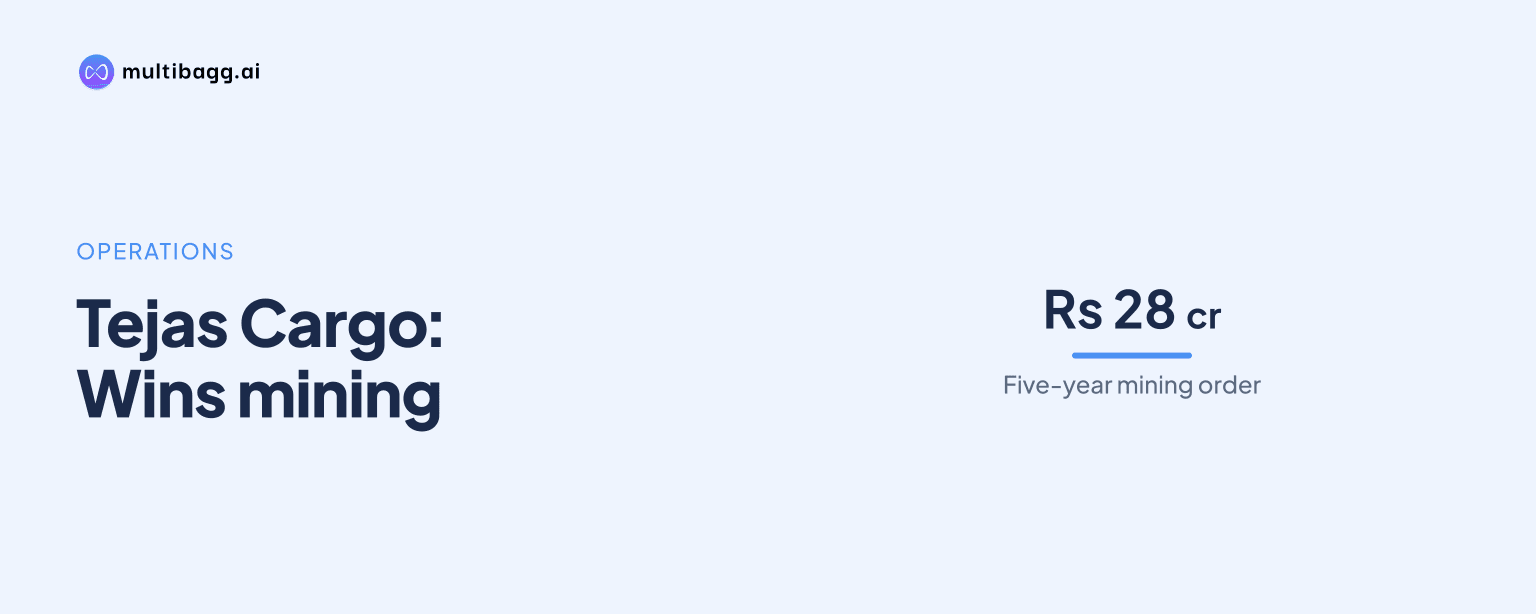
Tejas Cargo India Limited has won a Rs 28 crore, five-year bauxite extraction and excavation order from Chhattisgarh Mineral Development Corporation at Jamirapath, Chhattisgarh, marking its first disclosed mining work order. In the first half of financial year 2027 (H1 FY27), Tejas Cargo mined 23,590 metric tonnes (MT) against a FY27 target of 65,595.50 MT, and states that haulage is billed separately.
Know Tejas Cargo India inside out
Results, valuation, peers and who's buying, in one view.
What does Tejas Cargo's CMDC mining contract cover?
Tejas Cargo's first mining contract covers bauxite extraction and excavation at Jamirapath, Chhattisgarh, for Chhattisgarh Mineral Development Corporation, or CMDC. The order has a stated value of Rs 28 crore and a five-year tenure, which the presentation contrasts with the trip-based structure of its established road-freight work.
Tejas Cargo reported 23,590 MT mined in H1 FY27 and set a FY27 target of 65,595.50 MT for the CMDC bauxite operation. The reported first-half volume equals about 36% of the disclosed full-year target, although the presentation gives no quarterly production split, rate per tonne, payment schedule or mining revenue target.
Bauxite haulage is billable separately and is over and above the Rs 28 crore order value, according to the presentation. The distinction means the announced value relates to extraction and excavation, while transport of mined ore is a separately billed logistics activity connected to the mining operation.
How does the CMDC order change Tejas Cargo's business model?
The CMDC order expands Tejas Cargo's scope from full-truckload (FTL) road logistics into upstream ore extraction and excavation. Management describes the mining model as creating captive freight because mined ore can be transported separately from the five-year work order and billed over and above the mining contract.
The operating structure differs from the company's established trip-based freight business. Tejas Cargo completed 71,585 trips in H1 FY27 and reported revenue per trip of Rs 44,570, calculated by the company as revenue from operations divided by trips, whereas the CMDC order has a stated five-year work tenure.
The mining overview names CMDC and Dalmiya Cements Limited as clients in the company's mining and logistics proposition. However, the presentation discloses only the Rs 28 crore CMDC order and its 23,590 MT H1 FY27 output; it provides no contract value, volume, start date or reported revenue for Dalmiya Cements.
What operating base supports Tejas Cargo's mining entry?
Tejas Cargo reports an owned fleet of 1,381 vehicles in H1 FY27, including 426 40-tonne trailers and tippers in its mining overview. Its existing bulk-logistics operations move coal and fly ash for power utilities and industrial customers, providing an established transport base alongside the new extraction and excavation scope.
The company also identifies on-site loading and excavation at power plants as an existing capability. That activity is relevant to the CMDC work because the order involves extraction and excavation rather than road transport alone, although the presentation does not quantify equipment, staffing, capital expenditure or margins for mining.
Fleet capacity rose by 150 vehicles, from 1,231 in H1 FY26 to 1,381 in H1 FY27. A separate fleet-composition table lists 953 container trucks, 406 trailers and 22 electric vehicles in H1 FY27, while the mining overview cites 426 40-tonne trailers and tippers; the presentation does not explain the differing classifications.
Got a follow-up? Ask IRIS
How has Tejas Cargo's operating mix changed?
Tejas Cargo reported Rs 342 crore of revenue from operations in H1 FY27, with new verticals contributing 11.50% of revenue. Its transformation timeline identifies 2026 as the year it entered freight forwarding and mining, following its 2025 expansion into car carriers and fly ash and coal logistics.
Steel and cement clients accounted for 22.39% of H1 FY27 revenue in the mining presentation. The company's sector mix also shows a 22.4% H1 FY27 share for its industrial and infrastructure segment, while coal, fly ash, car carrier and freight forwarding are listed as strategic focus areas.
Operating volume increased year on year, while the reported revenue per trip declined. Trips rose by 15,613 to 71,585 in H1 FY27 from 55,972 in H1 FY26, but revenue per trip fell by Rs 9,316 to Rs 44,570; the presentation does not attribute the change to mining, freight forwarding, pricing or route mix.
What is Tejas Cargo targeting through FY27?
Tejas Cargo is targeting about 40% of revenue from its aggregated fleet by FY27, compared with 34.30% in H1 FY27. Management also discloses a plan for about 100 replacement or additional vehicles annually, alongside expansion in power and energy and waste management.
Management's Vision 2027 identifies mining, fly ash, minerals and freight forwarding as diversification areas. The same plan lists car-carrier operations for Tata Motors, Glovis for Hyundai and Toyota, while freight forwarding accounted for 4.25% of H1 FY27 revenue and handled 200 to 300 imported containers each month.
For CMDC, the immediate disclosed operational benchmark is the FY27 target of 65,595.50 MT after 23,590 MT was mined in H1 FY27. Tejas Cargo provides no FY27 mining revenue or profit target, making volume delivery, separately billed haulage and any additional work orders the disclosed measures of progress.
Conclusion
Tejas Cargo's Rs 28 crore CMDC bauxite order adds a five-year extraction and excavation assignment to a business built around trip-based logistics. Separately billable haulage links the new mining activity to its 1,381-vehicle fleet and bulk-logistics operations, while 23,590 MT of H1 FY27 output provides the first disclosed operating measure for the vertical.
The next disclosed milestone is progress toward the FY27 target of 65,595.50 MT at Jamirapath. Management's stated plan to raise aggregated-fleet revenue contribution from 34.30% in H1 FY27 to about 40% by FY27, and any later disclosure of mining revenue, haulage revenue, new orders or operating costs, will provide further evidence on the vertical's development.