










Tejas Cargo H1 income rises 13.4% as trips expand 27.89%
Key highlights
- Tejas Cargo reported H1 FY27 total income of Rs 347 crore, up from Rs 306 crore in H1 FY26.
- Tejas Cargo completed 71,585 trips in H1 FY27, up 27.89%, while revenue per trip fell 17.30% to Rs 44,570.
- Tejas Cargo’s H1 FY27 EBITDA was Rs 54.3 crore and EBITDA margin was 15.7%, versus Rs 47.8 crore and 15.6% a year earlier.
- Tejas Cargo added 43 vehicles in H1 FY27, including 20 electric vehicles and 10 car carriers.
powered by IRIS
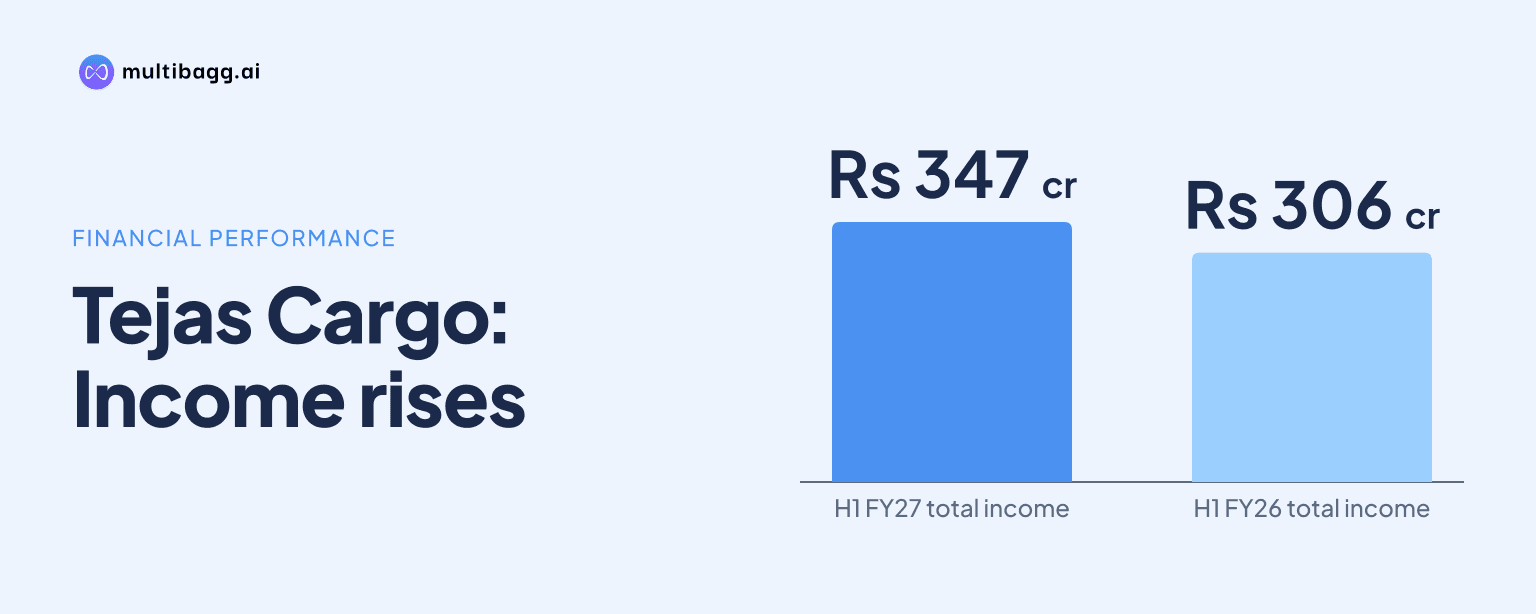
Tejas Cargo India Limited reported H1 FY27 total income of Rs 347 crore, up 13.4% year on year, as completed trips rose 27.89% to 71,585; revenue per trip fell 17.30% to Rs 44,570 and EBITDA margin was 15.7%, versus 15.6% in H1 FY26.
Know Tejas Cargo India inside out
Results, valuation, peers and who's buying, in one view.
How did Tejas Cargo’s H1 FY27 financial results change?
Tejas Cargo’s consolidated total income increased to Rs 347 crore in H1 FY27 from Rs 306 crore in H1 FY26. Revenue from operations rose to Rs 342.5 crore from Rs 301.6 crore, while other income was unchanged at Rs 4.4 crore in both periods. The company states that its EBITDA and margin calculations include other income.
Profit increased at a slower rate than total income. EBITDA rose by Rs 6.5 crore to Rs 54.3 crore from Rs 47.8 crore, while profit before tax increased to Rs 18.5 crore from Rs 16.8 crore. Profit after tax, or PAT, rose to Rs 13.8 crore from Rs 12.6 crore, but PAT margin declined to 4.0% from 4.1%.
Why did Tejas Cargo’s revenue per trip fall in H1 FY27?
Tejas Cargo’s disclosed trip data show that volume grew faster than yield in H1 FY27: trips increased 27.89% year on year to 71,585, while revenue per trip declined 17.30% to Rs 44,570. The presentation does not provide a segment, route or customer-level breakdown explaining the lower revenue earned per trip.
The company added 43 vehicles during H1 FY27, consisting of 20 electric vehicles, 10 car carriers, three tippers and 10 32-foot single-axle vehicles. These additions coincided with the higher trip count, although the presentation does not quantify how many trips or how much revenue each vehicle category generated.
Operating expenses increased to Rs 277 crore in H1 FY27 from Rs 244.4 crore in H1 FY26. Gross profit nevertheless rose to Rs 70 crore from Rs 61.6 crore, and gross profit margin edged up to 20.2% from 20.1%. Employee benefit expense rose to Rs 11.5 crore from Rs 9.3 crore, while other expenses fell to Rs 4.1 crore from Rs 4.5 crore.
What happened to Tejas Cargo’s margins and financing costs?
Tejas Cargo’s EBITDA margin was broadly unchanged at 15.7% in H1 FY27, compared with 15.6% in H1 FY26, even as total income increased by 13.4%. The 0.1-percentage-point increase in gross profit margin did not carry through to PAT margin, which declined by 0.1 percentage point to 4.0%.
Interest expense rose to Rs 10.3 crore in H1 FY27 from Rs 7.1 crore a year earlier, while depreciation increased to Rs 25.5 crore from Rs 23.8 crore. Consequently, profit before tax margin declined to 5.3% from 5.5%, and tax expense increased to Rs 4.6 crore from Rs 4.2 crore.
Diluted earnings per share, or EPS, rose to Rs 5.78 in H1 FY27 from Rs 5.27 in H1 FY26. Fixed-asset turnover was 2.91 times, compared with 2.6 times. Tejas Cargo labels its half-yearly operating and return ratios as trailing 12-month measures.
Got a follow-up? Ask IRIS
How is Tejas Cargo changing its fleet and business mix?
Tejas Cargo is extending activity beyond its core full-truckload, or FTL, business through coal, fly ash, mining, car-carrier and freight-forwarding operations. Its presentation identifies coal linked to CCL, fly ash linked to NTPC, RVNL and DVC, bauxite mining by CMDC Ltd., and mining work allocation from Dalmia Cements Limited, but gives no revenue or profit split for these areas.
Freight forwarding accounted for 4.25% of H1 FY27 revenue and handled 200 to 300 imported containers each month. Tejas Cargo describes the operation as an asset-light import-forwarding service for corporate clients, primarily from China and Vietnam, delivered through overseas agents and partners. It does not disclose the vertical’s prior-period revenue or profitability.
Tejas Cargo reported 22 electric vehicles deployed under long-term engagements, with another 30 additions in the pipeline and a target of 80 electric vehicles by year-end. Its enterprise resource planning, or ERP, system covering operations, maintenance and human resource management system functions is live, with complete deployment planned by Q1 FY28.
What do Tejas Cargo’s leverage, liquidity and cash-flow ratios show?
Tejas Cargo reported net debt to EBITDA of 1.9 times in both H1 FY27 and H1 FY26. Debt to equity increased to 1.2 times from 1.0 time, while interest coverage declined to 2.8 times from 3.4 times. The company also reported Rs 301 crore of rated banking facilities and an ICRA BBB+ (Stable) rating.
The current ratio improved to 1.3 times in H1 FY27 from 1.2 times in H1 FY26, while operating cash flow to EBITDA declined to 0.4 time from 0.6 time. Return on equity was 11.1%, down from 12.8%, and return on capital employed was 16.4%, down from 17.6%; both measures are presented on a trailing 12-month basis.
Conclusion
Tejas Cargo’s H1 FY27 figures show volume-led growth, with 71,585 trips supporting Rs 347 crore of total income and Rs 54.3 crore of EBITDA. However, the 17.30% decline in revenue per trip meant the EBITDA margin moved only 0.1 percentage point to 15.7%, while higher interest and depreciation coincided with a lower PAT margin.
The next disclosed milestones are the 30 electric vehicles in the pipeline, the target of 80 electric vehicles by year-end and full ERP deployment by Q1 FY28. Management is also targeting about 40% of FY27 revenue from the aggregated fleet, compared with 34.30% in H1 FY27, alongside a plan for about 100 replacement or additional vehicles annually.