








PESB equity reaches Rs 225 crore after warrant transactions

Find your next multibaggerBe a Pro Investor
Research stocks and track your picks on the go. Download the app.
Key highlights
- PESB's total equity was Rs 225 crore on September 30, 2026, compared with Rs 180.6 crore in March 2026.
- PESB converted 18 lakh warrants into shares and issued 16 lakh new convertible warrants at Rs 234 each, with 25% received.
- Consolidated H1 FY27 profit after tax increased 36.8% year on year to Rs 14.3 crore.
- PESB's MTF book exceeded Rs 100 crore, while short-term borrowings rose to Rs 65 crore from Rs 47 crore in March.
powered by IRIS
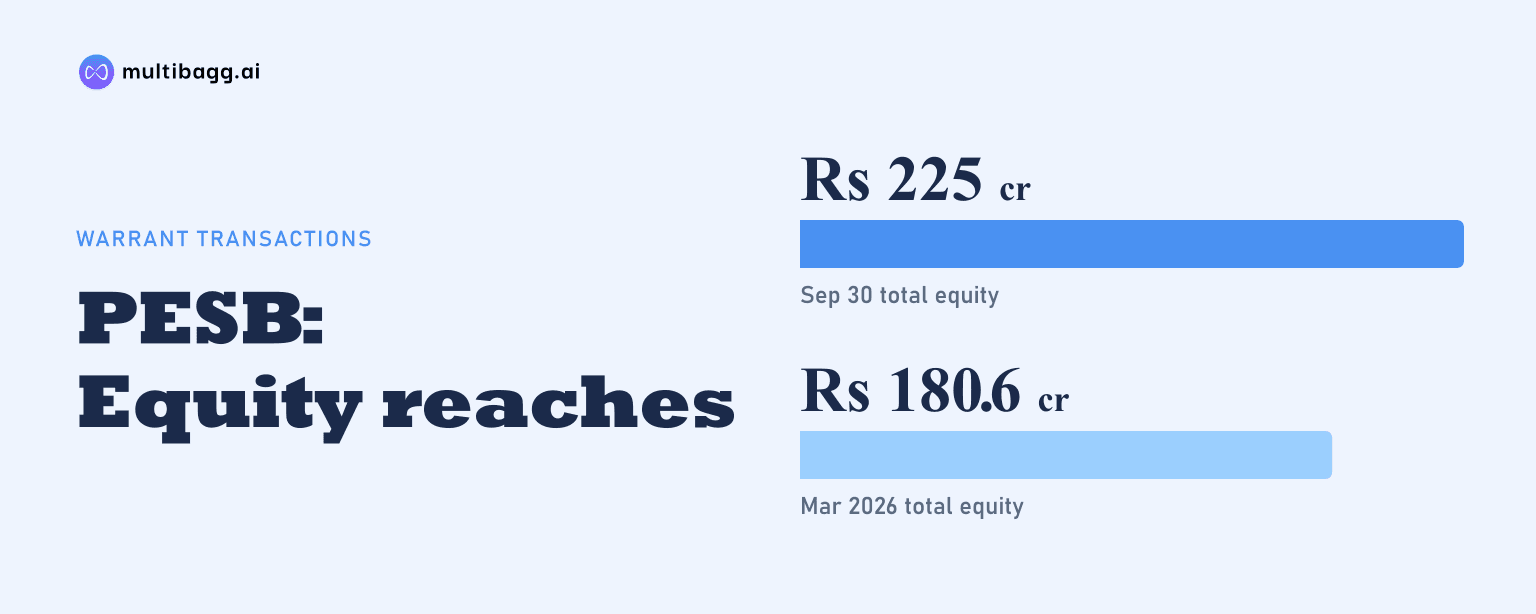
Pune E-Stock Broking Limited, or PESB, reported total equity of Rs 225 crore on September 30, 2026, up from Rs 180.6 crore in March, after H1 FY27 profit, conversion of 18 lakh warrants into shares and a new 16 lakh-warrant issue. Management said fresh capital would be deployed mainly in margin trading facility funding and merchant banking.
Know Pune e-Stock Broking inside out
Results, valuation, peers and who's buying, in one view.
How did PESB's equity reach Rs 225 crore?
PESB's total equity increased by Rs 44.4 crore over H1 FY27 to Rs 225 crore on September 30, 2026, from Rs 180.6 crore in March. Chief Financial Officer Arpit Shah attributed the movement to profit during the half year, conversion of warrants into 18 lakh equity shares and the issue of 16 lakh new convertible warrants.
The new convertible warrants were issued at Rs 234 each, with 25% of the subscription amount received by September 30, 2026. PESB also paid a final FY26 dividend of Rs 1 per share. Management did not provide a separate allocation of the equity increase between retained profit, warrant conversion and proceeds received from the new warrant issue.
Short-term borrowings rose by Rs 18 crore to Rs 65 crore from Rs 47 crore in March, and PESB said they were used mainly to fund its margin trading facility, or MTF, book. Long-term borrowings had declined to Rs 60 lakh by September 30, 2026, according to management.
Where will PESB deploy fresh capital?
PESB intends to deploy profits and fresh fund inflows mainly in MTF and merchant banking, management said during the H1 FY27 call. Shah said the expanding client base continued to create opportunities for MTF funding, while additional merchant-banking mandates and initial public offerings, or IPOs, would require capital deployment.
PESB's MTF book had exceeded Rs 100 crore in H1 FY27 and was fully collateralised by client shareholdings and cash. The company had more than 65,000 clients, including more than 17,000 traded clients, and said it would grow the MTF book carefully, prioritising quality rather than size alone.
Merchant banking is the other principal capital-deployment area named by management. PESB obtained its merchant-banking licence in 2025 and earned its first fees in 2026. Ronak Jhaveri said Apar Advertisers, the company's first approved IPO mandate, was an SME issue expected to list within the next couple of months, while other SME and mainboard mandates were in the pipeline.
Branch expansion and technology are secondary, need-based uses of funds rather than the main stated allocation categories. PESB is building an open application programming interface, or API, based algorithmic-trading platform for retail clients, but management did not disclose a separate budget for technology or flagship branches.
How did H1 FY27 profit support PESB's capital base?
PESB generated consolidated profit after tax of Rs 14.3 crore in H1 FY27, its highest profit for any half year, supporting internally generated capital. Profit after tax increased 36.8% from Rs 10.4 crore in H1 FY26 and 51% from Rs 9.5 crore in H2 FY26, while revenue from operations increased 29.6% year on year to Rs 34.2 crore.
Profit before tax rose 38.8% to Rs 19.1 crore from Rs 13.7 crore in H1 FY26. Net profit margin rose 220 basis points to 41.7%, while standalone profit after tax was Rs 13.4 crore versus Rs 9.3 crore a year earlier.
The growth came as management described lower derivatives activity across the industry. It said Securities and Exchange Board of India measures had more than halved options volumes in 2026, while the industry MTF book increased from more than Rs 1.4 lakh crore at June-end to about Rs 1.6 lakh crore at September-end. PESB's allocation to MTF is therefore directed at the funded-position segment management identified as expanding.
Got a follow-up? Ask IRIS
Can fee-based businesses improve PESB's return ratios?
PESB expects merchant banking, insurance and its alternative investment fund, or AIF, to add fee-based income over time, although management said the newer licences had not yet contributed significantly to revenue. Consolidated return on equity was 12.2% in FY26 and return on capital employed was 14.2%, with management identifying improvement in both ratios as a priority.
Pune Finvest, PESB's 79.8%-owned subsidiary, contains the non-banking financial company, or NBFC, business and insurance operations. Pune Finvest received Insurance Regulatory and Development Authority of India corporate-agency approval in July 2026 and began advisory operations under the QURA Insure brand in September 2026.
The PESB Alpha Fund, a Category III AIF launched in November 2025, managed around Rs 55 crore at the time of the call, including Rs 15 crore invested by PESB. PESB Asset Management LLP, a wholly owned subsidiary, acts as the fund manager. Management said AIF fee income should be relatively consistent because clients generally commit capital for at least three years.
PESB also distributes mutual funds from 36 asset management companies across more than 500 schemes. That business served more than 1,600 investors, had assets under management of over Rs 240 crore and a systematic investment plan book of over Rs 1.5 crore, providing an existing distribution base for cross-selling.
What risks could affect PESB's deployment plan?
PESB said regulation is a central risk for its broking, MTF and insurance activities. Management cited the possibility of changes in insurance commission rules and MTF regulations, while stating that the company would adapt its processes if final rules became stricter.
For the MTF book of more than Rs 100 crore, PESB said its software monitors positions, mark-to-market losses and collateral shortages. Staff contact clients when margins are deficient, and management said shares are liquidated if a collateral shortage continues for more than five days.
Management said promoters participated in the new warrant round, so it did not expect major dilution in promoter ownership after conversion. It noted that minor differences could occur, but the call did not provide a post-conversion shareholding table or a schedule for conversion of the 16 lakh new warrants.
Conclusion
PESB's Rs 225 crore equity balance reflects H1 FY27 profit, the conversion of 18 lakh warrants into equity shares and a new issue of 16 lakh warrants at Rs 234 each. The company is directing its larger capital base primarily toward the MTF book and merchant banking, while newer fee-based operations remain at an early revenue stage.
The next disclosed markers are the intended listing of Apar Advertisers within the next couple of months, further BSE disclosures on merchant-banking mandates and the conversion path for the new warrants. Management is also targeting more than 1 lakh customers by 2027 and expects wealth, merchant banking and insurance to contribute more meaningfully to earnings and return ratios.

