








Apeejay Surrendra Park Hotels targets 7,500 keys and 100 hotels by FY31

Find your next multibaggerBe a Pro Investor
Research stocks and track your picks on the go. Download the app.
Key highlights
- Park Hotels targets 100 hotels and 7,500 keys by FY31, from 43 hotels and 2,729 keys at H1 FY27.
- Park Hotels plans to add 57 hotels and 4,771 keys over six years, including seven hotels with 321 keys in FY27.
- Managed keys are expected to increase from 1,278 to 3,627, while management expects management income to rise from 2% to 4% over three years.
- Park Hotels reported H1 FY27 operating revenue of Rs 347 crore and operating EBITDA of more than Rs 100 crore.
powered by IRIS
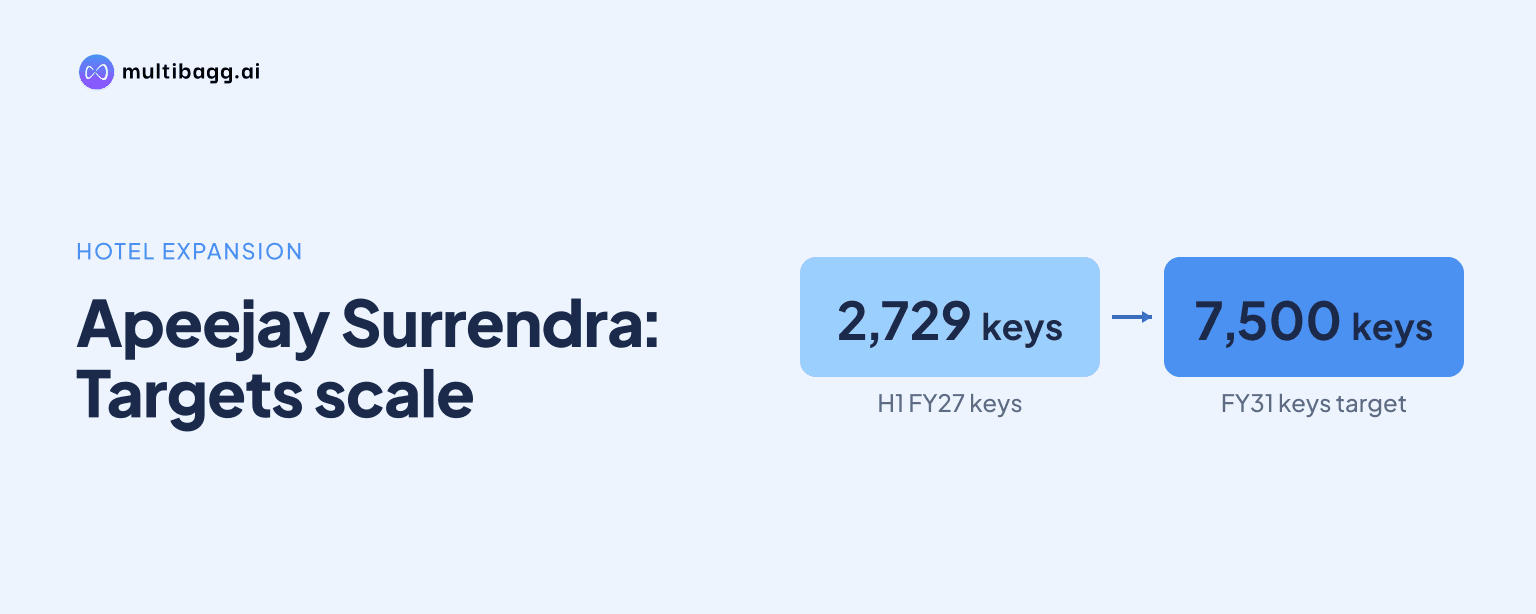
Apeejay Surrendra Park Hotels Limited aims to reach 100 hotels and 7,500 keys by FY31, from 43 hotels and 2,729 keys at the end of H1 FY27. Management said it plans to add 57 hotels and 4,771 keys over six years, with managed properties forming a larger portfolio share and managed keys rising from 1,278 to 3,627.
Know Apeejay Surrendra Park Hotels inside out
Results, valuation, peers and who's buying, in one view.
What is Park Hotels’ FY31 expansion target?
Park Hotels’ stated target is 100 hotels and 7,500 keys by FY31, compared with 43 hotels and 2,729 keys at the end of H1 FY27. The roadmap therefore calls for 57 additional hotels and 4,771 additional keys over six years, with management presenting managed properties as the principal growth format.
The first two years of the plan have specific additions. Park Hotels plans to add seven hotels with 321 keys in FY27 and 11 hotels with 558 keys in FY28. Management named Manali, Ayodhya, Dehradun, Indore and Gangtok among FY28 locations, and said Gangtok would be its second hotel in that market.
Park Hotels also opened a 42-room Zone Connect by The Park hotel in Mathura during FY27. The property has three room categories, an all-day dining Cafe C’s restaurant and indoor event space for up to 150 guests, extending the network in pilgrimage and cultural destinations alongside operating hotels in Katra and Prayagraj.
How will managed hotels drive Park Hotels’ growth?
Managed hotels will account for a larger share of Park Hotels’ portfolio under the FY31 strategy. Management said its managed portfolio comprised 1,278 keys at the November 17, 2026 call and is expected to reach 3,627 keys over six years, an addition of 2,349 keys.
Management described the planned managed-key increase as threefold growth in the vertical. It said the asset-light structure should enable Park Hotels to enter more markets while managing capital requirements, in contrast with an expansion funded entirely through owned hotel construction and property acquisitions.
Management-fee income was Rs 7 crore in H1 FY27 and was described by management as 2%. Managing Director Vijay Dewan said he expects management income from the vertical to rise to 4% over the next three years as the managed portfolio expands, although he did not give an absolute management-income target.
Park Hotels has also put SAP S/4HANA Finance and Material Management modules into operation. Management said the systems are intended to strengthen financial controls and reporting, improve material visibility and support consistent processes as the portfolio moves from 2,729 keys toward the FY31 target of 7,500 keys.
Got a follow-up? Ask IRIS
Which owned projects sit alongside Park Hotels’ managed expansion?
Park Hotels has more than 400 owned keys under development, including about 220 keys in Kolkata, about 80 keys in Juhu, Mumbai, and 100 keys in Visakhapatnam. These projects mean the company’s strategy retains owned development even as its 1,278-key managed platform is expected to grow faster.
In Juhu, Park Hotels acquired close to a 90% stake in Zillion Hotels during the year. Management said the fire no-objection certificate had been received, Brihanmumbai Municipal Corporation approval was expected shortly, and the project was expected to be completed by the end of the following year.
The planned Visakhapatnam development is a 100-room ultra-luxury hotel estimated to cost Rs 150 crore. Management said construction was expected to start within seven to 10 days of the November 17 call and targeted an opening in the second half of 2030, while an Andhra Pradesh government memorandum of understanding could provide Rs 10 crore to Rs 20 crore or more of benefits over five years.
Management guided to around Rs 100 crore of capital expenditure in H2 FY27, including spending on Juhu and the start of the Visakhapatnam project. It then indicated overall FY28 capital expenditure of Rs 150 crore to Rs 200 crore for Visakhapatnam, Juhu and operating needs; Flurys capital expenditure was separately estimated at Rs 30 crore to Rs 40 crore, depending on outlet openings and common-area requirements.
How is Park Hotels performing during the expansion?
Park Hotels reported H1 FY27 operating revenue of Rs 347 crore, up 7% year on year, and operating earnings before interest, tax, depreciation and amortisation, or EBITDA, of more than Rs 100 crore, also up 7%. Profit after tax fell to Rs 26 crore from Rs 30 crore in H1 FY26, which management attributed mainly to higher depreciation and interest costs.
In Q2 FY27, operating revenue rose 7% year on year to Rs 180 crore and operating EBITDA increased 11% to about Rs 54 crore. The operating EBITDA margin increased by 100 basis points to 30.27%, while profit after tax was about Rs 15 crore against Rs 16 crore in Q2 FY26.
Across owned hotels in H1 FY27, occupancy was 93%, average room rate was Rs 7,774 and revenue per available room was Rs 7,219. Management said the hotel business is weighted toward the third and fourth quarters and expects demand from meetings, incentives, conferences and exhibitions, weddings, winter leisure travel and faith tourism to support H2.
Interest costs increased following acquisitions and project spending. Management said Park Hotels paid Rs 188 crore for about 90% of Zillion and about Rs 21 crore for Purity at Vembanad Lake, Kerala, lifting gross loans from Rs 150 crore to Rs 300 crore; it also cited mutual-fund investments of about Rs 100 crore.
Conclusion
Park Hotels’ FY31 plan combines a 57-hotel, 4,771-key expansion with a shift toward managed properties. The strategy starts from 43 hotels and 2,729 keys at H1 FY27, while the planned increase in managed keys from 1,278 to 3,627 is intended to broaden the network with lower direct property capital requirements than an entirely owned rollout.
The next disclosed milestones are seven hotels and 321 keys in FY27, followed by 11 hotels and 558 keys in FY28. Management’s other markers include completion of the Juhu project by the end of the following year, the planned second-half 2030 opening of the Rs 150 crore Visakhapatnam hotel, and its expectation that H2 FY27 seasonality will help offset higher interest and depreciation costs.

