








The Park gross debt reaches Rs 300 crore after acquisitions

Find your next multibaggerBe a Pro Investor
Research stocks and track your picks on the go. Download the app.
Key highlights
- The Park’s gross debt doubled from Rs 150 crore to Rs 300 crore in H1 FY27.
- The Park paid Rs 188 crore for about 90% of Zillion Juhu and about Rs 21 crore for Purity Kerala.
- The Park held about Rs 100 crore in mutual funds and stated net debt-to-equity of 0.1 to 1.
- The Park expects around Rs 100 crore of H2 FY27 capex and Rs 150 crore to Rs 200 crore in FY28.
powered by IRIS
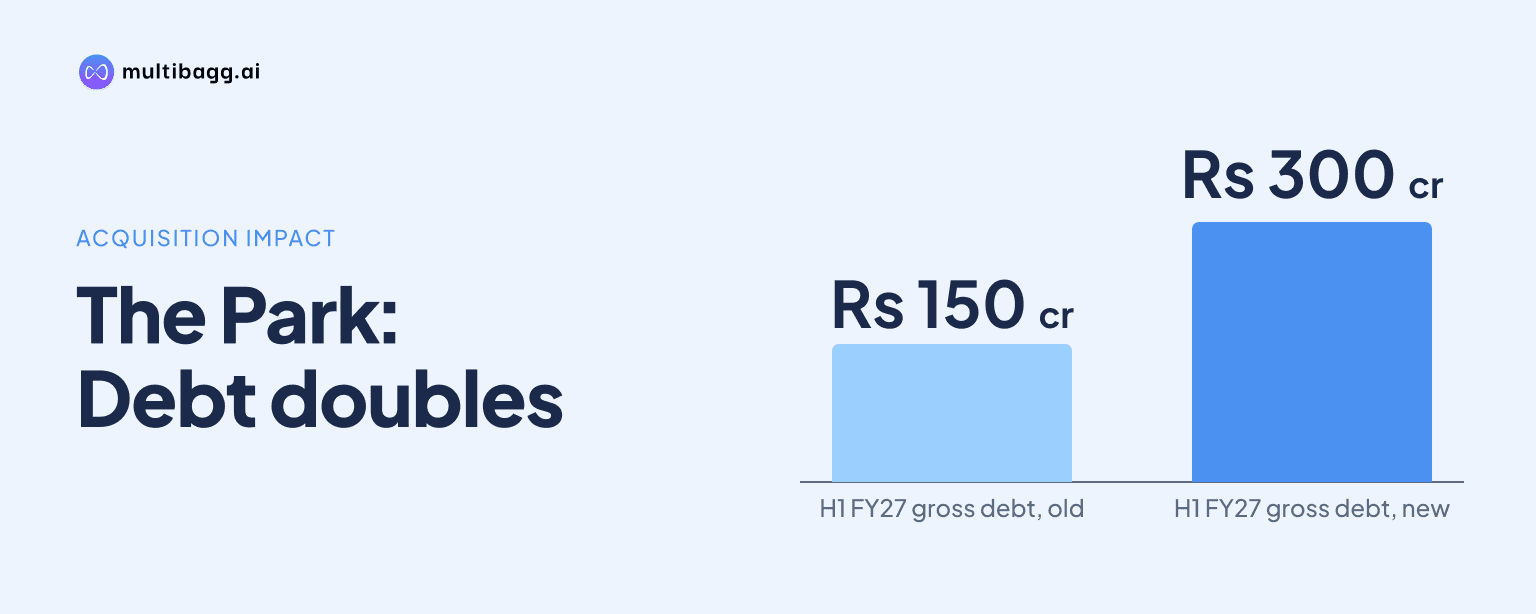
In H1 FY27, Apeejay Surrendra Park Hotels Limited’s gross debt doubled to Rs 300 crore from Rs 150 crore after it paid Rs 188 crore for Zillion Juhu and about Rs 21 crore for Purity, while management said roughly Rs 100 crore in mutual-fund investments left net debt-to-equity at 0.1 to 1.
Know Apeejay Surrendra Park Hotels inside out
Results, valuation, peers and who's buying, in one view.
Why did The Park’s gross debt rise to Rs 300 crore?
The Park said gross debt rose from Rs 150 crore to Rs 300 crore largely because of acquisitions and existing projects. Management said it had paid Rs 188 crore for about a 90% stake in Zillion Juhu and about Rs 21 crore for Purity at Vembanad Lake in Kerala. The disclosed acquisition payments total about Rs 209 crore, while the increase in gross debt was Rs 150 crore.
The higher debt also explains the rise in finance cost cited during the call. An analyst said operating earnings before interest, tax, depreciation and amortisation, or EBITDA, increased 11% year on year, while profit after tax, or PAT, declined 9.9%; interest expense more than doubled and depreciation rose. Management attributed the interest increase mainly to the two acquisitions completed over the 12 months from H1 of the prior year to H1 FY27.
What is The Park’s net debt position after mutual-fund investments?
The Park said its mutual-fund investments of about Rs 100 crore reduce gross debt of Rs 300 crore to net debt of roughly Rs 200 crore. Management stated net debt-to-equity of 0.1 to 1. It also cited a gross debt-to-EBITDA ratio of 0.23 to 1 while discussing the acquisition-related increase in loans.
In a later response, management described debt-to-equity as 0.23 to 1, the same figure earlier identified as gross debt-to-EBITDA. The transcript does not provide the balance-sheet calculations needed to reconcile those two descriptions, so the 0.23-to-1 measure should be treated as management-stated. Management said debt had been in the range of Rs 600 crore at the time of The Park’s initial public offering, or IPO, compared with Rs 300 crore currently.
Management said it intends to maintain the balance sheet while continuing expansion. The call, however, did not disclose a debt ceiling, repayment schedule, borrowing rate, refinancing plan or funding mix for future projects. It did disclose H2 FY27 capital expenditure, or capex, of around Rs 100 crore and FY28 capex of Rs 150 crore to Rs 200 crore.
Why did The Park’s PAT decline despite EBITDA growth?
The Park linked the divergence between EBITDA and PAT to higher interest and depreciation. Management said depreciation increased after the addition of Patiala and Chettinad Palace in the prior year, as well as from right-of-use, or ROU, assets associated with an increase in Flurys outlets between H1 of the prior year and H1 FY27. The analyst’s figures showed 11% year-on-year EBITDA growth alongside a 9.9% PAT decline.
Management reported Q2 operating EBITDA of Rs 54 crore and said it grew 16% quarter on quarter. It expects Q3 and Q4, which management described as more significant periods for the hotel business, to improve earnings and offset the higher interest and depreciation. The company did not provide a projected H2 FY27 interest expense, depreciation charge, PAT or profit before tax figure.
The Park’s seasonal expectation is linked to weddings and business events. Management said 36 of the 52 weddings in its FY27 calendar were scheduled between the November 17, 2026 call and March, with a concentration in December, January and February. It also cited conferences and conventions in H2, but did not disclose company-specific occupancy, average room rate or booking data.
Got a follow-up? Ask IRIS
How much capex could affect The Park’s future funding needs?
The Park expects around Rs 100 crore of capex in H2 FY27, including Juhu hotel spending and initial capex for Vizag. Management allocated about Rs 15 crore to Rs 20 crore of H2 spending to Flurys and Rs 10 crore to operating capex. It also said bookings or apartment sales at EM Bypass would generate inflows to finance the EM Bypass project and other capex, without providing an amount or timing.
For FY28, management guided to Rs 150 crore to Rs 200 crore of overall capex for Vizag, Juhu and operating requirements. It separately said Flurys capex would remain Rs 30 crore to Rs 40 crore, depending on the number of outlets opened and common-space requirements. The call did not state what portion of FY28 spending would be funded by operating cash flow, mutual-fund investments, EM Bypass inflows or additional borrowings.
Vizag is a longer-term project within this spending programme. The Park plans a 100-room ultra-luxury hotel beside its existing 65-room Visakhapatnam hotel at a cost of Rs 150 crore, with an expected opening in the second half of 2030. Management said it had paid the required Greater Visakhapatnam Municipal Corporation fee and expected construction to begin within seven to 10 days of the call.
Management also said the Andhra Pradesh agreement could provide Rs 10 crore to Rs 20 crore or more in savings over the project period. This includes a capital subsidy with a stated Rs 10 crore limit for qualifying hotels above Rs 100 crore and a state goods and services tax refund over five to seven years. The actual subsidy outcome and timing were not quantified beyond that range.
Conclusion
The Park’s debt increased as it acquired Zillion Juhu and Purity Kerala, taking gross debt to Rs 300 crore from Rs 150 crore. Management’s cited Rs 100 crore of mutual-fund investments brought net debt to roughly Rs 200 crore and supported its stated net debt-to-equity ratio of 0.1 to 1, but the associated interest costs and added depreciation coincided with a 9.9% PAT decline despite 11% EBITDA growth.
The next disclosures to watch are whether seasonally stronger Q3 and Q4 trading improves PAT and profit before tax, and how The Park funds about Rs 100 crore of H2 FY27 capex and Rs 150 crore to Rs 200 crore in FY28. Construction on the Rs 150 crore Vizag hotel was expected to begin shortly after the November 17, 2026 call, with opening planned for the second half of 2030.

