










Petronet’s Dahej 5 mtpa expansion lacks committed offtake
Key highlights
- Petronet has no signed offtaker agreement or customer commitment for Dahej’s additional 5 mtpa capacity.
- Petronet said take-or-pay arrangements would follow a committed offtake agreement for the 5 mtpa expansion.
- Management indicated aggregate capex of around Rs 9,000 crore in FY27 and around Rs 9,000 crore in FY28.
- Petronet reported Rs 658 crore of operational and commercial efficiency gains in Q2, versus Rs 494 crore in Q1.
powered by IRIS
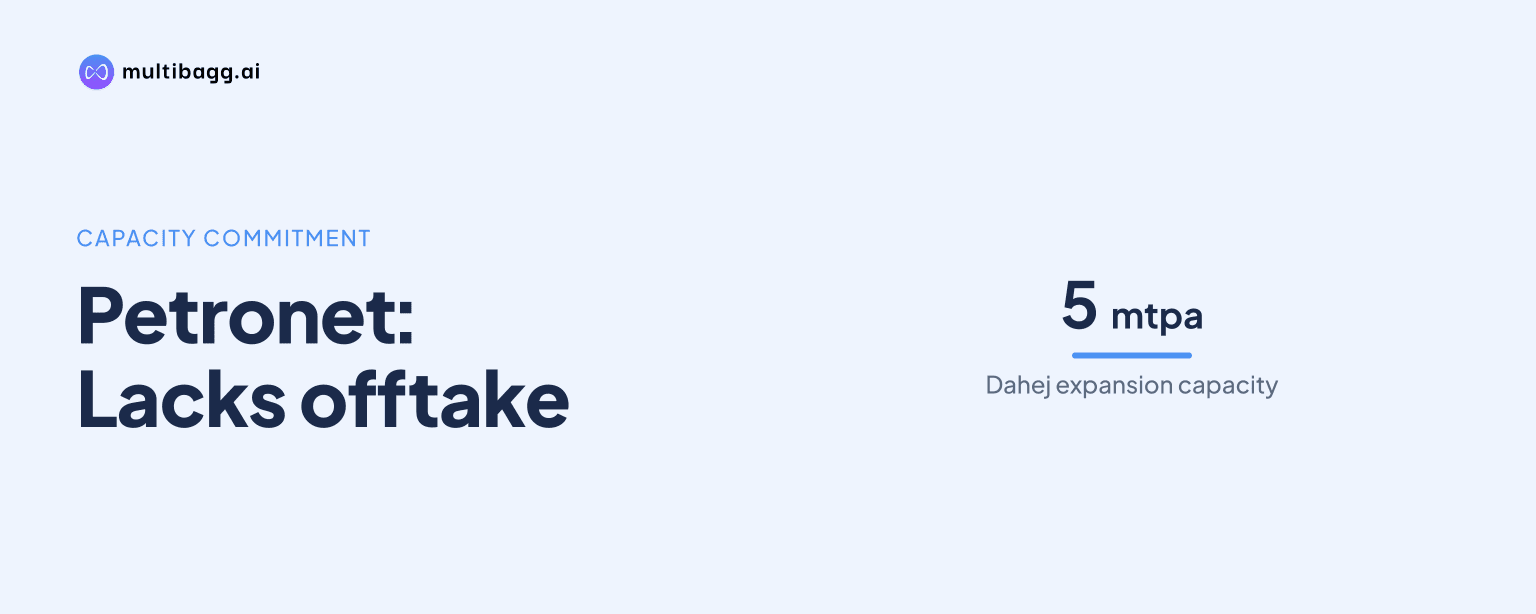
Petronet has no signed offtaker agreement or customer commitment for the additional 5 million tonnes per annum, or mtpa, of capacity planned at Dahej. Management said take-or-pay arrangements would follow a committed offtake agreement, while long-term capacity tie-ups remain its preferred route once the current liquefied natural gas market environment normalises.
Know Petronet LNG inside out
Results, valuation, peers and who's buying, in one view.
Does Petronet have customers committed to the extra Dahej capacity?
No, Petronet said it has not signed an offtaker agreement or received any commitment from offtakers for the additional 5 mtpa at Dahej. Management was asked whether it was seeking take-or-pay support for the expansion and replied that take-or-pay would take place after a committed offtake agreement is in place.
The disclosure means the planned 5 mtpa addition does not yet have a customer commitment identified on the call. Petronet did not disclose a prospective customer, a reserved capacity volume, a tariff, a contract-signing target or a construction-linked offtake milestone for the expansion. The commercial support for the additional Dahej capacity therefore remains dependent on future contracting.
Petronet separately discussed contracts that are due for renewal in April 2028. Management said discussions with existing offtakers are ongoing and it was hopeful that arrangements would be finalised before the renewed contracts begin. That update concerns current contracts, whereas the additional 5 mtpa Dahej capacity has no disclosed offtaker commitment.
When could Petronet secure Dahej capacity tie-ups?
Petronet did not give a signing date, but management said it was hopeful that capacity tie-ups could be completed quickly once the current market environment normalises. It said long-term capacity tie-ups are always preferred because they provide sustainability, and added that many market participants are looking to tie up terminal capacity alongside LNG volumes.
Management connected this expectation with a potential decline in LNG spot prices, but did not specify a price level or a timetable. Its comments did not amount to guidance that agreements will be signed. They set out management’s view that a more normal market could improve the conditions for buyers to commit to both LNG supply volumes and terminal capacity.
The company also linked LNG prices to demand conditions in India. Management said refinery, petrochemical and city-gas segments could drive additional gas demand if prices soften. However, Petronet did not quantify the potential demand from those sectors or state how much of any increase would be directed to the additional 5 mtpa at Dahej.
How does the uncontracted expansion fit Petronet’s capex plan?
Petronet expects aggregate capital expenditure, or capex, of about Rs 9,000 crore in FY27 and said FY28 should be at the same level, but it did not allocate this spending to the additional 5 mtpa Dahej project. Management said a gradual trough phase in capex would begin from FY29 onward.
The FY27 and FY28 indications cover Petronet’s wider investment programme rather than the Dahej expansion alone. As a result, the call does not establish the cost of the additional 5 mtpa capacity, its spending schedule, or whether project spending depends on completing an offtake agreement. The stated Rs 9,000 crore figure is an aggregate capex indication, not a Dahej-specific commitment.
Petronet also said it had incurred about Rs 3,300 crore on its petrochemical project up to September 30. Management put the useful life of that facility at 25 years and said it was too early to provide operating-cost guidance. This separate investment explains why the broader FY27 and FY28 capex outlook cannot be read as spending solely on LNG terminal capacity.
Got a follow-up? Ask IRIS
What does Petronet’s LNG operating model show?
Petronet said it does not procure LNG cargoes without downstream tie-up and does not take exposure to volume or price. During the current force majeure situation affecting Qatar supplies, management said its offtakers, rather than Petronet, are bringing cargoes to compensate for the shortfall in volume.
Management said operational and commercial efficiency gains were Rs 658 crore in Q2, compared with Rs 494 crore in Q1 and Rs 41 crore in the corresponding Q2 of the previous year. Petronet will now disclose this combined measure rather than separately reporting trading gains and inventory gains. It also reported a Rs 27 crore foreign-exchange loss in the quarter due to lease accounting.
Management said efficiency gains include operational savings such as lower fuel use and reduced boil-off loss, and that these efficiencies can be monetised more effectively when LNG prices are high. The Rs 658 crore figure is not evidence of demand contracted for the additional 5 mtpa at Dahej. It reflects the reported operating and commercial outcome in Q2, while new Dahej capacity remains without an offtaker agreement.
Conclusion
Petronet’s additional 5 mtpa Dahej expansion currently has no signed offtaker agreement, no disclosed customer commitment and no stated take-or-pay backing. Management nonetheless continues to prefer long-term capacity tie-ups and sees the prospect of faster contracting when LNG spot prices decline and the market normalises. The company’s FY27 and FY28 aggregate capex indication of about Rs 9,000 crore points to continued investment activity, but does not identify the amount earmarked for the Dahej addition.
The next developments to watch are whether Petronet announces committed users for the 5 mtpa capacity and whether market conditions lead to combined LNG-volume and terminal-capacity agreements. Management also said renewal discussions for contracts beginning in April 2028 remain ongoing, while it expects the Kochi-Bangalore pipeline to connect to the national grid within the current financial year, despite GAIL indicating December.