










Petronet LNG Limited reports record Q2 profit of Rs 1,235 crore
Key highlights
- PLL reported record Q2 FY27 PBT of Rs 1,659 crore and PAT of Rs 1,235 crore.
- PLL processed 231 TBTU of LNG in Q2 FY27, up 12% from 207 TBTU in Q1 FY27.
- Dahej processed 216 TBTU in Q2 FY27 and operated at 73% utilisation on 22.5 million tonnes of annual capacity.
- First-half FY27 PBT was Rs 3,174 crore and PAT was Rs 2,368 crore, with both up 43% year on year.
powered by IRIS
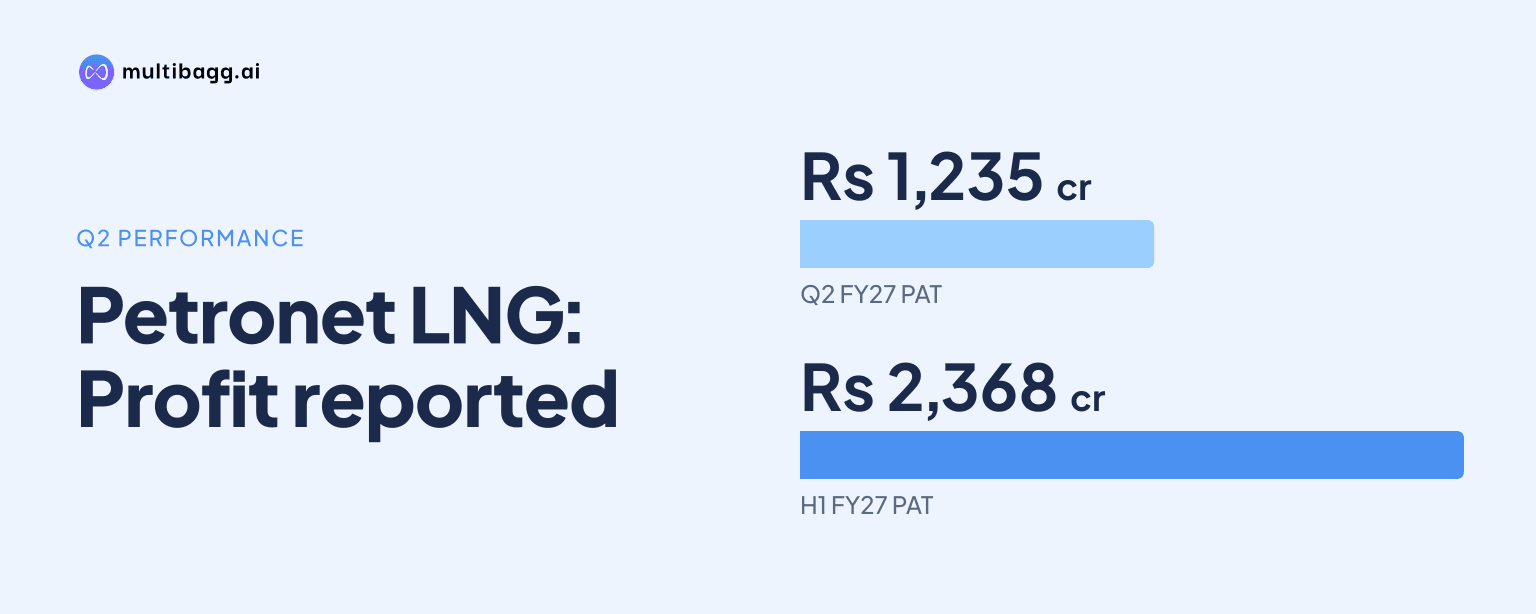
Petronet LNG Limited reported record Q2 FY27 profit after tax of Rs 1,235 crore and profit before tax of Rs 1,659 crore, while processing 231 trillion British thermal units, or TBTU, of liquefied natural gas. Management said the quarter and first half were PLL's best ever for both profit measures, supported by higher throughput at Dahej.
Know Petronet LNG inside out
Results, valuation, peers and who's buying, in one view.
How did PLL perform in Q2 FY27?
PLL delivered record Q2 FY27 profit before tax, or PBT, of Rs 1,659 crore, up 10% from Rs 1,514 crore in Q1 FY27 and 53% from Rs 1,083 crore in Q2 FY26. Profit after tax, or PAT, was Rs 1,235 crore, compared with Rs 1,133 crore in the preceding quarter and Rs 806 crore a year earlier, representing sequential growth of 9% and year-on-year growth of 53%.
The profit outcome came alongside higher LNG processing, with PLL handling 231 TBTU in Q2 FY27 against 207 TBTU in Q1 FY27 and 228 TBTU in Q2 FY26. Processing increased 12% sequentially and 1% year on year, while management described the quarter as the company's best-ever second quarter for both PBT and PAT.
Management also reported Rs 658 crore of gains from operational and commercial efficiencies in Q2 FY27, rather than separately disclosing trading and inventory gains. It said foreign exchange was separate from that measure and recorded a Rs 27 crore foreign-exchange loss related to lease accounting during the quarter.
What drove PLL's LNG throughput increase?
PLL's higher Q2 FY27 throughput was led by Dahej, where processed volume rose to 216 TBTU from 192 TBTU in Q1 FY27 and 211 TBTU in Q2 FY26. Dahej added 24 TBTU sequentially and 5 TBTU year on year, accounting for most of the company's 231 TBTU of LNG processed in the quarter.
The difference between PLL's total 231 TBTU and Dahej's 216 TBTU was 15 TBTU in Q2 FY27. This comparison shows that Dahej represented the principal source of the 24 TBTU sequential rise in company-wide processing from Q1 FY27.
Management said Indian gas demand had remained steady through October 2026, although it did not disclose an October volume. India imported 20.15 million tonnes of LNG in the first nine months of calendar 2026, compared with 25.3 million tonnes in all of calendar 2025, according to management's analysis. It said increased supply from the US, Oman, Nigeria, Angola, Trinidad and Australia had offset lower volumes from Qatar and the UAE.
Why was Dahej utilisation lower year on year?
Dahej's Q2 FY27 utilisation was lower year on year because the terminal's capacity base had expanded to 22.5 million tonnes per annum from 17.5 million tonnes per annum last year, even though processed volume increased. Utilisation was 73% in Q2 FY27 versus 92% in Q2 FY26, while throughput rose to 216 TBTU from 211 TBTU.
Sequentially, the measures moved in the same direction: Dahej utilisation increased to 73% in Q2 FY27 from 66% in Q1 FY27, and throughput climbed to 216 TBTU from 192 TBTU. Management specifically said the current and preceding-quarter utilisation percentages used the expanded 22.5 million-tonne annual capacity denominator.
Overall utilisation was 64% in Q2 FY27, compared with 58% in Q1 FY27. The 6-percentage-point increase accompanied a 12% sequential rise in total LNG processing to 231 TBTU. The call did not provide an overall Q2 FY26 utilisation rate, so it did not establish a comparable year-on-year company-wide utilisation change.
Got a follow-up? Ask IRIS
How did PLL perform in the first half of FY27?
PLL reported first-half FY27 PBT of Rs 3,174 crore and PAT of Rs 2,368 crore, with both measures 43% above the corresponding first half of the prior year. Management said these were its best-ever first-half PBT and PAT results.
Q2 FY27 contributed Rs 1,659 crore of the first-half PBT total and Rs 1,235 crore of the first-half PAT total. The company did not disclose first-half LNG throughput in its opening remarks, so the transcript does not provide a direct comparison between six-month processed volume and profit growth.
Management attributed Indian gas-demand growth to fertilizer, city gas distribution, or CGD, and power-sector demand. It said fertilizer demand previously supplied by Qatar cargoes was being met through other long-term and spot cargoes, while CGD demand continued to grow and power demand received support when coal supplies were affected.
What does PLL expect in the second half of FY27?
Management expects capital expenditure to increase in the second half of FY27 after PLL spent Rs 1,626 crore in the first half and placed all major orders for its project. It said financial progress could appear lower than physical progress, but on-ground execution was proceeding on schedule.
PLL is also discussing longer-term capacity arrangements with certain existing capacity holders and with new market entrants, management said. It identified GAIL, IOC, BPCL and GSPC as existing capacity holders that continued to bring higher volumes and were contractually committed, but it did not disclose a target utilisation rate, contract volume or timetable for the discussions.
Management's demand view was not formal guidance. It said LNG prices had ranged between $20 and $25 from March through September 2026 and Indian demand had remained resilient despite reduced Qatar and UAE supply. It also said there had been no major demand decline through October 2026, while noting that future market conditions could change.
Conclusion
PLL combined record quarterly and first-half profitability with a sequential increase in LNG processing and higher Dahej utilisation. The year-on-year decline in Dahej's utilisation percentage did not reflect lower terminal throughput, because the calculation used the expanded 22.5 million-tonne annual capacity base rather than the 17.5 million-tonne base used last year.
The next disclosures to watch are second-half capital expenditure following Rs 1,626 crore spent in the first half, the execution progress of the project for which major orders have been placed, and any long-term Dahej capacity agreements. Management said physical project progress was on schedule and expects an uptick in capital expenditure in the second half of FY27.