










Pidilite price hikes seek margin recovery after Q2 shock
Key highlights
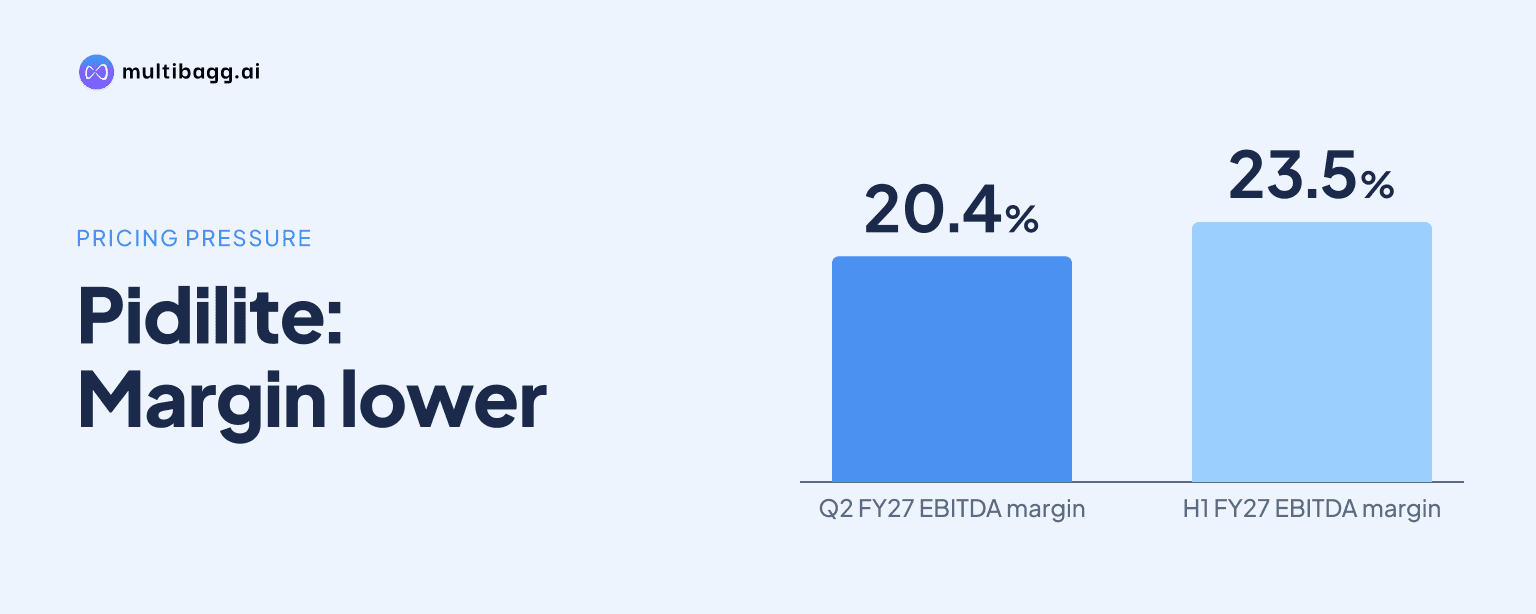
- Pidilite's standalone Q2 FY27 EBITDA margin was 20.4%, compared with 23.5% for H1 FY27.
- Pidilite raised Fevicol and Dr Fixit prices on October 1 after VAM increased again during Q2 FY27.
- Standalone Q2 FY27 revenue grew 21.7% and underlying volume growth was 10.7%.
- VAM consumption was $1,630 in Q2 FY27, compared with $1,370 in Q1 FY27.
powered by IRIS
Pidilite Industries Limited raised prices for Fevicol and Dr Fixit on October 1 after raw-material volatility cut its standalone Q2 FY27 earnings before interest, tax, depreciation and amortisation (EBITDA) margin to 20.4%, while management said pricing and a VAM level of around $1,200 supported its 20% to 24% corridor in H2.
Know Pidilite Industries inside out
Results, valuation, peers and who's buying, in one view.
Why did Pidilite raise Fevicol and Dr Fixit prices?
Pidilite raised prices because vinyl acetate monomer (VAM) and other inputs increased again after a sharp intra-quarter decline, creating pressure on replacement costs. Management said VAM, which it uses as an indicator of wider input inflation, rose to almost $2,000 after the West Asia conflict before cooling to about $1,000, with some consignments possibly at $900, in Q2 FY27.
Pidilite said it rebated prices when VAM fell because competitors carrying limited inventory were responding to spot prices, and because the company gives primacy to demand and growth rather than transferring every short-term cost movement to customers. VAM then rose again midway through or in the second half of Q2 FY27, prompting one round of price increases for Fevicol and Dr Fixit on October 1.
Management said the company manages pricing over the year rather than changing prices each month as raw materials move. That approach meant the Q2 FY27 cost increase was not passed through immediately in full, but Pidilite said it had already taken price increases of about 12% to 15% in areas of high inflation, largely through two staggered rounds in Q1 FY27.
How much did Pidilite's Q2 margin decline?
Pidilite's standalone Q2 FY27 EBITDA margin was 20.4%, at the lower end of its stated 20% to 24% corridor. Management said gross margin declined both sequentially and year on year, and that the 720-basis-point gross-margin movement translated into a 430-basis-point EBITDA-margin decline because 21.7% standalone revenue growth generated operating leverage.
The quarterly result differed from Q1 FY27 because the earlier period benefited from lower-cost inventory bought in Q4 FY26. Management said Q1 FY27 EBITDA margin was 26.3%, while H1 FY27 EBITDA margin was 23.5%, near the upper end of the stated range. It asked investors to assess margins over H1 and longer periods during raw-material volatility.
What drove Pidilite's raw-material cost pressure?
Pidilite said Q2 FY27 bore the full impact of elevated input costs, with VAM consumption at $1,630, nearly twice the level in the same quarter a year earlier and above $1,370 in Q1 FY27. Management also cited crude at about $115 and inflation in several materials with crude linkages as contributors to the cost increase.
Pidilite's finance team said crude does not translate immediately into its input costs. Much of the company's raw-material and packaging base is made up of downstream petrochemical products, but individual prices also depend on local demand and supply. It cited VAM as an example, saying soft demand in China or Europe can prevent the full effect of higher input costs from reaching VAM prices.
Management described VAM's movement as both volatile and uncertain because the West Asia conflict affected the movement of goods as well as cargo costs. It said VAM had remained at about $800 to $900 through FY26, making the move toward almost $2,000 and the subsequent fall toward $1,000 difficult to reflect through stable market pricing.
Got a follow-up? Ask IRIS
Is Pidilite demand holding up and which businesses grew?
Pidilite reported broad-based demand in Q2 FY27, with standalone underlying volume growth of 10.7% despite the input inflation and pricing actions. Consumer and Bazaar underlying volume growth was 11.1%, ahead of 9.2% in business-to-business (B2B), while standalone revenue was under Rs 4,000 crore, up 21.7% in nominal terms.
The H1 FY27 comparison also showed Consumer and Bazaar underlying volume growth of 11.6%, compared with 8.3% in B2B and 11.0% overall. Management said Pidilite maintains some premium to the market while prioritising demand and growth, but it did not disclose a post-October 1 demand trend for Fevicol or Dr Fixit.
Subsidiary businesses also reported revenue growth above 20% in Q2 FY27. International subsidiaries grew 21.8%, with Dubai, Bangladesh, Kenya and Thailand each growing more than 20%, while international subsidiary EBITDA rose 53%. Domestic subsidiaries grew 22.2%, with Consumer and Bazaar and B2B each up 22%.
Management identified ICA wood finishes and construction-chemical businesses, including epoxy grouts, marble and stone finishes, and waterproofing products, as contributors to domestic subsidiary growth. Nina was the exception because waterproofing workfront availability was constrained during the monsoon period; management said the other domestic businesses grew more than 20%.
What further pricing and margin actions has Pidilite outlined?
Pidilite said it was taking a further 3% to 5% price increase in selected areas with heightened inflation after the October 1 action on Fevicol and Dr Fixit. The increase varies by product, brand and category, and follows the 12% to 15% pricing action management said had been taken in high-inflation areas, mostly during Q1 FY27.
Management said another price increase could follow toward the end of Q3 FY27 or early in the following quarter, depending on how input costs develop. At a current VAM price of around $1,200, it said it was confident about Q3 FY27 and quite confident that H2 FY27 EBITDA margin would remain within the 20% to 24% corridor, ideally toward the higher end.
The outlook is management's assessment rather than a reported H2 FY27 result. It depends on the company managing raw-material volatility without frequent price changes, while preserving demand in Fevicol, Dr Fixit and the wider Consumer and Bazaar portfolio.
Conclusion
Pidilite's Q2 FY27 margin result shows the immediate cost of absorbing volatile VAM and crude-linked inputs: standalone EBITDA margin reached 20.4% even as revenue grew 21.7% and underlying volume increased 10.7%. The H1 FY27 EBITDA margin of 23.5%, compared with 26.3% in Q1 FY27, reflects how lower-cost inventory and then elevated input costs affected the two quarters differently.
The next factors to watch are VAM, crude-linked material costs and execution of the additional 3% to 5% pricing actions. Management said it may consider another increase near the end of Q3 FY27 or early in the following quarter, and it has set the disclosed reference point of maintaining H2 FY27 EBITDA margin within the 20% to 24% corridor at VAM of around $1,200.