










Pidilite Projects Reorganisation Aids Q2 Project Conversions
Key highlights
- Pidilite reorganised Projects by customer segment in Q2 and said conversion benefits were already visible.
- Pidilite reported first-half underlying volume growth of 11%, up from 10.1% in the prior-year first half.
- Urban growth was slightly ahead of rural growth in Q2 after urban demand improved over the past couple of quarters.
- Pidilite completed six to seven external-render pilots in North India through its Grupopuma joint venture.
powered by IRIS
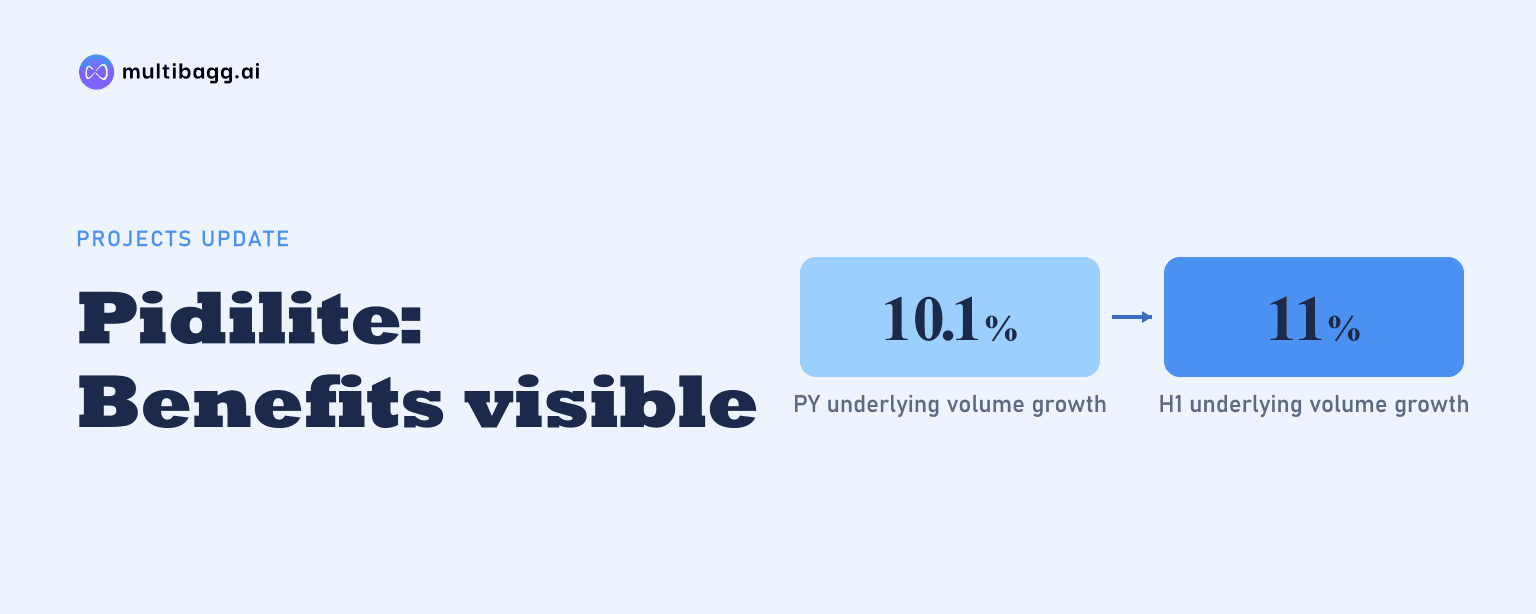
Pidilite said its Q2 reorganisation of the Projects business by customer segment was already aiding project conversions, with further benefits expected in Q3. The change coincided with first-half underlying volume growth of 11%, up from 10.1% in the prior-year first half, and continuing momentum in construction chemicals across retail and project channels.
Know Pidilite Industries inside out
Results, valuation, peers and who's buying, in one view.
Why did Pidilite reorganise its Projects business?
Pidilite reorganised Projects to serve customers by segment rather than mainly classify opportunities as small, medium or large projects. Management said the new model targets medium and large builders in residential and commercial construction, separates institutions into their own category, and creates dedicated coverage for engineering, procurement and construction, or EPC, contractors.
The company implemented the revised team structure in Q2 and said it saw some benefits during the quarter. Management described the project pipeline as healthy and said conversions were happening well, but it did not disclose pipeline value, conversion rates, Projects revenue or the financial contribution from the reorganisation.
Pidilite’s stated mechanism is a key-account approach that can offer a wider company portfolio rather than only construction chemicals. Management said its focus on key accounts and solutions beyond construction chemicals was already underway, indicating that the change is intended to match product applications and customer requirements more closely across project types.
Which customer segments does Pidilite Projects now cover?
Pidilite Projects now covers three broad customer routes: medium and large residential and commercial builders, institutions including hotels, hospitals and education facilities, and EPC contractors. Management presented these routes as the replacement for the previous size-based classification of projects.
The institutional category separates hotels, hospitals and education facilities from mainstream builder-led work. Pidilite did not provide sales, contract values, employee numbers or product mix for this segment, but management said the Q2 team reorganisation was beginning to yield results as the company changed its ways of working.
EPC refers to engineering, procurement and construction contractors that execute projects for customers. Pidilite said a separate focus on EPC contractors places this channel alongside builder and institutional coverage, while allowing the company to offer solutions across its range rather than limit the discussion to individual construction-chemical products.
How is Pidilite’s construction-chemicals business performing?
Pidilite said construction-chemicals momentum was broad across retail and Projects, led by Dr. Fixit waterproofing, Roff tile adhesives, grouts and Tenax marble, tile and stone-care products. Management also said the floor-coating business was beginning to gain momentum, adding another application area to the portfolio.
On the retail side, management said momentum was good in urban markets and emerging India, which it described as rural areas and small towns. Tile adhesives continued to grow as a category, while Pidilite said it was growing faster than the category with the stated aim of gaining market share; the transcript did not provide category size, market share or a retail growth rate.
Demand patterns shifted in Q2 as urban growth improved relative to rural growth. Management said rural growth had historically exceeded urban growth, but urban demand had strengthened over the past couple of quarters and was slightly ahead of rural demand in Q2, while rural growth continued to hold at its earlier level.
Pidilite also increased brand activity in Q2 for two construction-chemical brands. Roff introduced a new campaign in the middle of Q2, while Dr. Fixit introduced new advertising copy toward the end of Q2; management said both brands would receive more visibility in Q3 alongside continuing field marketing and technology-led message customisation.
Got a follow-up? Ask IRIS
What does the Projects change mean for Pidilite’s growth mix?
Pidilite said Projects gives it a business-to-business growth route alongside its retail construction-chemicals presence. Management said the Projects business was driving strong growth and described construction chemicals as an area with robust growth in both the consumer-and-bazaar channel and the business-to-business channel.
The reorganisation comes during a period of sustained company-wide volume expansion. Management said Pidilite had delivered double-digit underlying volume growth for about six to eight quarters, while first-half underlying volume growth increased to 11% from 10.1% in the prior-year first half, a rise of 0.9 percentage points.
Management said its medium-term desire was to move underlying volume growth from conventional double digits toward the early teens over time. It also said the company was not pursuing volume for its own sake, characterising its objective as profitable underlying volume growth rather than providing a numerical target or timetable.
The construction portfolio also includes earlier-stage opportunities. Pidilite said its Grupopuma joint venture had completed six to seven successful external-render pilots in North India and was working on some large projects; management noted that external renders account for 15% to 20% of conventional exterior walls in parts of Southern Europe, without giving an Indian adoption target.
What evidence should readers look for in Q3?
Readers should look for management’s Q3 update on project conversions because Pidilite said benefits from the Q2 segment-based reorganisation would continue to play out in that quarter. The company has not separately reported Projects revenue or margins, so management commentary on pipeline conversion remains the available evidence from this transcript.
Retail demand across urban and emerging India is another measure to follow. In Q2, urban growth was slightly ahead of rural growth after a recent urban recovery, while management said rural growth remained steady; continued growth in both geographies would support the Dr. Fixit, Roff, grouts, Tenax and floor-coatings portfolio.
Input costs and demand conditions remain relevant to the wider operating backdrop. Management said the absolute value of cost increases had been passed on and more, but said calibrated pricing would depend on demand and on-ground conditions, while El Nino, elevated crude prices and a possible escalation in the West Asia conflict were not fully factored into its outlook.
Conclusion
Pidilite’s Q2 Projects reorganisation changes the business from broad project-size classifications to customer-segment coverage for builders, institutions and EPC contractors. Management linked the revised structure to early conversion benefits and a healthy pipeline, while retail construction chemicals continued to show momentum across waterproofing, tile adhesives, grouts, stone care and floor coatings.
The next disclosed checkpoint is Q3, when management expects more benefits from the Q2 change to emerge. Readers should also watch whether the Roff and Dr. Fixit campaigns support retail demand, whether urban growth remains ahead of rural growth, and whether crude prices, El Nino or West Asia-related disruption affect demand, costs or pricing.