










PIGL Q2 EBITDA rises 45% as margin reaches 12.34% in FY27
Key highlights
- PIGL’s Q2FY27 consolidated EBITDA rose 44.76% to Rs 9.52 crore.
- PIGL’s Q2FY27 EBITDA margin increased to 12.34% from 9.36% in Q2FY26.
- PIGL’s Q2FY27 revenue from operations grew 9.78% to Rs 77.14 crore.
- PIGL reported an order book above Rs 320 crore as of September 30, 2026.
powered by IRIS
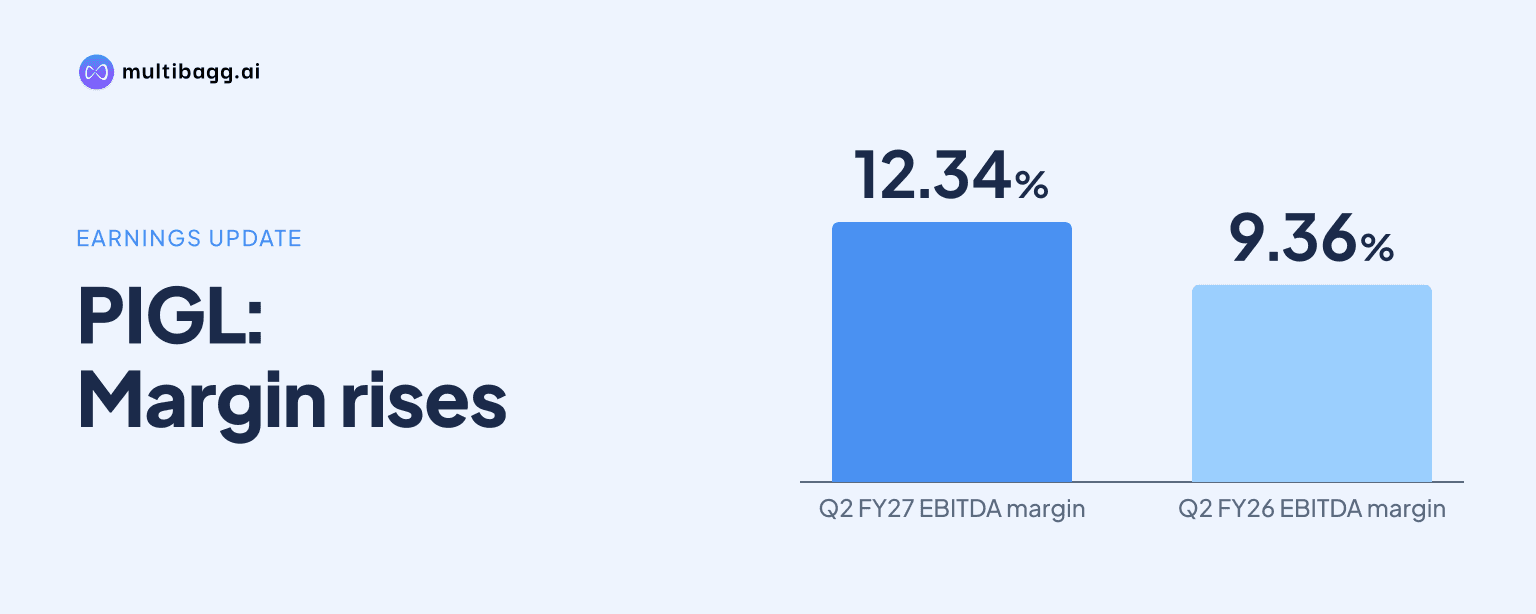
Power & Instrumentation (Gujarat) Ltd reported consolidated EBITDA of Rs 9.52 crore in Q2FY27, up 44.76% year on year, as revenue from operations rose 9.78% to Rs 77.14 crore and EBITDA margin reached 12.34%, compared with 9.36% in Q2FY26. PIGL attributed the margin expansion to backward integration and operational efficiency.
Know Power & Instrumentation (Gujarat) inside out
Results, valuation, peers and who's buying, in one view.
How did PIGL perform in Q2FY27?
PIGL’s consolidated operating profit grew faster than revenue in Q2FY27. Earnings before interest, tax, depreciation and amortisation, or EBITDA, increased by Rs 2.95 crore from Rs 6.57 crore in Q2FY26 to Rs 9.52 crore, while revenue from operations increased by Rs 6.87 crore from Rs 70.27 crore to Rs 77.14 crore.
Profit after tax, or PAT, rose 31.91% to Rs 6.21 crore in Q2FY27 from Rs 4.71 crore in Q2FY26 in the financial highlights. Earnings per share, or EPS, increased to Rs 2.80 from Rs 2.66. Against Q1FY27, revenue rose from Rs 48.89 crore and EBITDA increased from Rs 5.01 crore, reflecting higher sequential execution.
PIGL’s Q2FY27 EBITDA margin was 2.98 percentage points above Q2FY26 and 2.08 percentage points above Q1FY27. The company defines EBITDA margin as including other operating income. Consolidated results include Peaton Electrical, or PECL, in which PIGL held a 60% stake as of March 2026.
Why did PIGL’s EBITDA margin rise in Q2FY27?
PIGL said backward integration and operational efficiency lifted EBITDA margin to 12.34% in Q2FY27. PECL manufactures panels, busducts and compact substations for PIGL projects and external customers, and PIGL increased its holding in PECL from 51.06% in 2025 to 60% in March 2026.
The consolidated profit-and-loss statement recorded gross profit of Rs 13.28 crore in Q2FY27, up 40.28% from Rs 7.93 crore in Q2FY26. Gross margin increased to 17.21% from 11.28%, exceeding the 9.78% rise in revenue, while employee expenses increased to Rs 1.64 crore from Rs 1.13 crore and other expenses rose to Rs 1.80 crore from Rs 0.20 crore.
Management also attributed PAT growth to better debt management despite expansion. Finance cost was Rs 1.80 crore in Q2FY27, compared with Rs 0.80 crore in Q2FY26, while long-term borrowings at September 2026 stood at Rs 5.35 crore, down from Rs 11.63 crore at March 2026.
What did PIGL report for the first half of FY27?
PIGL reported consolidated H1FY27 revenue of Rs 126.04 crore, up 12.96% from Rs 111.57 crore in H1FY26, while EBITDA increased 36.58% to Rs 14.53 crore from Rs 10.64 crore. The financial highlights showed EBITDA margin at 11.5% in H1FY27, compared with 10.33% a year earlier.
H1FY27 PAT rose 26.36% to Rs 9.26 crore from Rs 7.33 crore, while EPS was Rs 4.17 compared with Rs 4.16 in H1FY26. Standalone revenue grew 1.01% to Rs 110.27 crore, compared with consolidated revenue growth of 12.96%, with PECL included in the consolidated figures.
PIGL’s total assets increased to Rs 286.22 crore at September 2026 from Rs 260.98 crore at March 2026. Short-term borrowings increased to Rs 31.21 crore from Rs 20.66 crore, trade payables rose to Rs 46.71 crore from Rs 42.17 crore, and cash and cash equivalents declined to Rs 1.11 crore from Rs 3.77 crore.
Got a follow-up? Ask IRIS
What order book supports PIGL’s FY27 plan?
PIGL closed September 30, 2026 with an order book above Rs 320 crore and an active bid pipeline above Rs 500 crore. Management said the order book is expected to be executed within 12 to 15 months and that H2FY27 is expected to be better as execution momentum continues.
Transmission and distribution accounted for 90% of the order book, while airports and other works represented 7% and solar engineering, procurement and construction, or EPC, represented 3%. State utilities through centrally sponsored schemes made up 93% of the client mix, compared with 7% for the private sector.
Management’s FY27 outlook calls for 30% revenue growth with margin expansion driven by backward integration. Its roadmap includes converting the Rs 500 crore-plus bid pipeline, scaling the 400 kilovolt extra-high-voltage, or EHV, segment, targeting projects above Rs 200 crore, and expanding PECL sales of panels and Central Power Research Institute-approved busducts.
How does PECL fit into PIGL’s growth plans?
PECL provides PIGL with in-house supply of panels, busducts and compact substations, alongside a products-led revenue stream from external customers. PECL had an order book above Rs 12 crore as of September 30, 2026 and operates a 1.26 lakh square foot facility at GIDC Talod, Gujarat, with in-house research and development.
PECL turnover increased to Rs 57.30 crore in FY26 from Rs 36 crore in FY25, following Rs 23.60 crore in FY24 and Rs 25.40 crore in FY23. The company is licensed by Siemens to manufacture SIEPAN 8PU low-voltage switchboards and is eligible to assemble, test and sell Schneider-compliant PrismaSeT I switchboards.
PIGL’s FY27 roadmap identifies products-led growth through PECL as one of five priorities. Management plans to scale panels and approved busduct systems for in-house projects and external customers, alongside growth in solar EPC and supply of solar-grade electrical panels under PM-KUSUM.
Conclusion
PIGL’s Q2FY27 results showed a widening gap between operating-profit growth and revenue growth, with EBITDA rising 44.76% against a 9.78% increase in revenue. The rise in gross margin to 17.21% from 11.28%, alongside PECL’s consolidation at a 60% holding, provides the reported basis for management’s explanation of backward integration and operating efficiency.
The next measure will be execution against management’s FY27 outlook of 30% revenue growth with margin expansion. Investors can watch conversion of the Rs 500 crore-plus bid pipeline, delivery of the Rs 320 crore-plus order book over 12 to 15 months, and progress in 400 kilovolt EHV projects and PECL’s products-led sales.