










Pine Labs Limited broadens flow income as it rises 25%
Key highlights
- Pine Labs said flow-based income rose about 25% year on year in Q2 FY2027.
- Pine Labs said flow-based transaction volumes grew about 50%, aided by UPI market-share gains.
- Pine Labs deployed close to 100,000 mid-market terminals over the trailing 12 months.
- Pine Labs distributes about 25,000 to 30,000 Bharat Yatra NCMC cards each month.
powered by IRIS
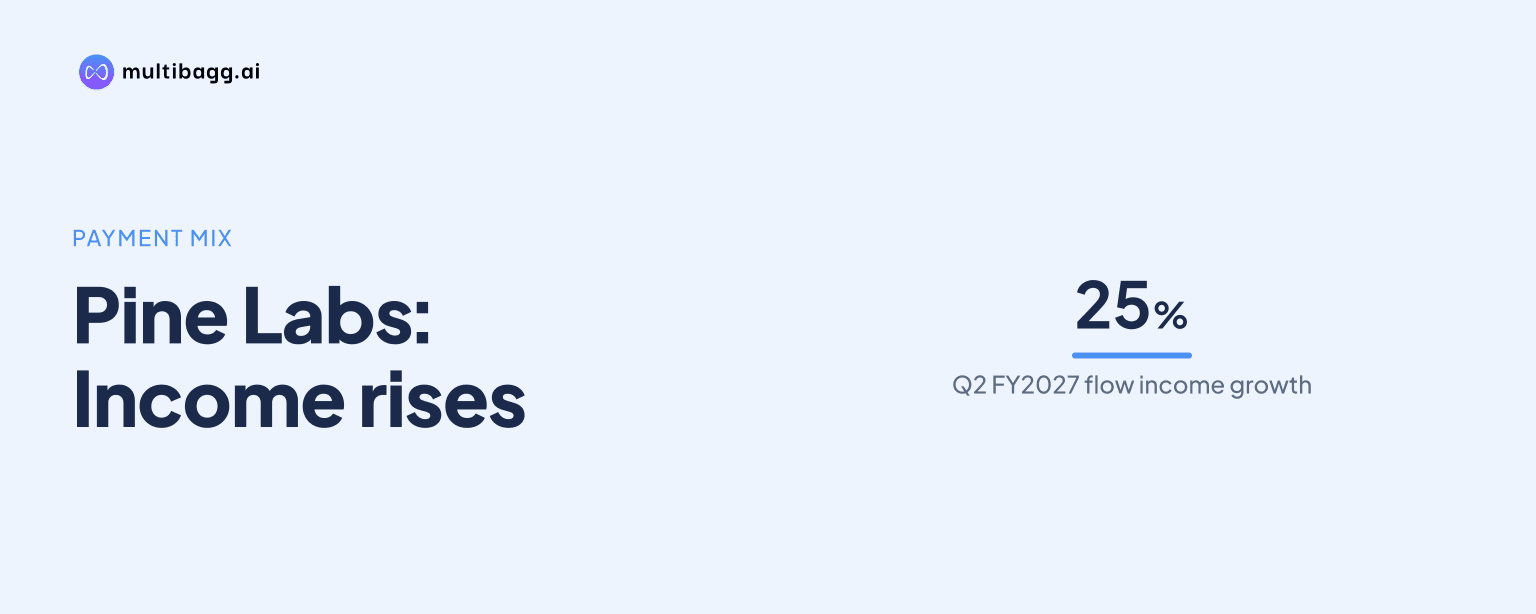
Pine Labs Limited said flow-based income increased 25% year on year in Q2 FY2027 as data-related, marketing-related and merchant-distribution services added transaction-linked revenue alongside affordability offerings. Transaction volumes rose about 50%, supported by management-reported market-share gains in Unified Payments Interface, or UPI, payments.
Know Pine Labs inside out
Results, valuation, peers and who's buying, in one view.
How fast did Pine Labs' flow-based income grow?
Pine Labs' flow-based income grew about 25% year on year in Q2 FY2027, while associated volumes increased about 50%. Management attributed the faster volume increase partly to market-share gains in UPI, but did not provide absolute income, volume or take-rate figures for the flow-based segment. Income therefore did not increase at the same pace as volumes.
Pine Labs reported company-level revenue growth of about 24% and adjusted earnings before interest, tax, depreciation and amortisation, or EBITDA, growth of about 27% year on year in Q2 FY2027. Management said its offline, issuing and online businesses each grew faster than their respective markets, although it did not quantify market growth rates or segment revenue on the call.
What new services are broadening Pine Labs' flow-based revenue?
Pine Labs said flow-based income now includes data-related services, marketing-related services and distribution of marketing-related products, in addition to installment-payment services. Management described these as new revenue streams and said their year-on-year rise was healthy, but did not disclose each service's revenue contribution, pricing or share of the segment.
Pine Labs also linked the new services to its merchant network. In the mid-market, including apparel brands, coffee shops, restaurants, duty-free outlets and airports, it offers value-added services intended to bring consumer footfall to merchants. Management said Pine Labs takes a small transaction-linked fee from these arrangements, connecting merchant distribution to flow-based income rather than solely to point-of-sale, or POS, equipment deployment.
Management's comments show that the revenue base is expanding beyond affordability products, but they do not quantify whether affordability's share of flow-based income has declined. Pine Labs remained focused on expanding affordability and said it expected to move further beyond the electronics segment in Q3 FY2027. The disclosed diversification is an addition of services, not evidence of a measured reduction in affordability revenue.
How is Pine Labs using merchant distribution to support new revenue?
Pine Labs said it deployed close to 100,000 terminals in the mid-market segment on a trailing 12-month basis, providing a wider merchant base for value-added and flow-based services. Management said mid-market merchants increasingly require integration with enterprise resource planning, invoicing and billing systems, and that those technology requirements have helped Pine Labs win new merchant logos.
The enterprise business also supported the distribution footprint in Q2 FY2027. Pine Labs said it retained 100% of its enterprise business and completed deployment across Tanishq stores after previously having no presence there for a long period. Management also said it gained share with another large retailer, without identifying that retailer or giving the terminal count involved.
This merchant strategy differs by segment. Enterprise accounts provide retention and branded distribution, while the mid-market is adding terminals and new logos across several merchant categories. Management said the combined enterprise and mid-market distribution allows Pine Labs to generate flow-based income, although it did not disclose how much originates from either group.
Got a follow-up? Ask IRIS
Which other products could add transaction-linked income?
Pine Labs said it is extending issuing, online payments and bill-payment operations, creating additional use cases around its merchant and distribution platforms. In prepaid and gift cards, management said gaming brands are a newer distribution category, while the Bharat Yatra National Common Mobility Card, or NCMC, programme distributes about 25,000 to 30,000 prepaid cards each month, or nearly 1,000 cards daily.
Management said Blinkit and Zepto are channels for a large share of those NCMC cards, which are used for daily transit. It also said gaming has generated better take rates in the prepaid business, though no rate was disclosed. Separately, Pine Labs planned to launch an employee tax-benefit card by the end of November or in early December, aimed at corporates it already serves.
In online payments, Pine Labs said the top four quick-commerce companies use its payment gateway for daily transactions and that it provides installment-payment services for electronics, mobile phones and consumer durables. Pine Labs was also one of the payment gateways enabled during Flipkart's Big Billion Days, while one of the country's largest consumer billers had signed up and was expected to go live in Q3 FY2027.
What does Pine Labs expect to develop in the second half?
Pine Labs said it intends to increase sales investment in the second half of FY2027 while scaling gaming gift-card distribution, employee tax-benefit cards, data services, marketing services and advertising-related revenue. Management said it had invested heavily in salespeople in the first half and was deploying more salespeople internationally following business wins.
Pine Labs also identified UPI as an emerging opportunity but gave no timetable for UPI merchant discount rate, or MDR, revenue. Management said that decision rests with the National Payments Corporation of India, or NPCI. Internationally, Pine Labs said it was processing 1 lakh transactions a day in the United Arab Emirates, had nearly 1 lakh POS deployments in Malaysia and 50,000 POS machines in the Philippines, across operations in about 22 countries.
Conclusion
Pine Labs' Q2 FY2027 disclosures indicate that its transaction-linked model is being extended through merchant-facing data, marketing and distribution activities as well as installment payments. The nearly 100,000 mid-market terminal deployments over the trailing 12 months, enterprise retention and new merchant wins provide the distribution network through which those services can be offered.
The next disclosed milestones are the employee tax-benefit card planned for late November or early December, the Q3 FY2027 launch of a new consumer biller and a wider affordability push beyond electronics in Q3 FY2027. Management also plans to scale gaming distribution and data, marketing and advertising-related revenues, while the timing of any UPI MDR change remains unresolved with NPCI.