










Pine Labs says Singapore exit had little Q2 EBITDA impact
Key highlights
- Pine Labs said a Singapore retailer exit reduced Q2 FY2027 overseas gift-card distribution revenue without a material EBITDA impact.
- Pine Labs reported about 24% year-on-year revenue growth and about 27% adjusted EBITDA growth in Q2 FY2027.
- Pine Labs said its UAE business began processing 1 lakh transactions a day, while Malaysia approached 1 lakh POS deployments.
- Pine Labs plans to deploy at least 10 lakh more UPI soundboxes and had about 5,200 employees after adding roughly 675 to 680 staff.
powered by IRIS
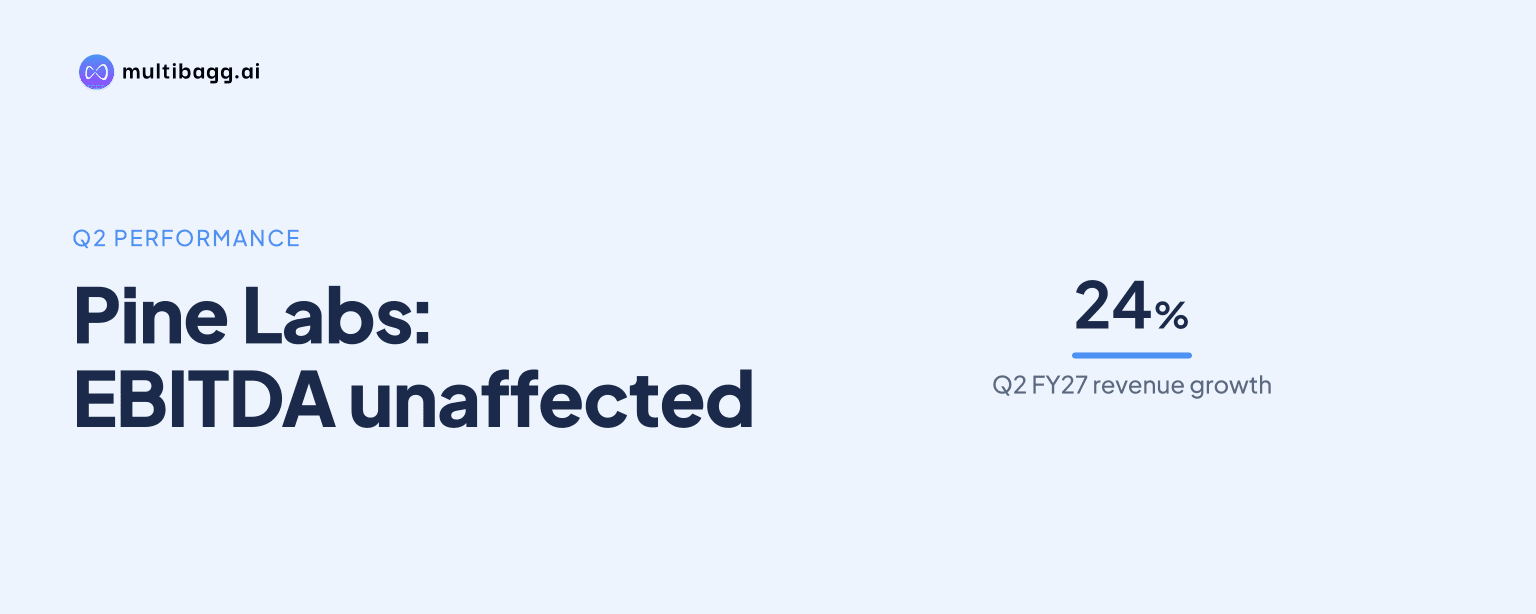
Pine Labs Limited said its Q2 FY2027 overseas revenue slowdown stemmed from a global retailer leaving Singapore, cutting a low-contribution gift-card distribution business without materially affecting EBITDA. Pine Labs said its UAE operations nevertheless reached 1 lakh transactions a day, while Malaysia neared 1 lakh point-of-sale deployments and the Philippines operated 50,000.
Know Pine Labs inside out
Results, valuation, peers and who's buying, in one view.
Why did Pine Labs’ international revenue slow in Q2?
Pine Labs said the Q2 FY2027 slowdown reflected one specific Singapore client change: a large global retailer decided to leave that market, reducing Pine Labs’ distribution of the retailer’s gift cards and prepaid cards. Management did not disclose the revenue lost, but said investors should use Q2 as the base after this merchant-related change rather than infer a wider deterioration in overseas operations.
The effect appeared in a quarter when an analyst said international revenue mix had dipped and estimated quarter-on-quarter international growth at only 2% to 3%. Group Chief Financial Officer Sameer Kamath said the overseas mix should be assessed over the long term because India also has several growing revenue streams, rather than being judged solely from a single quarter’s share of revenue.
Pine Labs distinguished the Singapore activity from its core overseas payments operations. Amrish Rau, chief executive officer, said most other international operations are reported as net revenue or operate at high contribution margins, while Singapore gift-card distribution involved a different accounting policy and was a low-contribution-margin activity. That distinction is central to why a revenue reduction did not translate into a material earnings effect.
Did the Singapore exit affect Pine Labs’ EBITDA?
Pine Labs said the Singapore retailer exit had no material impact on earnings before interest, tax, depreciation and amortisation (EBITDA) in Q2 FY2027 because the discontinued gift-card distribution revenue carried low contribution margins. Management did not quantify either the revenue decline or the EBITDA effect, so the disclosed conclusion is qualitative rather than a calculation of profit saved or lost.
At the group level, Pine Labs reported about 24% year-on-year revenue growth and about 27% year-on-year adjusted EBITDA growth in Q2 FY2027. Those figures cover all business lines, not international operations alone, but they provide the reported context for management’s assertion that the Singapore revenue loss was not material to the EBITDA line.
Management also maintained its view that EBITDA should expand in the second half of FY2027 compared with the first half. Rau tied that expectation to a larger share of flow-based income from payment platforms, while noting that newly hired sales teams typically take about nine months to become productive. This is management’s outlook, not a reported second-half result.
Which overseas Pine Labs operations are still scaling?
Pine Labs said its payments businesses in the United Arab Emirates (UAE), Malaysia and the Philippines continued to scale in Q2 FY2027 despite the Singapore client exit. In the UAE, where Pine Labs has partnerships with Emirates NBD and Wio Bank for offline and online payment technology, the company said it had begun processing 1 lakh transactions a day.
Malaysia remained Pine Labs’ oldest overseas business and, according to Kamath, continued to grow faster than the overall company. The company said it was approaching 1 lakh point-of-sale (POS) terminals in Malaysia, while its platform supported 50,000 POS machines in the Philippines. Pine Labs said it was present in about 22 countries, though it did not provide country-level revenue or profitability figures.
These operating indicators contrast with the Singapore event because they relate to payment-processing and terminal-platform activity rather than gift-card distribution. Pine Labs described UAE, Australia and the Philippines as businesses continuing to scale and grow revenue, whereas the Singapore reduction came from the distribution of an e-commerce retailer’s cards.
Got a follow-up? Ask IRIS
What is Pine Labs investing in after Q2?
Pine Labs said it would continue investing in sales during the second half of FY2027, including in international markets where it has won business. The company had about 5,200 employees after adding roughly 675 to 680 net employees, almost all in sales and field operations supporting incremental deployments, rather than in back-office or technology functions.
The expansion is also linked to the company’s plan to deploy at least 10 lakh more soundboxes for Unified Payments Interface (UPI) acceptance. Rau said a soundbox costs roughly 500 rupees to 600 rupees or less, and described the sales effort needed to sign merchants as more material than the device capital expenditure itself. The company had already hired personnel for this effort.
Pine Labs said 75% to 77% of transactions on its POS machines were UPI transactions, compared with about 25% card transactions. Management said UPI transactions on its devices had compounded at about 68% over the past two years and anticipated another year of around 70% growth, based on organised retailers’ demand for automated reconciliation through device-based UPI acceptance.
How broad is Pine Labs’ growth beyond overseas payments?
Pine Labs said its flow-based income grew about 25% year on year in Q2 FY2027, while the associated volumes grew about 50%. Management attributed the difference partly to market-share gains in UPI and said flow-based revenue now includes dynamic currency conversion, payment aggregation fees, consumer internet-company access fees, data services, marketing services and advertising services, alongside affordability products.
The company also cited domestic scale indicators across its other businesses. It deployed close to 100,000 terminals in the mid-market segment over the trailing 12 months, said it now served all Tanishq stores, and distributed around 25,000 to 30,000 Bharat Yatra National Common Mobility Card prepaid cards a month. That is roughly 1,000 cards a day, mainly through Blinkit and Zepto.
For the second half, Pine Labs identified gaming gift-card distribution, employee tax-benefit cards, data and advertising services, affordability beyond electronics and UPI as areas of focus. Management said the employee tax-benefit card was expected by the end of November or early December, and that a large consumer biller signed in Q2 was expected to go live in Q3.
Conclusion
The disclosed evidence indicates that Pine Labs’ Q2 international revenue softness was concentrated in a Singapore gift-card client exit, rather than a reported retreat from overseas payments. The client’s departure removed low-contribution distribution revenue, while group adjusted EBITDA grew about 27% year on year and operations in the UAE, Malaysia and the Philippines showed transaction or deployment scale.
The next point to watch is whether the payment businesses that Pine Labs said are scaling can sustain growth after the Q2 reset in Singapore. Management’s disclosed markers include UAE daily transactions, Malaysia’s approach to 1 lakh POS deployments, the planned second-half sales investment, the 10 lakh soundbox deployment plan and the expected Q3 launch of a large consumer biller.