










Pine Labs Ltd. targets 21% EBITDA after sales build-out
Key highlights
- Pine Labs added a net 675 to 680 employees and had about 5,200 employees after the hiring.
- Nearly all new staff were in sales and field operations, while technology and back-office hiring was minimal.
- Management said sales hires typically need about nine months to become productive and remunerative.
- Pine Labs expects at least a 21% full-year EBITDA margin and higher second-half EBITDA than in the first half.
powered by IRIS
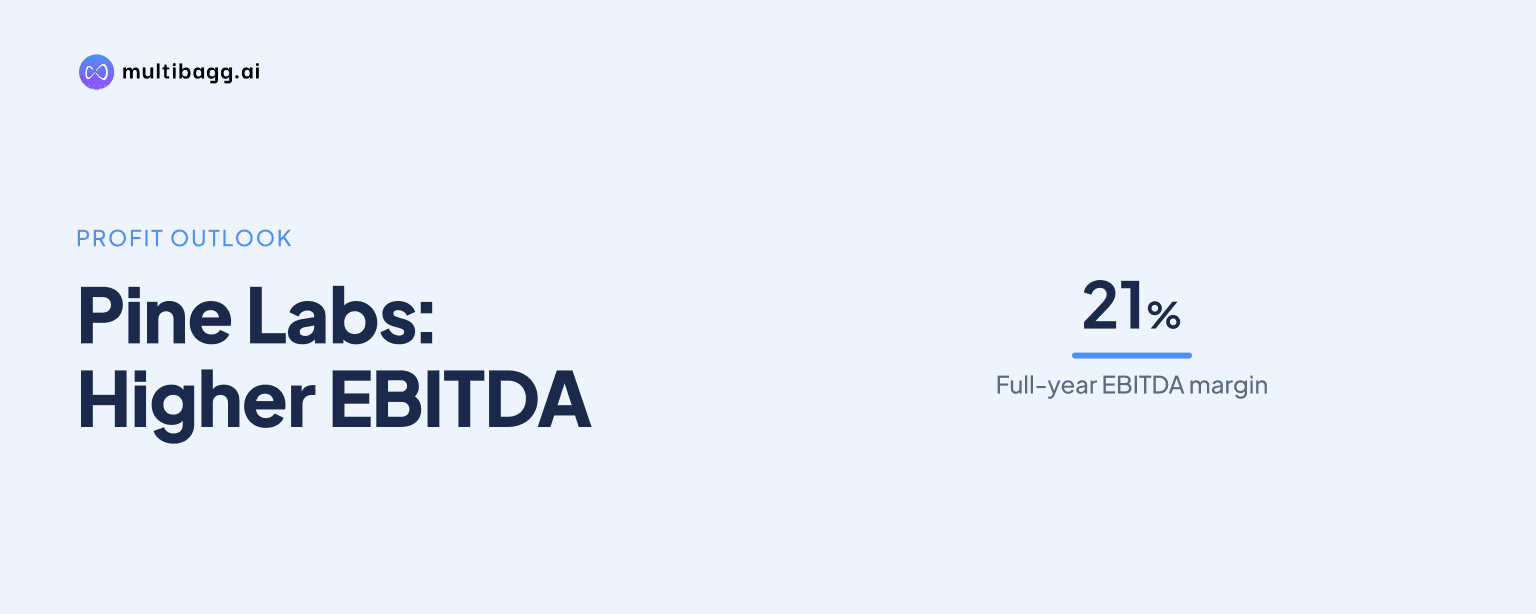
Pine Labs Ltd. added a net 675 to 680 employees, almost entirely in sales and field operations, and management expects the investment to become productive in about nine months, supporting at least a 21% full-year earnings before interest, tax, depreciation and amortisation (EBITDA) margin. Pine Labs had about 5,200 employees after the hiring.
Know Pine Labs inside out
Results, valuation, peers and who's buying, in one view.
Why did Pine Labs add nearly 680 employees?
Pine Labs added the employees to increase merchant coverage, payment deployments and field execution rather than to expand its technology or back-office teams. Sameer Kamath said the company had about 5,200 employees after a net addition of about 675 to 680 people, with nearly all additions in sales and some in field operations supporting incremental installations. Hiring in back-office and technology roles was minimal by comparison.
The recruitment covers post-sales, the issuing business, online sales and global markets. Management linked the staffing increase to the opportunity to capture more Unified Payments Interface (UPI) transactions at merchant locations and to expand in the mid-market segment, which it said was growing at about 39% to 40%. The company did not provide a future employee-count target or a forecast for its wage bill.
Pine Labs also connected the field build-out to its plan to deploy 10 lakh additional soundboxes. The programme is directed at existing merchant locations where the company may already have point-of-sale (POS) machines but does not capture every UPI payment. Management said the sales effort required to sign merchants and install devices was more material than soundbox hardware expenditure, with individual soundboxes costing about Rs 500 to Rs 600 or less.
How long will Pine Labs' hiring affect EBITDA?
Pine Labs expects the enlarged sales force to take about nine months to become productive and remunerative. Chief Executive Officer Amrish Rau said sales staff generally do not recover their salary and related costs in that initial period, making the hiring cycle a near-term cost before the company expects additional merchant activity to produce revenue.
Management therefore expects second-half EBITDA to be at a much higher level than the first half. An analyst on the call said the first-half EBITDA margin was about 18%, compared with 21% in the prior year. Rau said Pine Labs was not reducing its full-year expectation and expected to deliver at least a 21% EBITDA margin for the year.
Rau attributed the expected improvement to the operating model of payment processing and to higher flow-based income. Pine Labs records dynamic currency conversion, aggregation fees, consumer-internet transaction services, data services, marketing, advertising and affordability products in that revenue category. Management said these services together drove more than 25% year-on-year growth in flow-based revenue.
The margin outcome remains management's forward-looking assessment rather than a reported result. It depends on new sales and field staff turning merchant outreach, device installations and transaction capture into revenue during the stated nine-month ramp. Pine Labs did not quantify how much revenue or EBITDA the 675 to 680 additional employees must generate to meet the 21% objective.
Got a follow-up? Ask IRIS
What is increasing Pine Labs' operating costs?
Pine Labs said indirect costs include cloud infrastructure, data costs, outsourced field employees and market-development spending. Management said cloud and data costs have historically been about 8.5% to 9% of top line, including cloud infrastructure, and should remain variable at about 8% to 9% despite efforts to modernise systems and use artificial intelligence.
Other indirect expenses include outsourced employees for ground-level execution, large oil marketing company contracts, expansion beyond consumer durables and information technology (CDIT) categories, and off-roll and on-roll sales recruitment. An analyst cited indirect costs of about Rs 425 crore to Rs 426 crore. Management did not identify that amount as a new normal run rate, saying instead that these costs support new geographies, opportunities and merchant-level presence.
Quarterly comparisons are also affected by the timing of the GFF sponsorship. Pine Labs said it was a large sponsor of GFF, which occurred in the third quarter of the prior year but in the second quarter of the current year. Management described the event as a product-showcasing expense that can move between quarters and said it supports monetisation opportunities from displayed capabilities.
First-half capital expenditure was also influenced by supply timing and advance-payment terms. Management said about Rs 35 crore to Rs 40 crore of procurement shifted from the fourth quarter into the first quarter because of chip-related delays. A further Rs 20 crore to Rs 25 crore of advances were included in capital expenditure as vendors sought about 80% payment upfront, compared with 20% previously, before procurement occurred.
How do soundboxes support Pine Labs' sales plan?
Pine Labs said its planned 10 lakh soundboxes are intended to capture UPI payments at existing merchants rather than to target a new lower-end merchant base. Management gave an example of a merchant where a Pine Labs POS machine processes 80% to 85% of payments while another provider's soundbox receives a further 10% to 20% of transactions. The company had previously accepted those missed transactions when UPI was not monetisable.
Management now wants to capture that payment share by placing soundboxes at the same merchant sites. It said a customer in a busy store may choose a QR-code payment on a soundbox if it is quicker than using a fully integrated checkout flow. At merchants in grocery and large-format retail, Pine Labs said UPI accounts for more than 50% of transactions on its terminals at a minimum.
The company does not view soundbox hardware as the main capital-expenditure issue. Rau said 10 lakh devices were not material from a capital-expenditure perspective because individual units cost about Rs 500 to Rs 600 or less. The material investment is the sales and field capacity needed to secure merchant acceptance, complete installation and support subsequent payment volumes.
The programme sits alongside normal deployment of full-service POS machines. Pine Labs said full-service-machine expansion was already part of its existing plan and would continue as before. The additional 10 lakh deployment specifically targets locations where the company believes UPI transactions are currently being processed through another soundbox or payment interface.
Conclusion
Pine Labs is accepting higher sales and field costs after adding about 675 to 680 people to a workforce of roughly 5,200. Management's case is that the cost effect is temporary because new sales employees need about nine months to become productive, while greater merchant coverage, soundbox placement and flow-based revenue should lift second-half EBITDA.
The key item to watch is whether the expanded team converts the planned 10 lakh soundbox deployment and broader merchant coverage into transactions during that nine-month period. Management has retained its expectation of at least a 21% full-year EBITDA margin and said second-half EBITDA should be much higher than the first half, while providing no future headcount or wage-bill target.