










Platinum Industries Limited sees CPVC dosage drive volumes
Key highlights
- India’s CPVC additives market was approximately 160,000 TPA in FY2023, with about 7-8% CAGR expected.
- CPVC requires about 25% stabiliser dosage versus 3-3.5% for PVC, according to Platinum.
- Platinum reports about 13% market share and describes itself as the third-largest player.
- Calcium-based stabilisers increased to 34% of the cited market in 2023 from 8% in 2016.
powered by IRIS
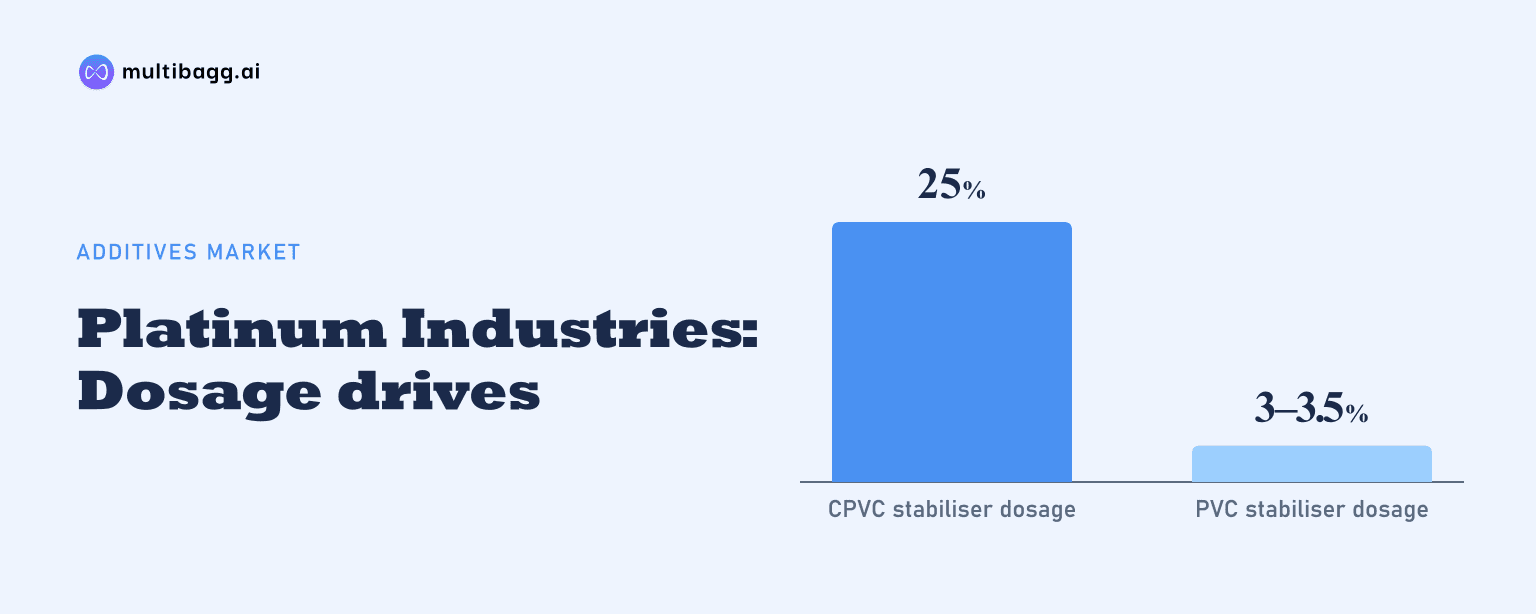
In FY2023, Platinum Industries Limited identified a 160,000-tonnes-per-annum (TPA) Indian CPVC additives market in which stabiliser dosage is about 25%, versus 3-3.5% for PVC, making CPVC a higher additive-volume opportunity as plumbing use and infrastructure demand expand.
Know Platinum Industries inside out
Results, valuation, peers and who's buying, in one view.
How large is India’s CPVC additives market?
India’s CPVC additives market was approximately 160,000 TPA in FY2023, and Platinum expects it to grow at about 7-8% compound annual growth rate (CAGR). Platinum attributes the outlook to rising CPVC penetration in plumbing, infrastructure-led demand and incremental domestic capacity additions that are improving supply dynamics.
The CPVC estimate was 40,000 TPA larger than the approximately 120,000-TPA PVC additives market that Platinum cited for 2023. CPVC’s stated growth range of about 7-8% CAGR is, however, at or below the 8% CAGR cited for PVC additives, whose drivers include infrastructure, urbanisation and a shift to lead-free stabilisers under NJT norms.
The presentation uses 2023 for PVC and FY2023 for CPVC, so the periods are labelled differently. On the disclosed figures, CPVC was about 33% larger than PVC additives, based on the 40,000-TPA difference, while PVC had the more specific 8% growth rate.
Why does CPVC require more stabiliser than PVC?
CPVC requires about 25% stabiliser dosage, compared with 3-3.5% in PVC, according to Platinum. That dosage difference is the volume mechanism behind Platinum’s CPVC opportunity: a given quantity of CPVC requires substantially more stabiliser than PVC.
The disclosed dosage gap is 21.5 to 22 percentage points. At 25%, CPVC dosage is about 7.1 times the 3.5% PVC dosage at the upper end of the PVC range and about 8.3 times the 3% dosage at its lower end; these are calculations from Platinum’s stated dosage rates, not forecasts of sales.
Platinum links CPVC demand to heat-resistant plumbing applications, including geysers and taps. It also says CPVC formulations have processing complexity and that few competitors succeed in India, but it does not provide a separate forecast for CPVC resin consumption, plumbing demand or its own CPVC additive volume.
The 160,000-TPA market figure therefore does not stand alone in Platinum’s argument. The company’s case rests on CPVC’s higher material intensity, under which growing heat-resistant plumbing applications could create a larger stabiliser-volume requirement than equivalent growth in conventional PVC applications.
Got a follow-up? Ask IRIS
How is India’s stabiliser mix changing?
India’s stabiliser mix moved toward calcium-based products between 2016 and 2023, with calcium’s share rising to 34% from 8% and lead’s share falling to 51% from 76%, according to Platinum. The cited stabiliser market increased to 200 kilotonnes (KT) from 100 KT over the same period.
PVC consumption in the presentation rose to 4.2 million metric tonnes per annum (MMTA) in 2023 from 2.9 MMTA in 2016, alongside the 100-KT rise in stabiliser demand. Pb denotes lead, Ca denotes calcium, and LMM is the label used in the presentation.
Platinum presents the 2016-2023 mix shift as part of a transition to sustainable stabilisers. Its strategy includes lead-free and eco-friendly additives for construction, automotive and consumer-goods uses, while the company says it invests about 1% of revenue in research and development.
Platinum says its calcium-organic stabilisers can reduce toxic emissions by up to 60%, citing an Environmental Protection Agency figure. The presentation does not quantify the revenue, volume or margin contribution of calcium-organic products or CPVC additives within its overall business.
What is Platinum’s position in CPVC additives?
Platinum reports about 13% market share and describes itself as the third-largest player, while pursuing volume-led growth in CPVC, which it calls a high-margin segment. The presentation does not define whether the 13% figure applies only to CPVC, to PVC and CPVC combined, or to another additives market category.
Platinum’s standalone revenue rose 33.7% to Rs 434.36 crore in FY26 from Rs 324.89 crore in FY25. Standalone earnings before interest, tax, depreciation and amortisation (EBITDA) increased 10.0% to Rs 60.23 crore, while profit after tax increased 9.6% to Rs 53.53 crore.
Revenue grew faster than EBITDA and profit after tax in FY26. Standalone EBITDA margin declined to 13.9% from 16.9%, while profit-after-tax margin declined to 12.3% from 15.0%; these are results for the overall standalone business rather than a CPVC-specific segment.
Platinum says it serves more than 30 countries and plans to optimise production processes, expand capacity, strengthen client relationships and increase presence in high-growth regions. It provides no dated CPVC capacity target, capital-expenditure figure, commissioning schedule or market-share target to quantify conversion of the 160,000-TPA domestic opportunity into sales.
Conclusion
Platinum’s CPVC opportunity combines a FY2023 market estimate of 160,000 TPA with dosage of about 25%, compared with 3-3.5% for PVC. The company presents that intensity difference, together with plumbing and infrastructure demand, as the basis for greater additive-volume contribution from CPVC applications.
What to watch next is Platinum’s stated volume-led CPVC growth, capacity-expansion activity and lead-free product development. The company reports about 13% market share but has not disclosed a CPVC-specific capacity plan, sales target or timetable, leaving future disclosures to show whether its position changes.