










Platinum Industries targets Q4 FY27 Egypt plant export platform
Key highlights
- Platinum Industries targets Q4 FY27 for full operation of its 60,000-MTPA Egypt facility.
- Platinum Industries estimates about Rs 300 crore of Egypt-project revenue over three years after launch.
- Exports accounted for about 20% of Platinum Industries' H1 FY27 revenue.
- Egypt's identified domestic market is 25,000 tons and is described as import-dependent.
powered by IRIS
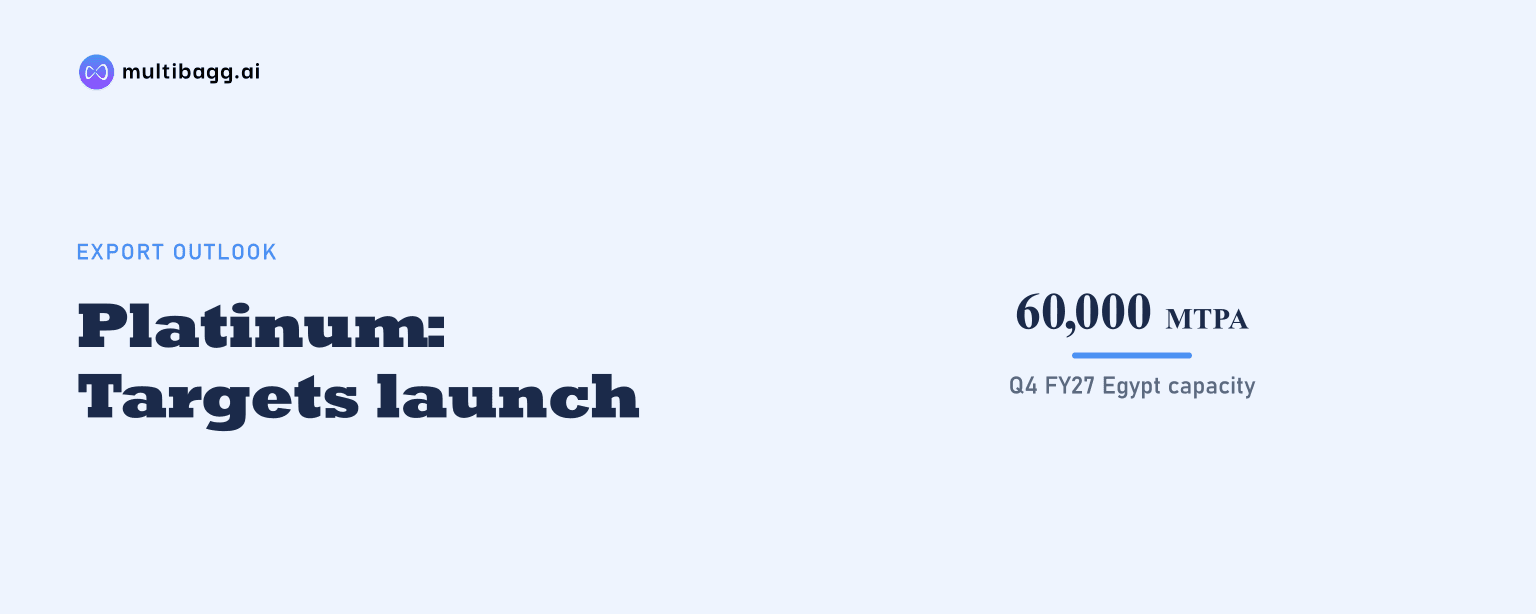
Platinum Industries Limited targets full operation of its 60,000-metric-tonnes-per-annum Egypt plant in Q4 FY27, positioning it as an export platform for PVC and CPVC stabilizers. Platinum Industries estimates the facility could generate about Rs 300 crore of revenue across the three years after launch, using trade access and proximity to overseas markets.
Know Platinum Industries inside out
Results, valuation, peers and who's buying, in one view.
When will Platinum Industries' Egypt plant open?
Platinum Industries expects its Egypt greenfield manufacturing facility to be fully operational in Q4 FY27 with capacity of 60,000 metric tonnes per annum, or MTPA. The project is included in the company’s FY26 to FY29 plan, which targets a 35% compound annual growth rate, or CAGR.
Egypt is a planned capacity addition rather than a reported operating asset. By comparison, Platinum Industries says its new Pathalgaon facility became fully operational on 21 May 2026, making the Egypt site the next disclosed manufacturing milestone in its expansion plan.
The presentation does not disclose a construction cost, phased commissioning plan, or production-volume target before the Q4 FY27 operational date. It also does not state whether output will begin before the plant is described as fully operational.
The planned 60,000-MTPA capacity exceeds the 25,000-ton import-dependent Egyptian market identified by Platinum Industries. This comparison indicates that the facility is intended to serve export demand as well as local Egyptian customers, consistent with the company’s export-platform rationale.
How will Platinum Industries use Egypt as an export hub?
Platinum Industries intends to use Egypt to supply the Middle East, North Africa, South America, Europe, the United States and Africa with PVC and CPVC stabilizers. The company cites a Free Trade Agreement, or FTA, with several South American countries and Qualified Industrial Zones, or QIZ, status that it says enables duty-free and seamless exports to the United States.
The location is intended to change the logistics route for overseas sales. Platinum Industries says proximity to target markets should reduce freight costs compared with shipments from India, while low fuel costs, government incentives and proximity to the Suez Canal support its stated location case.
Those benefits are presented as commercial mechanisms, not quantified financial savings. The presentation provides no freight-cost comparison, duty-rate estimate, government-incentive value or projected margin change from producing in Egypt rather than shipping from India.
Platinum Industries assigns separate markets to each of its regional hubs. India is positioned to serve India, Eastern Europe and Southeast Asia, while Egypt is positioned for the Middle East, North Africa and South America; a planned Europe/USA expansion is intended to provide access to Western Europe, the United States and Japan.
The Egypt project therefore sits within a broader multi-hub structure rather than replacing the India hub. The company says the regional model is designed to address different regulatory environments and market requirements, although it gives no timetable or capacity target for the planned Europe/USA expansion.
What will Platinum Industries make and sell from Egypt?
Platinum Industries plans to produce PVC and CPVC stabilizers from the Egypt facility. PVC means polyvinyl chloride, while CPVC means chlorinated polyvinyl chloride, and the project is aimed at Egypt’s 25,000-ton import-dependent market as well as export markets.
The company estimates the relevant global market at about 1.5 million tonnes and says it is growing at a 5% to 6% CAGR. Platinum Industries links this growth outlook to rising demand for lead-free solutions in emerging regions, but does not provide a country-by-country demand forecast.
Its wider portfolio includes lead additives and stabilizers, calcium-zinc and calcium-organic additives, Hybrid low-lead additives, Highstab lead-free stabilizers, CPVC compounds, metal soaps and lubricants. The Egypt project, however, specifically identifies PVC and CPVC stabilizers rather than the full product portfolio.
Platinum Industries supplies sectors including PVC pipes, fittings, profiles, electrical wires, SPC floor tiles, roofing and packaging. The company does not disclose the product mix, customer contracts, regulatory approvals or committed export volumes for the Egypt plant.
The stated capacity-market comparison also leaves the allocation of output unresolved. Platinum Industries has not specified how much of the 60,000-MTPA capacity it expects to sell within Egypt versus the Middle East and North Africa, Europe, the United States, Africa or South America.
Got a follow-up? Ask IRIS
What revenue could Platinum Industries earn from Egypt?
Platinum Industries estimates revenue potential of about Rs 300 crore over the three years after the Egypt facility launches. This is a company project estimate rather than reported revenue, and its outcome depends on the Q4 FY27 operational target, ramp-up, customer demand and access to the identified export markets.
Exports accounted for about 20% of Platinum Industries’ H1 FY27 revenue. The company says exports are expected to accelerate through the Egypt project’s cost and proximity advantages, but it does not disclose the H1 FY27 revenue base, the rupee value of exports or an export-revenue target for FY28 or FY29.
As a result, the proportion of company revenue represented by the stated Rs 300 crore potential cannot be calculated from the presentation. Nor does the source provide an annual split of that three-year estimate, utilisation assumptions or a projected selling price for the stabilizer products.
Platinum Industries already serves more than 30 countries from its ISO 9001:2015-certified Palghar facility in Maharashtra. Egypt would add an overseas production location to that existing international footprint, rather than marking the company’s first engagement with overseas markets.
The company describes itself as India’s third-largest PVC additives player with about 13% market share. Its Egypt strategy is therefore based on adding manufacturing proximity and trade access to an existing additives business, while the source does not disclose an expected Egyptian market-share outcome.
How does Egypt fit Platinum Industries' FY26-FY29 plan?
Platinum Industries places the Egypt plant within a four-part FY26-FY29 strategy targeting 35% CAGR. The other disclosed levers are higher utilisation and efficiency at Pathalgaon, deeper penetration in existing geographies with current and new products, and the launch and scaling of new product lines.
The sequence disclosed by Platinum Industries begins with Pathalgaon, which was fully operational on 21 May 2026, followed by the targeted Q4 FY27 opening of Egypt. This combines domestic operating scale with an overseas manufacturing platform, though the source does not quantify Pathalgaon capacity or utilisation targets.
The company also describes an ambition to become a leading global specialty chemicals player by 2030. That is an ambition rather than a measurable forecast because the presentation provides no 2030 revenue, capacity, market-share or profitability target.
Platinum Industries says it is pursuing technical partnerships involving eco-friendly stabilizers and additives, while highlighting lead-free and organo-tin solutions. This product direction corresponds with the Egypt presentation’s reference to rising lead-free demand in emerging regions, but no customer adoption data is disclosed.
Conclusion
Platinum Industries’ Egypt project is designed as a 60,000-MTPA export-oriented addition with a stated Q4 FY27 full-operation target, rather than a facility serving only Egypt’s 25,000-ton import-dependent market. The company’s estimated Rs 300 crore revenue potential over three years relies on PVC and CPVC stabilizer sales supported by location, freight and trade-access mechanisms.
The next disclosed milestone is whether Platinum Industries meets the Q4 FY27 full-operation target and subsequently reports plant ramp-up. Investors can also watch whether exports rise from their approximately 20% share of H1 FY27 revenue, whether Pathalgaon utilisation improves after 21 May 2026, and whether the company adds quantified sales, utilisation or cost measures to its FY26-FY29 35% CAGR plan.