










Platinum Industries Limited Q2 margin falls to 8.9% on freight
Key highlights
- Platinum Industries’ consolidated Q2 FY27 revenue rose 23.3% to Rs 121.3 crore, while EBITDA margin declined to 8.9% from 13.8%.
- Export shipping cost was Rs 5 crore on Rs 24 crore of Q2 FY27 exports, compared with about Rs 2.5 crore on Rs 22 crore of Q1 FY27 exports.
- Platinum Industries’ expanded Palghar facility was operating at about 30% to 35% utilisation during the Q2 FY27 call.
- Management expects partial Egypt production by December 31, 2026 and estimates Rs 25 crore to Rs 30 crore of FY27 revenue from the facility.
powered by IRIS
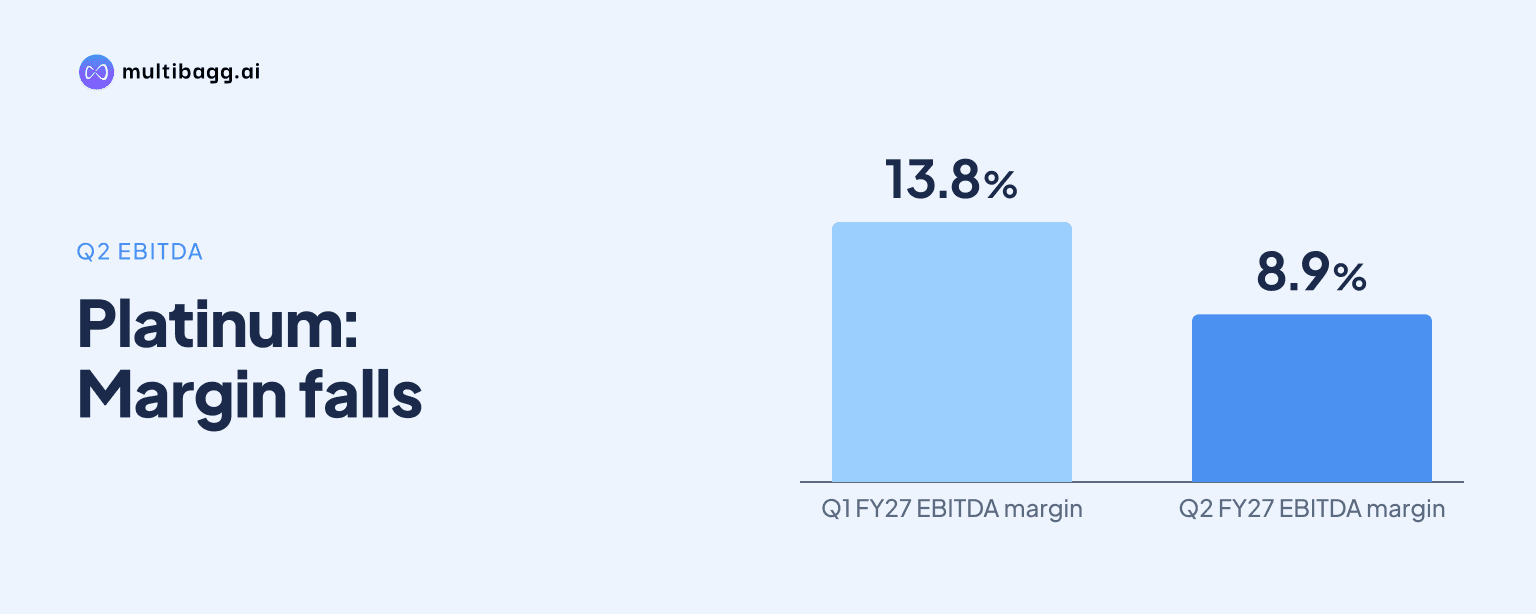
Platinum Industries Limited reported a consolidated earnings before interest, tax, depreciation and amortisation (EBITDA) margin of 8.9% in Q2 FY27, down from 13.8% a year earlier, after export shipping cost reached Rs 5 crore on Rs 24 crore of exports; consolidated revenue nevertheless rose 23.3% to Rs 121.3 crore.
Know Platinum Industries inside out
Results, valuation, peers and who's buying, in one view.
Why did Platinum Industries’ Q2 margin fall?
Platinum Industries said the principal reason for the Q2 FY27 margin decline was a doubling of export logistics cost between Q1 and Q2 while export revenue rose only modestly. Export revenue was about Rs 22 crore in Q1 FY27, with logistics cost of about Rs 2.5 crore, compared with Rs 24 crore of exports and Rs 5 crore of shipping cost in Q2 FY27. On those disclosed figures, freight increased by about Rs 2.5 crore for an additional Rs 2 crore of export revenue.
The quarterly financial result reflected that cost pressure. Consolidated EBITDA declined to Rs 10.8 crore in Q2 FY27 from Rs 13.6 crore in Q2 FY26, even as revenue from operations increased to Rs 121.3 crore from Rs 98.4 crore. Profit before tax fell to Rs 10.5 crore from Rs 14.8 crore, and profit after tax declined to Rs 7.6 crore from Rs 11 crore.
At the November 5, 2026 call, management said it had no indication that shipping rates had already started declining. The chairman said freight costs were not at appropriate levels and could come down, but Platinum Industries was not assuming a reduction over the next three to four months. Management nevertheless said it expected to cover the effect over the next two quarters.
Did Platinum Industries’ revenue growth translate into higher profit?
No, Platinum Industries’ Q2 FY27 revenue growth did not translate into higher profit because EBITDA fell by Rs 2.8 crore despite the 23.3% increase in consolidated revenue. Management also said Q2 exports were 40% higher than in Q2 of the prior fiscal year, but the Rs 5 crore shipping charge reduced the contribution from that export activity. The result shows that higher sales did not offset logistics cost, product mix and facility-ramp-up effects in the quarter.
The first-half result showed the same divergence between revenue and operating profit. Consolidated revenue from operations increased 7.7% to Rs 230.20 crore in H1 FY27 from Rs 213.8 crore in H1 FY26, while EBITDA declined to Rs 24.3 crore from Rs 28.7 crore. Management reported an H1 FY27 EBITDA margin of 10.5% and cited 13.4% as the comparison margin, although the transcript labels that percentage as Q2 FY26.
H1 FY27 profit before tax was Rs 25.5 crore against Rs 32.60 crore in the corresponding prior period, while profit after tax was Rs 18.7 crore against Rs 24.1 crore. Basic and diluted earnings per share were Rs 3.43 for H1 FY27. In Q2 FY27, basic and diluted earnings per share were Rs 1.40, compared with reported consolidated profit after tax of Rs 7.6 crore.
Standalone numbers followed a similar pattern. Q2 FY27 standalone revenue rose 23.9% to Rs 120 crore from Rs 96.9 crore, but EBITDA fell to Rs 10.5 crore from Rs 14.2 crore and the margin reduced to 8.8% from 14.6%. Management linked the wider profitability volatility in H1 FY27 to elevated ocean freight, lower high-margin product mix and the ramp-up of expanded manufacturing capacity.
Got a follow-up? Ask IRIS
How did product mix and Palghar utilisation affect profitability?
Platinum Industries said a temporarily lower share of high-margin lead-free polyvinyl chloride (PVC) stabilisers affected profitability alongside freight costs. Management said there was no major product-level margin decline overall, but said chlorinated polyvinyl chloride (CPVC) margins had declined by 1% to 2% quarter on quarter. It also cited a 3% to 4% reduction in lead-free stabiliser margins in H1 FY27, without specifying the comparison period in the response.
The expanded Palghar facility was operating at about 30% to 35% utilisation during the Q2 FY27 discussion. Management said margin expansion would follow higher utilisation, process optimisation and operating leverage as production scales. The chief financial officer also said Platinum Industries remained debt-free when asked about increased depreciation and finance costs.
Management set out a longer ramp-up timeline rather than a near-term utilisation target. The chairman described current utilisation as about 30% and said Platinum Industries aimed to cross about 50% over the next two years as it added customers and increased sales. That timetable makes customer additions, production loading and the share of lead-free PVC stabilisers relevant to the company’s stated 13% to 15% annual EBITDA-margin projection.
Can the Egypt plant change Platinum Industries’ freight exposure?
Platinum Industries expects the Egypt plant to change the origin of many export sales, but management does not expect an immediate removal of freight exposure in FY27. The facility’s planned capacity was increased from 30,000 metric tonnes per annum to 60,000 metric tonnes per annum. Management expects partial capacity to start by December 31, 2026 and the remaining capacity to be commissioned or commenced by March 31, 2027.
Management estimated Egypt revenue of Rs 25 crore to Rs 30 crore in FY27, based on sales from roughly January through mid-March. It said lead stabiliser production would be commissioned first, with other products to follow. The facility had earlier been expected to start partial operations in September or October 2026, and management estimated that the delay had deferred Rs 30 crore to Rs 35 crore of sales over three to four months.
Once Egypt begins operations, management said India would mainly export to East Africa, Bangladesh and neighbouring countries, while other export markets would be served from Egypt. Management expects the Egypt unit to contribute meaningfully from FY28 and to strengthen the export mix and long-term margin profile. These are management expectations, not reported FY27 results, and depend on the December 2026 and March 2027 commissioning schedule.
Platinum Industries did not provide short-term FY27 revenue guidance. Instead, management reiterated its objective of about 35% compound annual growth rate over three years. The company also said domestic sales had begun increasing from October 2026 after weakness in the PVC pipe industry from April through September, when management cited an 18% to 20% sales decline at some industry participants.
Conclusion
Platinum Industries’ Q2 FY27 outcome shows that revenue growth alone did not protect profitability: consolidated revenue increased 23.3% to Rs 121.3 crore, but EBITDA declined to Rs 10.8 crore and the margin fell to 8.9%. Management attributed the movement primarily to Rs 5 crore of shipping cost on Rs 24 crore of exports, supplemented by lower lead-free PVC stabiliser mix and low utilisation at Palghar.
The next disclosed markers are partial Egypt production by December 31, 2026, remaining Egypt capacity by March 31, 2027, and Palghar utilisation moving from about 30% to a target of more than 50% over two years. Management’s stated 13% to 15% EBITDA-margin projection and three-year 35% compound annual growth objective depend on those execution steps, product mix and the future course of shipping costs.