










Polycab India F&O Exit: Key Dates and Market Impact
Key highlights
- NSE will remove Polycab India from the equity derivatives segment on December 30, 2026, while cash-market trading will continue.
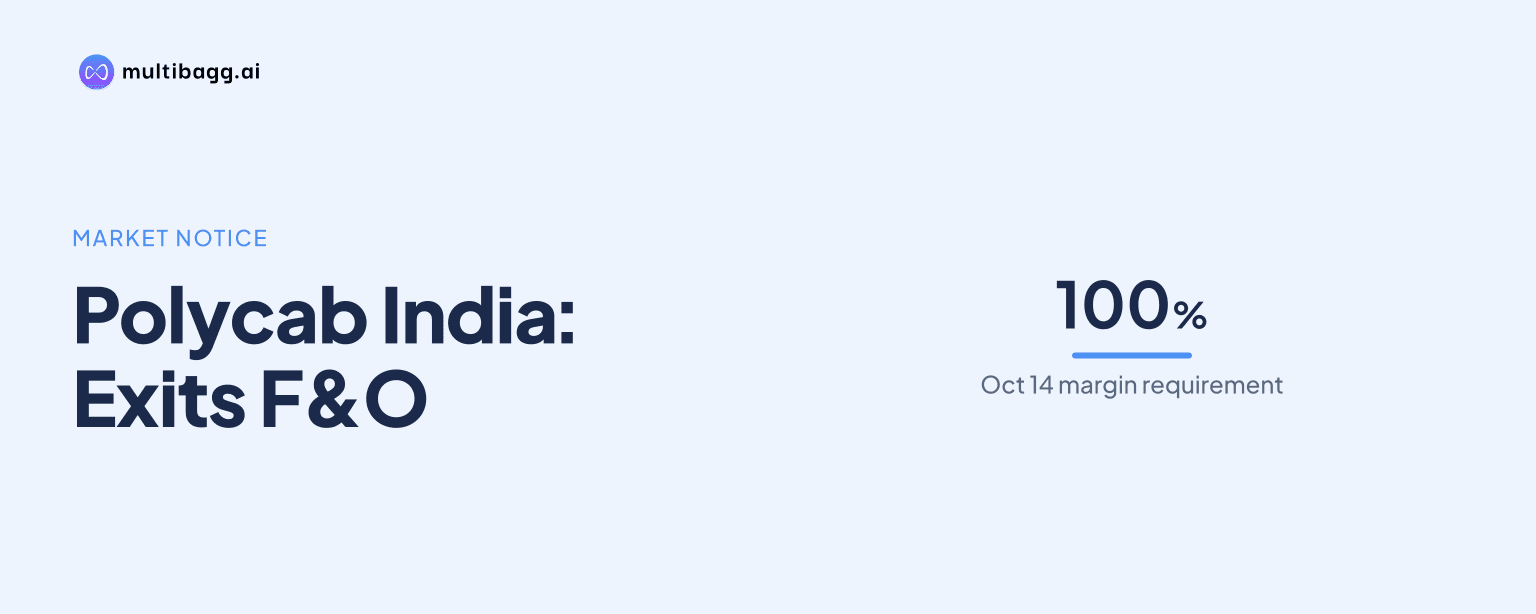
- NSE has imposed a 100% margin requirement on existing derivative positions and new positions created from October 14, 2026.
- The insolvency dispute involves a Rs 2.79 crore operational debt claim, compared with Polycab’s annual revenue of around Rs 29,100 crore.
- Polycab shares fell more than 5% to an intraday low of Rs 7,995 on October 13 after the exchange notification.
powered by IRIS
Insolvency dispute triggers market action
Know Polycab India inside out
Results, valuation, peers and who's buying, in one view.
Polycab India Ltd is set to exit the National Stock Exchange's equity derivatives segment from December 30, 2026, following its placement under the Insolvency and Bankruptcy Code framework. The exchange action follows an insolvency petition admitted by the Ahmedabad bench of the National Company Law Tribunal on October 7. The case relates to disputed invoices for ingot supplies raised by operational creditor Asier Metals. The operational debt cited in the matter is Rs 2.79 crore. Polycab is a major manufacturer of wires and cables, with annual revenue of around Rs 29,100 crore and a market capitalisation exceeding Rs 1.1 lakh crore. The difference between the disputed amount and the company's scale has brought attention to the market implications of the insolvency classification. The insolvency admission was subsequently stayed by the National Company Law Appellate Tribunal, but the derivatives restriction remains in force.
NCLAT stays the NCLT admission order
The NCLAT stayed the NCLT order admitting the insolvency proceedings on October 9, subject to Polycab depositing the disputed amount. The appellate tribunal also granted a request for early listing of the appeal, which is scheduled for October 15, 2026. A stay provides interim relief against the insolvency admission order. However, it does not automatically reverse separate exchange actions taken under their surveillance and derivatives rules. This distinction has become central to the Polycab case. The company remains under the exchanges' insolvency surveillance framework despite the appellate relief. Its trading classification is IRP Stage 0, under which normal trading continues and fresh retail buying is not blocked by brokers. The status nevertheless has consequences for derivatives eligibility and may be relevant to index methodology reviews.
NSE sets December 30 derivatives exit
NSE said Polycab will be removed from the equity derivatives segment from December 30, 2026. No new futures and options expiry months will be introduced after the October 2026 contracts expire. Existing contracts expiring in October, November and December will continue to trade until their respective expiry dates. NSE may introduce new strike prices within these remaining contract months. Trading in Polycab futures and options will cease after the final existing contracts expire. The action does not remove Polycab's equity shares from the cash market. Investors will continue to be able to buy and sell the company's shares under applicable exchange rules. The decision specifically affects futures and options trading rather than the listed equity itself.
Margin requirement rises for open positions
NSE also announced a 100% margin requirement for existing derivative positions. The requirement applies on a T+2-day basis and to new positions created from October 14, 2026. Higher margins increase the funds required to maintain derivative positions. This can reduce the leverage normally available to futures and options traders. The measure applies while the outstanding October, November and December contract series remain tradable. It is part of the exchange's handling of the stock after its IBC framework classification. Traders holding positions must account for the increased margin obligation before the contracts reach expiry. The change adds an immediate trading consideration ahead of the scheduled segment exit.
Share price reacts to exchange circular
Polycab India shares fell more than 5% to an intraday low of Rs 7,995 on NSE on October 13 after the exchange notification. The decline followed the announcement that the stock would leave the F&O segment from December 30. The market reaction came despite the NCLAT stay on the underlying insolvency admission. This showed that the exchange decision had not been reversed by the appellate order. Derivatives exclusion can affect trading strategies that use futures and options for hedging, arbitrage or short-term positioning. It can also alter the stock's trading ecosystem because no fresh contract months will be introduced after October. The reported share-price movement reflects the immediate response to the operational impact of the exchange circular.
Got a follow-up? Ask IRIS
Key dates and factual details
MSCI eligibility remains a market focus
Market participants have also focused on Polycab's possible eligibility under global index methodologies. According to the cited MSCI India Board policy, securities under the ESM and IRP frameworks on BSE and NSE are excluded from the MSCI Equity Universe. A security deleted under this process cannot be added back to MSCI Global Investible Market Indices for 12 months. Any removal, however, depends on the index provider's specific rules, classification and review process. It does not follow automatically from every insolvency admission. Motilal Oswal has said Polycab would likely be removed from the MSCI index because of the policy covering stocks under insolvency procedures. Quant Analysts estimated that a deletion could trigger selling of $400 million to $500 million in Polycab shares, though that estimate depends on an actual index decision.
Why the scale of the claim matters
The case has drawn scrutiny because the disputed Rs 2.79 crore claim is small relative to Polycab's reported annual revenue of around Rs 29,100 crore. But IBC-related market rules are driven by a company's regulatory classification, rather than a comparison between the claim amount and revenue. Once the NCLT admitted the petition, the company came under the relevant insolvency surveillance process. The NCLAT's stay addresses the judicial proceeding at the interim stage. The NSE decision on derivatives is a separate market-structure consequence of the classification. This sequence explains why Polycab can have normal cash-market trading and interim appellate relief while still facing an F&O withdrawal. It also highlights the importance of procedural status for listed companies and market participants.
Corporate actions continue separately
The supplied corporate-action data shows Polycab's ex-date and record date for a dividend of Rs 47 per share were both June 19, 2026. The face value of the equity share is Rs 10. This dividend event predates the October insolvency and derivatives developments. The company has also informed exchanges about allotment of shares under its ESOP and a board meeting for the quarter and half-year ended September 30, 2026. These disclosures are separate from the CIRP-related proceedings. They indicate that regular listed-company disclosure processes continue alongside the legal and trading-framework developments. Investors should distinguish between corporate actions, financial disclosures and exchange restrictions when assessing the available information.
What investors and traders should watch
The immediate milestones are the October 15 NCLAT hearing and the expiry of the remaining derivatives contracts. Existing F&O positions can trade until their respective October, November and December expiries, subject to the revised margin rules. From December 30, no active Polycab F&O contracts will remain available for trading. Cash-market trading in the shares is not affected by the stated derivatives exclusion. The appellate proceedings and any subsequent exchange or index-provider actions will determine whether the present restrictions change. For now, the NCLAT stay has not undone NSE's derivatives phase-out. The case remains an example of how an insolvency classification can create market consequences even while the underlying legal order is under appellate review.