










Polycab India insolvency proceedings set aside by NCLAT
Key highlights
- NCLAT set aside the NCLT Ahmedabad order dated October 7, 2026, ending Polycab India’s CIRP over alleged operational dues of ₹2.78 crore.
- Polycab India was released from CIRP and restored to independent operation through its board of directors.
- NCLAT’s interim order on October 9 required the claimed amount to be deposited with its Registrar through a fixed deposit receipt.
- Polycab shares recovered from intraday lows on October 30, while the company’s planned exclusion from the futures and options segment was reported for December 30, 2026.
powered by IRIS
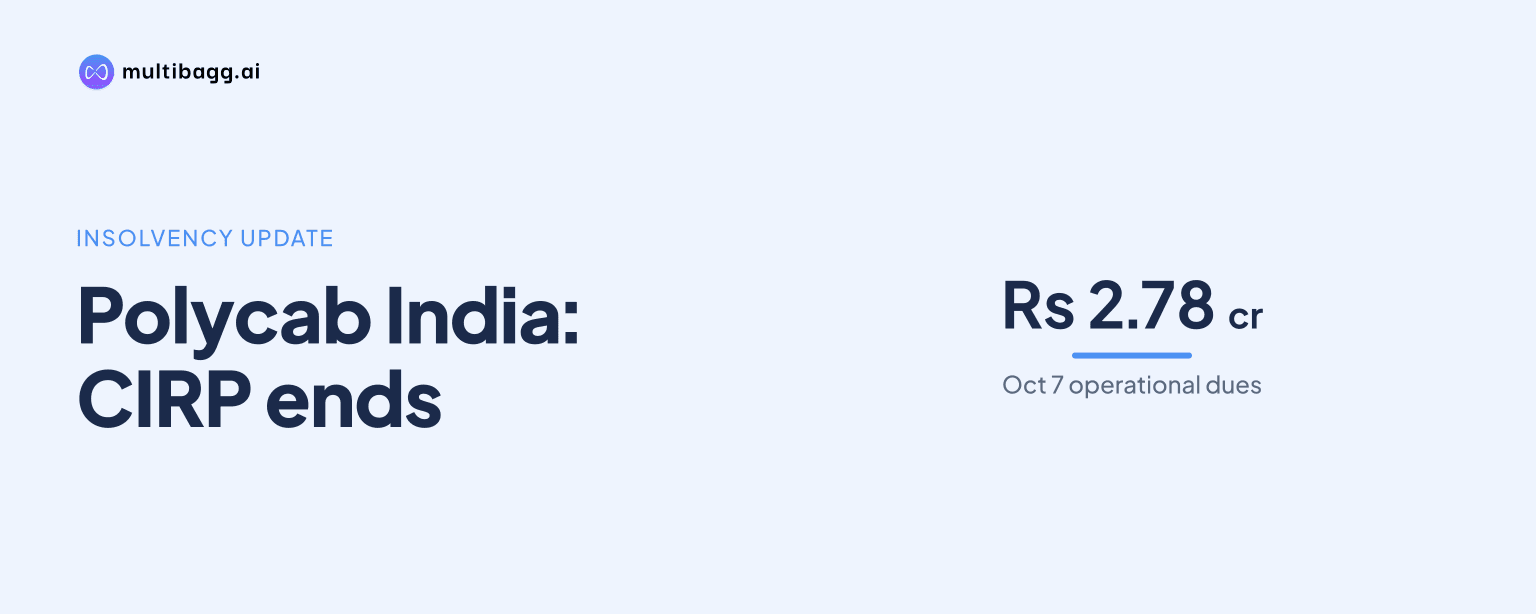
Polycab India Limited has been released from the corporate insolvency resolution process after the National Company Law Appellate Tribunal set aside the NCLT Ahmedabad order that admitted a Section 9 petition over alleged operational dues of ₹2.78 crore. The ruling restores Polycab’s ability to operate through its board of directors.
Know Polycab India inside out
Results, valuation, peers and who's buying, in one view.
Why did NCLAT set aside Polycab’s insolvency proceedings?
The National Company Law Appellate Tribunal, or NCLAT, set aside the insolvency proceedings after holding that the adjudicating authority had erroneously admitted the operational creditor’s application under Section 9 of the Insolvency and Bankruptcy Code. The appellate tribunal allowed the appeal filed by Bharat Ajay Jaisinghani, described in the proceedings as Polycab’s suspended director.
The appeal challenged the October 7, 2026 order of the National Company Law Tribunal’s Ahmedabad Bench. That order had admitted an insolvency petition filed by Asier Metals Private Limited, an operational creditor, over an alleged operational debt of ₹2.78 crore. Reports also described the claim as ₹2.79 crore.
The NCLAT’s order set aside not only the admission order but also the initiation of the corporate insolvency resolution process, or CIRP, and all consequential orders. The tribunal stated that Polycab was released from the rigours of CIRP and could function independently through its board.
The bench comprised officiating chairperson Justice Yogesh Khanna and technical members Barun Mitra and Ajai Das Mehrotra. The case was titled Bharat Ajay Jaisinghani v. Asier Metals Pvt. Ltd. & Anr.
How did the Polycab insolvency case unfold?
The dispute reached the NCLT after Asier Metals filed a Section 9 IBC application concerning alleged dues linked to aluminium ingot supplies. The NCLT Ahmedabad Bench admitted the application on October 7, beginning the CIRP against Polycab.
Following the NCLT admission, Sunit Jagdishchandra Shah was appointed as Interim Resolution Professional, according to reports. Under the insolvency framework, admission of a CIRP application can place a company’s management and operations under the resolution process, subject to the provisions of the Code.
Polycab challenged the admission before the NCLAT. On October 9, the appellate tribunal granted interim relief by staying the NCLT order and keeping the CIRP in abeyance. The stay was subject to the deposit of the entire claimed amount with the NCLAT Registrar in the form of a fixed deposit receipt within one week.
At the interim stage, the tribunal recorded Polycab’s willingness to deposit the amount without prejudice to its rights and contentions. Reports said Polycab had raised the existence of a dispute involving credit notes. The final order has now removed the CIRP and its consequential directions.
What did the NCLAT ruling mean for Polycab’s management?
The NCLAT ruling means Polycab is no longer subject to the CIRP initiated by the NCLT Ahmedabad Bench. The appellate tribunal expressly stated that the company could function independently through its board of directors.
This is significant because the initial admission of the insolvency petition had led to the appointment of an Interim Resolution Professional. With the admission order and consequential orders set aside, the legal basis for that process no longer remains under the appellate ruling.
Polycab had said during the earlier proceedings that it had a strong case on merits and viewed the matter as a commercial dispute involving ₹2.79 crore. The company also said at that stage that its business and management operations were continuing as usual and that it did not expect a material adverse impact on financial or business operations.
The tribunal’s October 9 deposit direction had provided interim protection for Asier’s claimed amount while the appeal was pending. The final order focused on the erroneous admission of the Section 9 application and ended the CIRP proceedings against Polycab.
Got a follow-up? Ask IRIS
How did the insolvency case affect Polycab shares and market status?
Polycab shares recovered from their intraday lows on October 30 after the company received the NCLAT relief, according to market reports. The share-price movement reflected the market’s response to the removal of the insolvency process, although the supplied reports do not provide a closing price or percentage change.
The initial insolvency admission had also created implications for Polycab’s derivatives market status. Reports said the company’s shares had been marked for exclusion from the futures and options segment from December 30, 2026, following the NCLT admission.
Index-related issues also emerged during the appeal. On October 27, the NCLAT directed MSCI not to delete Polycab from its indices until the tribunal pronounced its order in the appeal. The supplied material does not state the subsequent index treatment after the final ruling.
For investors, the case illustrates how an insolvency admission under the IBC can create immediate operational and market implications even when the underlying amount is relatively small compared with a company’s scale. The appellate decision removes the CIRP risk arising from this specific petition.
Why does the ruling matter under the Insolvency and Bankruptcy Code?
The ruling matters because Section 9 proceedings under the IBC concern applications by operational creditors, and admission can trigger CIRP. In this case, the NCLAT concluded that the application should not have been admitted by the NCLT.
Polycab’s appeal referred to a pre-existing commercial dispute, including credit notes, according to reports from the October 9 hearing. The NCLAT’s final finding that the adjudicating authority had erroneously admitted the application is central to the outcome, without requiring any conclusion here on the underlying commercial claim.
The case also shows the role of interim appellate relief. The NCLAT first stayed the CIRP on October 9 while requiring a deposit of the claimed amount, before delivering its final decision to set aside the insolvency process.
For operational creditors and corporate debtors, the sequence underlines the importance of the NCLT’s admission stage in an IBC case. An appellate challenge can examine whether the statutory basis for initiating CIRP was properly established.
Conclusion
The NCLAT has provided Polycab with complete relief in the insolvency matter brought by Asier Metals over alleged dues of ₹2.78 crore. By setting aside the NCLT admission order, the CIRP and consequential directions, the tribunal restored Polycab’s control through its board of directors.
The key matters to watch are any disclosures by Polycab or Asier on the underlying commercial dispute, the treatment of the amount deposited pursuant to the interim order, and any updates concerning Polycab’s futures and options or MSCI index status.