










Popular Vehicles FY26 revenue grew while losses widened
Key highlights
- Popular Vehicles reported FY26 revenue from operations of Rs 6,406.9 crore, up from Rs 5,541.2 crore in FY25.
- Popular Vehicles’ FY26 net loss widened to Rs 12.5 crore from Rs 10.5 crore in FY25.
- Popular Vehicles’ net debt to EBITDA increased to 3.1 times in FY26 from 2.2 times in FY25.
- Popular Vehicles generated Rs 100.2 crore of net operating cash flow in FY26, compared with Rs 150.8 crore in FY25.
powered by IRIS
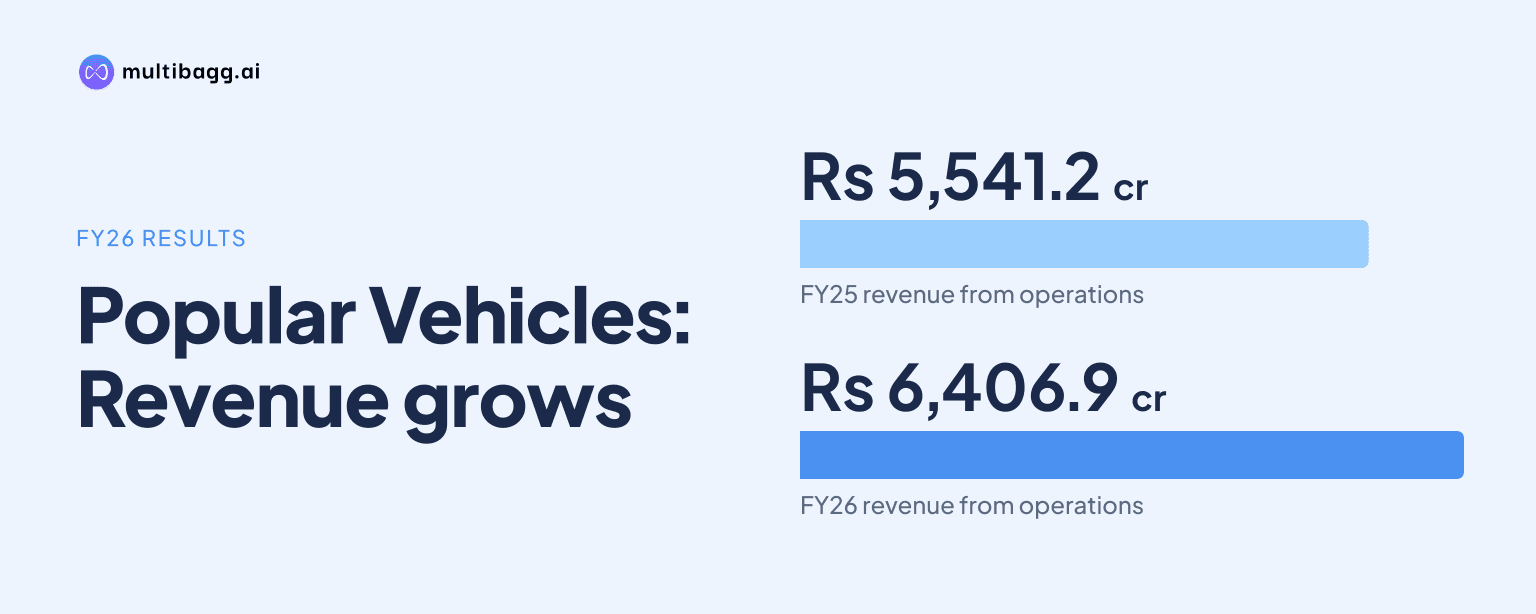
Popular Vehicles & Services increased revenue from operations to Rs 6,406.9 crore in FY26 from Rs 5,541.2 crore in FY25, but its net loss widened to Rs 12.5 crore from Rs 10.5 crore as gross margin fell to 13.4% and net debt to EBITDA reached 3.1 times.
Know Popular Vehicles & Services inside out
Results, valuation, peers and who's buying, in one view.
Why did Popular Vehicles’ FY26 revenue increase?
Popular Vehicles’ revenue from operations rose by Rs 865.7 crore to Rs 6,406.9 crore in FY26, reversing the decline from Rs 5,615.5 crore in FY24 to Rs 5,541.2 crore in FY25. Other income was Rs 20 crore, compared with Rs 20.4 crore in FY25, taking total income to Rs 6,426.9 crore.
The presentation shows growth across several disclosed original equipment manufacturer, or OEM, channels. Tata Motors commercial-vehicle new-vehicle revenue rose to Rs 1,350 crore in FY26 from Rs 1,034 crore in FY25, while Bharat Benz new-vehicle revenue increased to Rs 775 crore from Rs 576 crore. Ather new-vehicle revenue rose to Rs 132 crore from Rs 67 crore, alongside unit volume growth to 8,025 from 3,974.
Tata Motors commercial-vehicle service revenue increased to Rs 159 crore in FY26 from Rs 146 crore in FY25, while Bharat Benz service revenue increased to Rs 192 crore from Rs 128 crore. Ather service revenue was Rs 9 crore, compared with Rs 6 crore. The source does not provide a segment-by-segment reconciliation of these OEM figures to consolidated revenue.
Why did Popular Vehicles remain loss-making in FY26?
Popular Vehicles reported a pre-tax loss of Rs 13.3 crore in FY26 after a pre-tax loss of Rs 8.9 crore in FY25, compared with pre-tax profits of Rs 97.7 crore in FY24 and Rs 84.9 crore in FY23. The FY26 net loss was Rs 12.5 crore, and earnings per share were negative Rs 1.75, versus negative Rs 1.47 in FY25.
Earnings before interest, tax, depreciation and amortisation, or EBITDA, increased to Rs 203.8 crore from Rs 175.4 crore. However, EBITDA margin remained 3.2%, below 5.1% in FY24 and 4.8% in FY23. Gross profit rose by Rs 61 crore from FY25 but remained Rs 26 crore below FY24, despite FY26 revenue exceeding FY24 revenue by Rs 791.4 crore.
Cost of goods sold rose to Rs 5,564.5 crore from Rs 4,760.2 crore, reducing gross margin to 13.4% from 14.4% in FY25 and 15.7% in FY24. Employee cost increased to Rs 413.9 crore from Rs 387.1 crore, impairment losses were Rs 5.7 crore against Rs 2.9 crore, and other expenses increased to Rs 239 crore from Rs 236 crore.
Depreciation increased to Rs 127.3 crore from Rs 98.8 crore, leaving earnings before interest and tax, or EBIT, at Rs 76.4 crore, nearly unchanged from Rs 76.6 crore in FY25. Finance cost rose to Rs 103.7 crore from Rs 85.6 crore, exceeding FY26 EBIT by Rs 27.3 crore. The presentation also records a Rs 13.9 crore exceptional impact related to the New Labor Code and a divestment gain; it does not attribute the loss to acquisition-related costs.
Got a follow-up? Ask IRIS
How did Popular Vehicles’ leverage and balance sheet change?
Popular Vehicles’ total borrowings increased to Rs 696.1 crore in FY26 from Rs 423.1 crore in FY25, while total equity fell to Rs 627.8 crore from Rs 638.8 crore. Debt to equity increased to 1.1 times from 0.7 times, net debt to equity rose to 1.0 time from 0.6 times, and net debt to EBITDA reached 3.1 times from 2.2 times.
Property, plant and equipment rose to Rs 444.5 crore at March 2026 from Rs 311 crore a year earlier. Right-of-use assets increased to Rs 610 crore from Rs 388.2 crore, while non-current lease liabilities rose to Rs 652.8 crore from Rs 459.8 crore. Current borrowings rose to Rs 648.5 crore from Rs 421.3 crore, and non-current borrowings increased to Rs 47.5 crore from Rs 1.8 crore.
Total assets increased to Rs 2,383.3 crore at March 2026 from Rs 1,904.6 crore at March 2025. Inventories rose to Rs 617.4 crore from Rs 580.4 crore, trade receivables increased to Rs 259.4 crore from Rs 223 crore, and cash and cash equivalents rose to Rs 66.1 crore from Rs 24.5 crore. Return on capital employed fell to 5.8% from 7.2% in FY25 and 17.7% in FY24.
Did Popular Vehicles generate operating cash in FY26?
Popular Vehicles generated net cash from operating activities of Rs 100.2 crore in FY26 despite its Rs 13.3 crore pre-tax loss. This was below Rs 150.8 crore in FY25 but above Rs 79.9 crore in FY24. Cash generated from operations before working-capital changes was Rs 192.6 crore, compared with Rs 164.8 crore a year earlier.
Working-capital changes used Rs 65.1 crore in FY26, whereas they generated Rs 6.4 crore in FY25. At the same time, the reported working-capital cycle improved to 39 days from 46 days, as inventory days fell to 40 from 45, debtor days remained 15, and creditor days rose to 16 from 14.
Investing activities used Rs 145.6 crore in FY26, compared with Rs 39.4 crore in FY25, while capital expenditure increased to Rs 102.2 crore from Rs 53.8 crore. Financing activities generated Rs 87 crore after using Rs 141.9 crore in FY25. These movements lifted cash and cash equivalents by Rs 41.6 crore during FY26, compared with a Rs 30.5 crore decrease in FY25.
Conclusion
Popular Vehicles’ FY26 figures show that revenue growth did not restore profitability. Revenue from operations reached Rs 6,406.9 crore and EBITDA increased to Rs 203.8 crore, but gross margin declined to 13.4%, finance cost rose to Rs 103.7 crore and the company reported its second consecutive annual net loss. Positive operating cash flow of Rs 100.2 crore did not cover Rs 145.6 crore of investing outflows.
The main unresolved matters disclosed by the FY26 record are whether higher capital expenditure of Rs 102.2 crore and the expanded asset base translate into earnings, and whether borrowings decline from Rs 696.1 crore. Popular Vehicles also reported that Yanik, its spare-parts e-commerce platform, commenced commercial operations on October 5, 2026; its contribution is a further operating development to monitor.