










POSI+RON Energy Limited sees Indian gas demand reaching 103 BCM by 2030
Key highlights
- India’s gas consumption could reach about 103 BCM by 2030, versus more than 65 BCM in 2023.
- India had 28,157 kilometres of operational gas pipeline in June 2026, or about 81% of authorised pipeline.
- LNG supplied about 54% of India’s gas in April-September 2026, while imports could reach about 64 BCM by 2030.
- CGD had 9,096 CNG stations and 1.75 crore PNG connections as of July 2026.
powered by IRIS
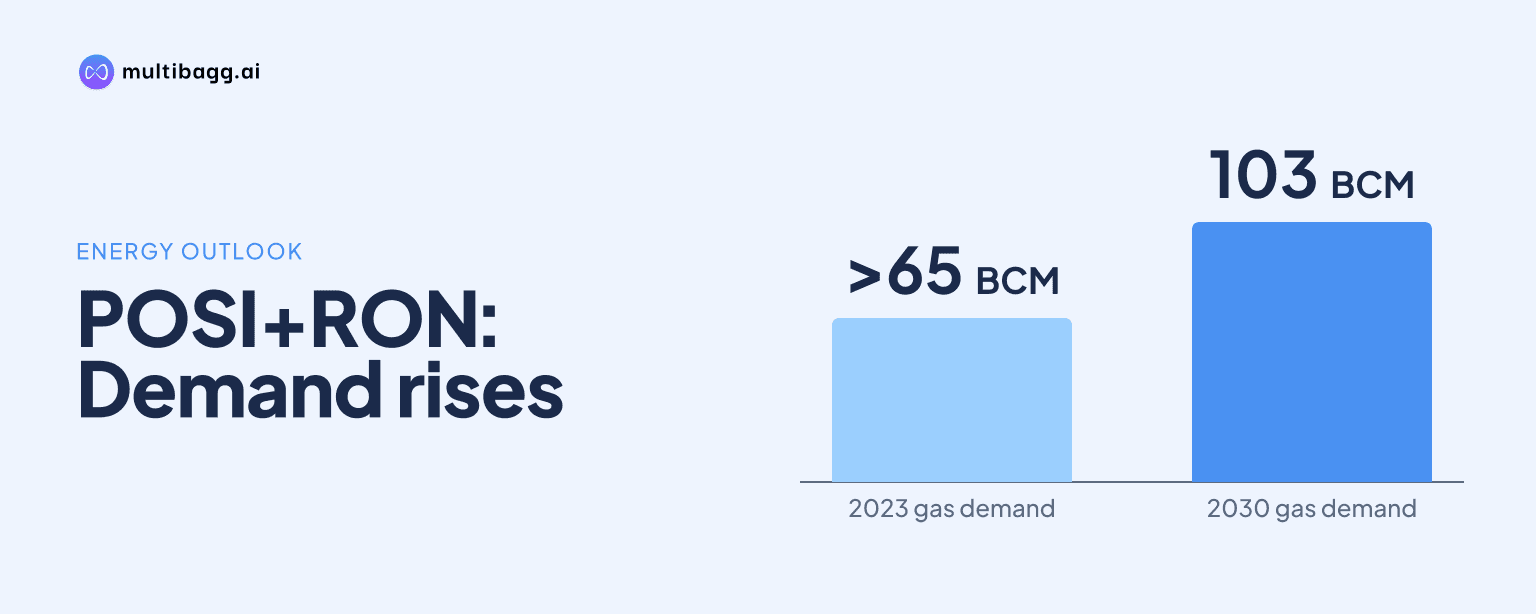
POSI+RON says India’s gas consumption could reach about 103 billion cubic metres (BCM) by 2030 under the International Energy Agency base case, following consumption of 68.70 BCM in FY2025-2026 and supported by pipeline, city-gas and liquefied natural gas infrastructure expansion.
Know Positron Energy inside out
Results, valuation, peers and who's buying, in one view.
How large could India’s gas market become by 2030?
India’s gas market could consume about 103 BCM by 2030, according to the International Energy Agency, or IEA, base case cited by POSI+RON. The presentation puts consumption at 68.70 BCM in FY2025-2026 and 35.7 BCM in H1 FY2027, and estimates demand growth of about 60% between 2023 and 2030. The government’s target is to raise gas to 15% of the primary energy mix by 2030 from about 6% today.
The presentation does not describe demand growth as uninterrupted. POSI+RON says the 2026 West Asia disruption is expected to reduce gas demand by about 2% during 2026, while accelerating supply diversification and infrastructure reform. It also projects liquefied natural gas, or LNG, imports to roughly double to about 64 BCM by 2030, placing imported supply at the centre of the projected market expansion.
Which sectors are expected to drive India’s gas demand?
City Gas Distribution, industry and power generation are the main demand engines identified by POSI+RON, with 1.75 crore piped-natural-gas, or PNG, household connections and 9,096 compressed-natural-gas, or CNG, stations recorded in July 2026. City Gas Distribution, or CGD, sales rose 27% year on year in July 2026, while authorised areas, excluding sub-judice areas, covered about 99% of India’s population.
Industrial demand grew more quickly in the cited July 2026 data, as industrial PNG sales increased about 51% year on year and 22,752 industrial customers were connected. Fertilisers are the largest single consuming segment at about 58 million metric standard cubic metres a day, or MMSCMD. Ceramics, glass, steel, textiles and petrochemicals are also identified as baseload industrial users.
Power-sector gas use rose about 3% year on year between October 2025 and February 2026, according to the presentation. The Petroleum and Natural Gas Regulatory Board, or PNGRB, projects power demand rising from about 25 MMSCMD to about 36-40 MMSCMD by 2030. POSI+RON notes that gas-fired generation serves peak and flexible needs but is first in line for curtailment when supply is short.
Fuel switching provides another source of demand in industry and transport. POSI+RON says CNG stations have increased about ninefold since FY2014, while PNGRB scenarios envisage 30,000-50,000 LNG trucks by 2030. The presentation identifies gas as replacing naphtha, fuel oil, liquefied petroleum gas and diesel in relevant applications.
How advanced is India’s gas infrastructure build-out?
India had 28,157 kilometres of operational national gas pipeline as of June 2026, equal to about 81% of the 34,803 kilometres authorised, according to POSI+RON. A further 8,251 kilometres were under construction or partly commissioned. The operational share moved from the presentation’s earlier 75% marker to 81%, improving connectivity to industrial clusters and downstream users.
CGD infrastructure has a larger remaining gap against its minimum work programme. As of July 2026, 9,096 CNG stations represented about 50% of the 18,336-station commitment, while 1.75 crore PNG connections represented about 14% of the 12.65 crore connection target. Authorised geographical areas covered about 96% of India’s area, distinguishing network authorisation from completed connections and stations.
LNG import-terminal capacity stood at about 57.7 million metric tonnes per annum, or MMTPA, across eight terminals after Dahej expanded from 17.5 MMTPA to 22.5 MMTPA on 31 March 2026. Announced projects point to capacity of about 77.5 MMTPA by FY2029. However, the presentation says terminal utilisation has remained around 45-50% since FY2023, so available capacity and actual LNG throughput are different measures.
Got a follow-up? Ask IRIS
How could market reforms change gas access?
The unified pipeline tariff and higher gas-exchange activity could widen access by standardising transport charges and supporting short-term procurement, according to POSI+RON. The tariff began on 1 January 2026 with two zones: Rs 54 per million British thermal units, or MMBtu, up to 300 kilometres and Rs 102.86 per MMBtu beyond 300 kilometres. The framework is described in the presentation as “One Nation, One Grid, One Tariff.”
The Indian Gas Exchange, or IGX, traded a record 76.8 million MMBtu in FY2026, up 28% year on year. POSI+RON links the increase with price discovery and flexible procurement, which can support spot and short-duration buying alongside bilateral supply arrangements. The presentation also says that digital market activity can deepen liquidity and market reach.
Longer-dated procurement is increasing alongside exchange-based buying. POSI+RON cites an Indian Oil Corporation-ADNOC agreement for up to 1.2 MMTPA over 14 years from 2026 and a GSPC-TotalEnergies agreement for 0.4 MMTPA over 10 years. It says the IEA flags a widening gap between contracted supply and demand after 2028, leaving the balance between contracted and spot LNG unresolved.
What could constrain the projected gas-demand growth?
Import reliance and LNG-price movements are the clearest constraints on the 103 BCM outlook. LNG supplied about 54% of India’s gas in April-September 2026, calculated from Petroleum Planning and Analysis Cell data cited by POSI+RON. The presentation also says the Hormuz disruption moved the United States ahead of Qatar as India’s top LNG supplier, showing how quickly sourcing patterns can shift.
Spot pricing illustrates that exposure. Asian spot LNG averaged about 20.7 per MMBtu in March 2026, compared with about 10.6 per MMBtu in January-February 2026. POSI+RON says spot and short-term cargoes can fill supply gaps, but identifies price risk as acute when those purchases are needed.
Supply-priority rules create a separate constraint for power demand. Domestic PNG and transport CNG are at the top of the 2026 supply-priority order, while the presentation identifies power as the first segment subject to curtailment in a shortage. That means the PNGRB demand range of about 36-40 MMSCMD for power by 2030 depends not only on capacity but also on supply availability.
Conclusion
POSI+RON’s presentation connects the projected expansion in India’s gas market with physical connectivity, CGD additions, imported LNG and mechanisms for short-term trading. Industrial PNG sales rising about 51% year on year in July 2026, compared with 27% CGD sales growth, indicate that both established city-gas networks and industrial users feature in the stated demand runway.
The next measures to watch are whether announced LNG terminal capacity reaches about 77.5 MMTPA by FY2029, whether CGD deployment progresses beyond 50% of the CNG-station commitment and 14% of the PNG-connection commitment, and how buyers address the IEA-cited post-2028 contracted-supply gap. POSI+RON’s roadmap also includes long-term supply agreements, cost optimisation and expansion into new industrial clusters.