










Unihealth Hospitals Limited targets 1,000+ India beds by FY 2030-31
Key highlights
- Unihealth plans more than 600 in-patient beds across India and Africa in 24–36 months.
- Unihealth targets more than 1,000 Indian in-patient beds by FY 2030–31.
- Unihealth reports 62% occupancy and 35% EBITDA for African operations.
- Unihealth plans a 100–150-bed Pune hospital, with location finalisation by end-FY 2026–27.
powered by IRIS
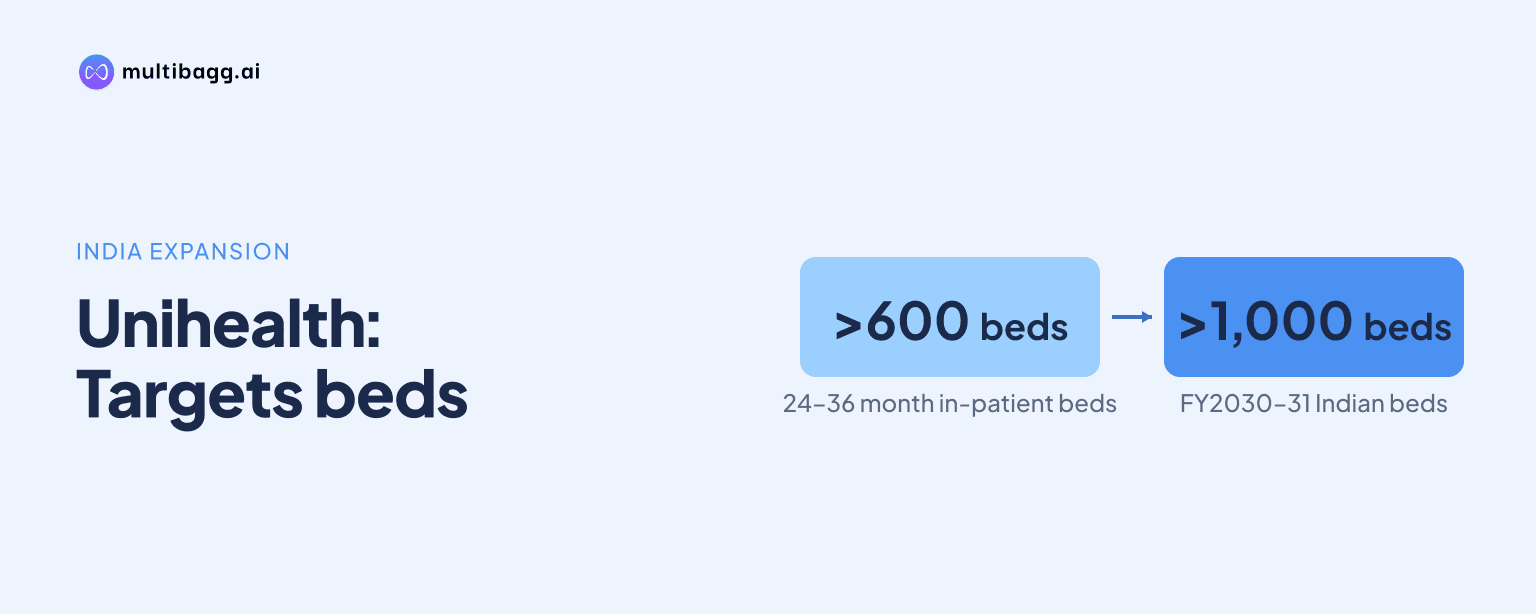
Unihealth Hospitals Limited targets more than 1,000 in-patient beds in India by FY 2030–31 after planning to add more than 600 beds across India and Africa within 24–36 months. The roadmap relies on leased hospital properties, with more than 300 planned beds in each region and three or more additional Indian hospitals.
Know Unihealth Hospitals inside out
Results, valuation, peers and who's buying, in one view.
What is Unihealth's bed-expansion plan?
Unihealth plans more than 300 additional in-patient beds in India and more than 300 in Africa during the next 24–36 months. The two regional programmes therefore indicate more than 600 planned incremental beds, while the company separately states an ambition for more than 1,000 commissioned beds across India and Africa.
India is also expected to receive three or more hospitals within the 24–36-month period. The presentation gives India a dated target of more than 1,000 in-patient beds by FY 2030–31, but does not provide an equivalent dated Africa-wide bed target.
The 24–36-month additions and the FY 2030–31 India target measure different stages of the plan. Unihealth does not disclose the existing Indian bed base used to reach the 1,000-plus target, the bed count for each of the three or more proposed hospitals, or commissioning dates for the projects.
How will Unihealth use leased properties for expansion?
Unihealth says its asset-light model will focus on leased hospital properties as it pursues more than 1,000 commissioned beds across India and Africa. The presentation does not state that the company will own the properties used for the expansion programme.
The leased-property approach sits alongside Unihealth's Design-Build-Operate, or DBO, model. Under this model, the company says it can earn revenue from planning and operating hospitals without necessarily owning them, a mechanism it presents as supporting scalability without large upfront capital investment.
Unihealth also reports more than 1,300 beds under management through its consultancy engine, which provides turnkey healthcare-project execution in Africa and India. That managed-bed measure is distinct from the planned 300-plus in-patient-bed additions in each region, and the presentation does not specify how many managed beds are leased, owned or commissioned by Unihealth.
Lease durations, rental commitments, project capital costs and property-level commissioning schedules are not disclosed in the roadmap. Those details would determine how the asset-light model translates into capacity additions during the stated 24–36-month period.
Where will Unihealth add hospitals and beds?
Unihealth identifies Mumbai, Pune and Nashik as Indian cities for boutique surgical hospitals with 50–200 beds. Its India roadmap also cites a 25% earnings before interest, tax, depreciation and amortisation, or EBITDA, target for these operations.
The presentation says a 50-bed UMC Hospitals facility in Navi Mumbai and a 200-bed facility in Nashik are operational. UMC Hospitals is the hospital brand used by Unihealth, and the 250 beds at these two named sites provide disclosed operating capacity separate from the future three-or-more-hospital addition plan.
Pune is the most detailed proposed Indian project. Unihealth plans a 100–150-bed multispecialty hospital there, with the location to be finalised by the end of FY 2026–27; it does not provide a construction start date or opening date.
In Africa, Unihealth plans to add more than 300 beds in 24–36 months, consolidate Uganda through a hub-and-spoke model, and expand into Tanzania and Kenya. The company also describes regional hubs for medical tourism, but does not list the facilities, specialities or bed counts planned in those two new markets.
The stated operating metrics differ between the two regions. Unihealth cites a 25% EBITDA target for its Indian boutique surgical hospitals, whereas it reports 35% EBITDA and 62% current occupancy for African operations; the presentation does not give a like-for-like facility or period definition for the comparison.
Got a follow-up? Ask IRIS
How does medical value travel support Unihealth's plan?
Unihealth plans to integrate African operations with Indian hospitals to increase medical value travel, or MVT, from Africa to India. Its roadmap describes enhancing inbound patient flow as part of the network strategy alongside more than 600 planned beds across the two regions.
The company cites a projected Indian MVT-sector value of $14.31 billion by 2029. It also says its MVT programmes include Ethiopian Air and Myanmar Airways, plus partnerships with more than 50 hospitals in India.
These arrangements are intended to connect African patients seeking specialised Indian treatment with Indian healthcare providers. However, Unihealth does not disclose MVT patient volumes, revenue, referral conversion rates, or the number of beds expected to serve MVT patients at its existing or planned hospitals.
The African hub model and the proposed Indian hospital additions are linked by the planned patient pathway rather than by a published financial forecast. The roadmap identifies regional medical-tourism hubs and more than three Indian hospitals to be added in 24–36 months, without allocating expected MVT activity to individual facilities.
What could affect delivery of Unihealth's roadmap?
Unihealth identifies import dependence, legal variations between regions and multi-jurisdictional compliance as challenges for operations across six countries. These factors are relevant to projects planned in Tanzania and Kenya as well as to the leased-property strategy in India.
The company also lists economic shifts that may affect healthcare affordability and access, alongside rising demand and competition in healthcare services. The presentation provides no numerical contingency for delays, import-cost changes or compliance costs affecting the more than 600 planned beds.
Africa contributes more than 75% of Unihealth's revenue, according to the presentation, making African execution material to the 300-plus-bed regional expansion. The company reports 62% current occupancy for African operations, but does not say how occupancy is expected to change as it adds beds in Uganda, Tanzania and Kenya.
Unihealth's reported financial history provides context rather than guidance for the expansion. Revenue rose from Rs 43.94 crore in FY23 to Rs 131.99 crore in FY26, while EBITDA margin increased from 34.58% to 42.93% over the same period; the presentation does not forecast the revenue or margin outcome of the planned hospital additions.
Conclusion
Unihealth's roadmap combines leased hospital properties, consultancy-led operating models and cross-border MVT initiatives with more than 600 planned in-patient beds over 24–36 months. The clearest capacity target is more than 1,000 in-patient beds in India by FY 2030–31, alongside African growth in Uganda, Tanzania and Kenya.
The next disclosed milestone is finalising the Pune location by the end of FY 2026–27 for a 100–150-bed multispecialty hospital. Management has not disclosed project-level lease terms, commissioning dates, capital requirements or the facilities that will make up the remaining planned Indian and African beds.