










UniHealth says normalized H1 owner profit is ₹23.02 crore
Key highlights
- UniHealth's normalized H1 FY 2026-27 profit attributable to owners was ₹23.02 crore, versus reported ₹14.22 crore.
- Revenue was unchanged at ₹76.45 crore in both reported and normalized H1 FY 2026-27 statements.
- UniHealth acquired an additional 49.81% stake in Victoria Hospital on September 2, 2026.
- Non-current lease liabilities were ₹58.82 crore at H1 FY 2026-27, versus ₹9.26 crore in FY26.
powered by IRIS
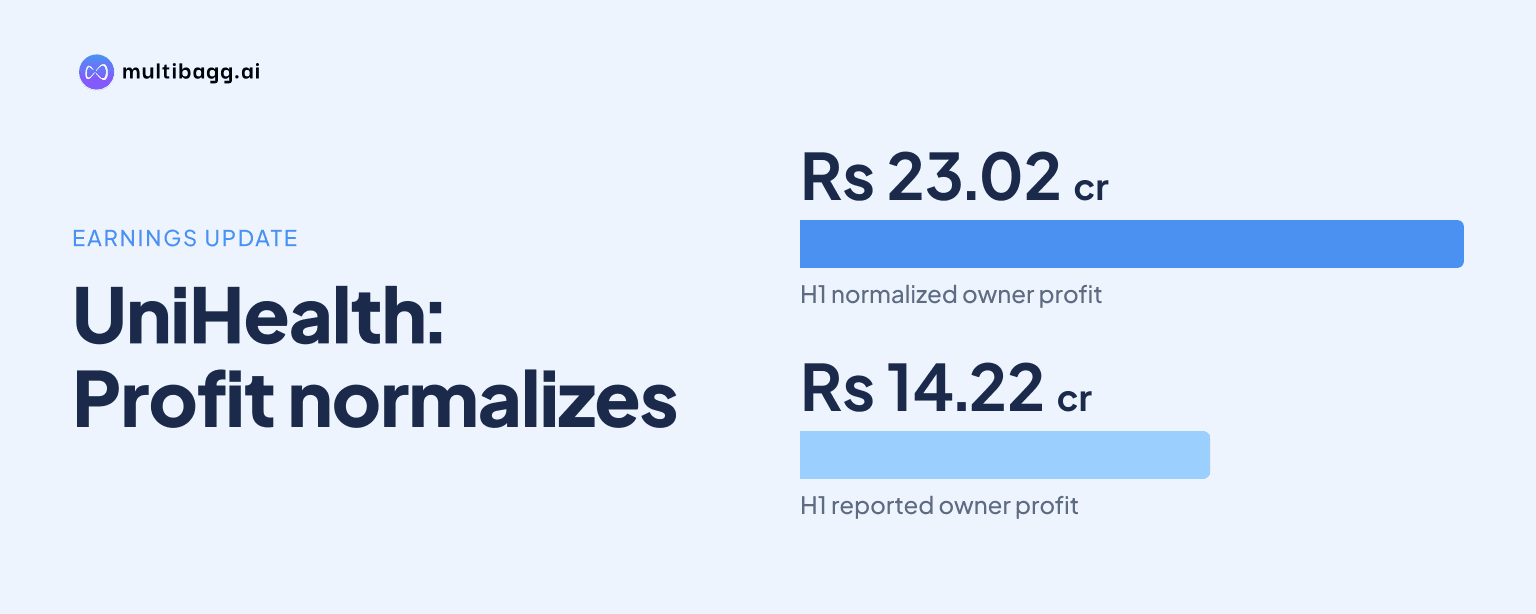
In H1 FY 2026-27, Unihealth Hospitals Limited said its normalized pro forma profit attributable to owners was ₹23.02 crore, ₹8.80 crore above the reported ₹14.22 crore, after adjusting Victoria Hospital profit attribution and lease accounting under Indian Accounting Standards (Ind-AS).
Know Unihealth Hospitals inside out
Results, valuation, peers and who's buying, in one view.
Why is UniHealth's normalized owner profit higher than reported profit?
The ₹8.80 crore difference primarily reflects a different allocation of Victoria Hospital Ltd. profit to UniHealth's owners, while lease normalization also changes operating expenses, finance cost and depreciation. Reported profit attributable to owners was ₹14.22 crore, compared with reported profit after tax (PAT) of ₹21.52 crore and ₹7.30 crore attributed to non-controlling interests.
UniHealth's normalized pro forma statement keeps revenue unchanged at ₹76.45 crore and total income unchanged at ₹77.78 crore for H1 FY 2026-27. It reports normalized PAT of ₹21.74 crore, only ₹0.22 crore above reported PAT, but changes the allocation between owners and non-controlling interests, with the latter shown as negative ₹1.28 crore under the pro forma presentation.
The pro forma measure is management's presentation rather than the reported Ind-AS result. Its effect is largest at the profit-attributable-to-owners line: EBITDA is ₹1.85 crore lower in the normalized view, whereas PBT is ₹0.22 crore higher because finance cost and depreciation are lower after the lease adjustment.
How did the Victoria Hospital acquisition affect H1 earnings attribution?
UniHealth said its September 2, 2026 acquisition of an additional 49.81% equity stake in Victoria Hospital Ltd. in Uganda changed how that hospital's profits were assigned to owners during H1 FY 2026-27. Under reported Ind-AS accounting, 50% of Victoria Hospital profit from April 1, 2026 to September 1, 2026 was attributed to UniHealth's owners, followed by 99.81% from September 2 to September 30, 2026.
The normalized pro forma instead assigns the full 99.81% of Victoria Hospital profit for the H1 period to UniHealth's owners. Management based that treatment on UniHealth's equity at September 30, 2026 being on a fully diluted basis, so the pro forma aligns profit attribution with the post-acquisition stake rather than the dates on which the stake was held.
That ownership convention explains why normalized owner profit rises by ₹8.80 crore even though total normalized PAT rises only ₹0.22 crore. The reported statement allocates ₹7.30 crore to non-controlling interests, while the normalized statement records negative ₹1.28 crore, a ₹8.58 crore movement in that line alongside the modest change in total PAT.
Got a follow-up? Ask IRIS
How does lease accounting change UniHealth's pro forma result?
UniHealth replaces Ind-AS lease depreciation and finance costs with monthly rent or lease expense for the commissioned UMC Hospitals in Navi Mumbai and Nashik in its normalized pro forma. The land and buildings at both facilities are held on leave-and-license or lease arrangements, which Ind-AS requires to be reflected through additions to assets and liabilities plus depreciation and finance costs.
This adjustment increases total expenditure to ₹53.72 crore from ₹51.87 crore and reduces EBITDA margin to 30.93% from 33.31%. It also lowers finance cost to ₹1.01 crore from ₹1.84 crore and depreciation to ₹4.49 crore from ₹5.72 crore, producing the ₹0.22 crore increase in PBT to ₹18.56 crore.
The balance sheet illustrates the scale of lease-related accounting at September 30, 2026. Non-current lease liabilities were ₹58.82 crore, up from ₹9.26 crore in FY26, while fixed assets rose to ₹165.54 crore from ₹93.97 crore. Total debt was reported at ₹28.37 crore for H1 FY 2026-27.
What do UniHealth's H1 financial and operating figures show?
UniHealth reported ₹77.78 crore of total income and ₹25.91 crore of reported EBITDA in H1 FY 2026-27, alongside earnings per share of ₹8.77. Earnings per share was below ₹9.79 in H1 FY26, but above ₹6.86 in H2 FY26, while return on capital employed was 6.76%, compared with 15.56% and 7.94%, respectively.
UniHealth ended H1 FY 2026-27 with net worth of ₹216.43 crore, total assets of ₹326.46 crore and cash and bank balances of ₹12.17 crore. Operating cash flow was ₹23.83 crore, compared with ₹5.69 crore in FY26, while investment cash flow was negative ₹74.45 crore and financing cash flow was ₹52.03 crore, leaving net cash flow of ₹1.41 crore.
Operationally, UMC Hospitals had 250 beds across its two Indian hospitals at the end of the period: 50 beds in Navi Mumbai and 200 beds in Nashik. Nashik services were commissioned on September 1, 2026, and management said it had initiated a search to acquire or establish a 100-to-150-bed multispecialty tertiary-care hospital in Pune.
Conclusion
UniHealth's ₹23.02 crore normalized pro forma owner-profit figure does not represent higher revenue, which remained ₹76.45 crore in both presentations. Instead, it reflects management's use of the 99.81% post-acquisition Victoria Hospital stake for H1 profit attribution and its recasting of lease-related operating, finance and depreciation expenses, against reported owner profit of ₹14.22 crore.
The next disclosed milestone is management's target to finalize the Pune location and premises by the end of the ongoing financial year for a proposed 100-to-150-bed hospital. Investors can also watch the operational development of the 200-bed Nashik hospital, commissioned on September 1, 2026, and subsequent reporting of the ₹58.82 crore non-current lease liability.