










Prime Cable Industries Limited guides Rs 370 crore FY27 revenue
Key highlights
- Prime Cable reported Rs 196.4 crore of H1 FY27 revenue, including Rs 20.5 crore of raw-material price pass-through.
- Prime Cable’s H1 FY27 normalised revenue was Rs 175.9 crore, up 94% from Rs 90.7 crore in H1 FY26.
- Prime Cable expects Rs 370 crore of normalised FY27 revenue and a 5.5% normalised PAT margin.
- Prime Cable’s order book reached Rs 294.0 crore by October 2026, including Rs 66.0 crore of MV cable orders.
powered by IRIS
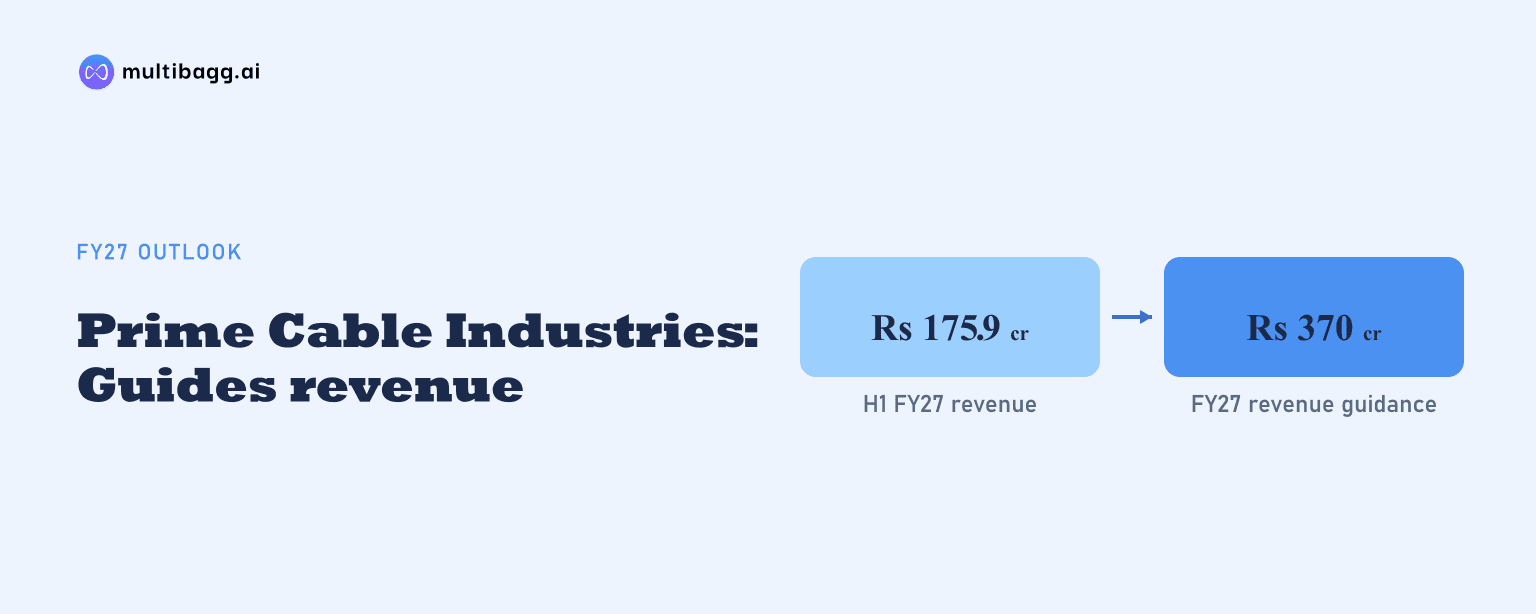
In FY27, Prime Cable expects Rs 370 crore of normalised revenue after its H1 FY27 reported revenue of Rs 196.4 crore included Rs 20.5 crore of raw-material inflation pass-through; normalised H1 revenue was Rs 175.9 crore and profit after tax rose 73% year-on-year to Rs 9.5 crore.
Know Prime Cable Industries inside out
Results, valuation, peers and who's buying, in one view.
How much of Prime Cable’s H1 FY27 revenue was pass-through?
Prime Cable said Rs 20.5 crore of its reported Rs 196.4 crore H1 FY27 revenue came from input-price inflation, leaving normalised revenue of Rs 175.9 crore. Prime Cable uses raw-material prices prevailing at the end of FY26 as the reference point for normalisation, intending to remove contract-revenue movements caused by material-price changes.
Prime Cable said many contracts contain price-variation clauses that pass changes in raw-material costs to customers. The clauses mean Prime Cable does not directly absorb the relevant increase in input costs, but the associated Rs 20.5 crore of H1 FY27 revenue does not generate incremental profit. Reported revenue can therefore rise or fall with raw-material prices without a proportionate change in underlying earnings.
How did Prime Cable’s H1 FY27 performance compare with earlier periods?
Prime Cable’s normalised revenue increased 94% year-on-year from Rs 90.7 crore in H1 FY26 and 22% from Rs 144.2 crore in H2 FY26. Reported H1 FY27 revenue rose 117% year-on-year and 36% sequentially, with the difference from normalised growth reflecting the stated H1 input-price effect.
Earnings before interest, tax, depreciation and amortisation (EBITDA) reached Rs 16.5 crore in H1 FY27, while profit after tax (PAT) was Rs 9.5 crore. The comparison below shows that both earnings measures increased from H1 FY26 and H2 FY26, while EBITDA margin declined against both periods.
Prime Cable’s EBITDA rose 68% year-on-year to Rs 16.5 crore, while PAT increased 73% to Rs 9.5 crore. EBITDA margin was 8.4% in H1 FY27, compared with 10.8% in H1 FY26 and 9.5% in H2 FY26. Normalised PAT margin was 5.4%, compared with 6.0% year-on-year and 4.7% sequentially.
What is Prime Cable’s FY27 normalised revenue target?
Prime Cable expects Rs 370 crore of normalised revenue in FY27, comprising Rs 340 crore from existing low-voltage and medium-voltage manufacturing lines and Rs 30 crore from the new medium-voltage line. Management said the target represents normalised growth of more than 50% on its stated comparison basis, while reported revenue may differ with raw-material price movements.
Management expects a normalised PAT margin of 5.5% in FY27. Prime Cable reported Rs 234.9 crore of revenue in FY26, but did not provide a normalised FY26 revenue figure in this release. Prime Cable said normalised H1 FY27 revenue had already exceeded the growth trajectory contemplated in its earlier FY27 guidance of 40% to 50%.
Got a follow-up? Ask IRIS
When will Prime Cable’s new medium-voltage line begin commercial production?
Prime Cable expects commercialisation of its new medium-voltage (MV) cable line at Giloth, Rajasthan, on November 21, 2026. Management attributed the shift in commissioning to unseasonal rains and said it did not currently expect the delay to reduce FY27 revenue aspirations because orders had already been secured.
The new line is expected to contribute Rs 30 crore of normalised revenue during its initial FY27 ramp-up, against peak normalised annual revenue potential of Rs 150 crore. Management’s objective is to reach peak monthly revenue of about Rs 12.5 crore in March 2027. It expects initial margins to be broadly comparable with those of existing low-tension facilities, with richer mix and operating leverage expected to become more meaningful in FY28.
Prime Cable also expects an adjacent Giloth facility to be commercialised in April 2027. Management projects that facility will add Rs 100 crore of normalised annual revenue capacity at around 85% utilisation. Prime Cable said it does not expect additional certifications, approvals or audits before MV commercial production because the new unit is within its existing Giloth premises, based on its current assessment.
What does Prime Cable’s order book indicate about medium-voltage demand?
Prime Cable’s order book stood at Rs 264.8 crore at H1 FY27 and increased to Rs 294.0 crore by the end of October 2026. MV cables accounted for Rs 66.0 crore of the October order book, which management cited as evidence of a growing presence in higher-value cable segments.
Prime Cable obtained accreditation for its in-house testing laboratory to test cables up to 33 kilovolts (kV). It also received several customer type-test certifications and product approvals for cables up to 33 kV. Management linked these milestones to the MV order book and the planned scale-up of production at the Giloth facility.
Conclusion
Prime Cable’s FY27 target depends on distinguishing sales recorded under raw-material price-variation clauses from normalised sales measured at end-FY26 material prices. H1 FY27 reported revenue of Rs 196.4 crore included Rs 20.5 crore of pass-through, while normalised revenue was Rs 175.9 crore and PAT reached Rs 9.5 crore, up 73% year-on-year.
The next disclosed milestones are commercialisation of the Giloth MV line on November 21, 2026, management’s objective of about Rs 12.5 crore in monthly line revenue in March 2027, and the planned April 2027 launch of the adjacent facility. Delivery against the Rs 370 crore FY27 normalised-revenue target and conversion of the Rs 294.0 crore October 2026 order book, including Rs 66.0 crore of MV orders, remain the stated measures to watch.