










Prime Cable cites NABL lab and approvals as tender barrier
Key highlights
- Prime Cable reports state-authority approvals across 20 states.
- Prime Cable says its NABL-accredited Unit II laboratory can test cables up to 33 kilovolts.
- Prime Cable’s September 2025 funnel identifies 3 small and medium enterprises with in-house NABL laboratories.
- Prime Cable reports a 37% bid win ratio and a 58.0% client retention rate.
powered by IRIS
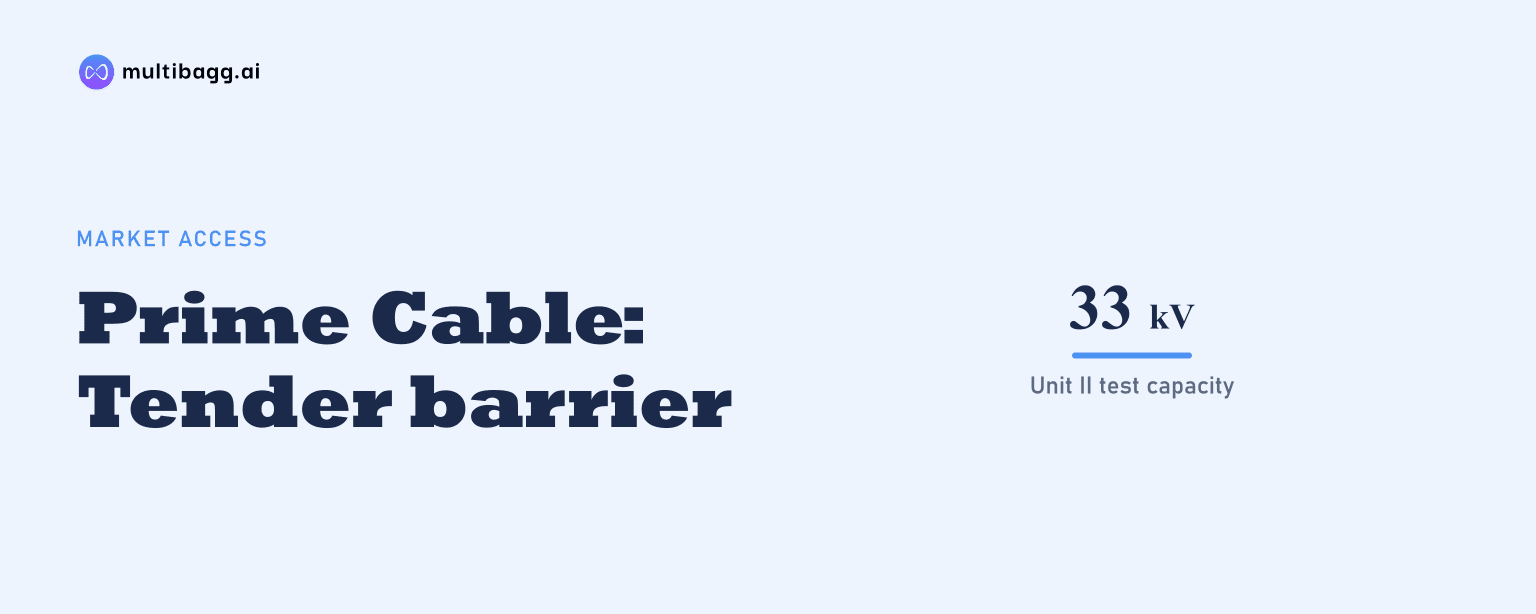
Prime Cable says its National Accreditation Board for Testing and Calibration Laboratories (NABL)-accredited Unit II laboratory can test cables up to 33 kilovolts and, alongside approvals across 20 states, supports tender qualification; its September 2025 market funnel identifies only three small and medium enterprises with in-house NABL labs.
Know Prime Cable Industries inside out
Results, valuation, peers and who's buying, in one view.
How does Prime Cable’s NABL laboratory support tender eligibility?
Prime Cable says NABL accreditation enables valid test reports that support pre-qualification requirements (PQR) for government and institutional tenders. Its in-house testing and calibration laboratory can test cables up to 33 kilovolts, which the presentation places in the medium-voltage cable segment. The company describes the route as NABL accreditation, valid test reports, PQR qualification and tender eligibility.
The company says the in-house facility can shorten testing turnaround and improve its response to tender timelines. It states that NABL accreditation is mandatory or preferred for some government and institutional tenders, but does not claim that accreditation alone secures a contract. Bid qualification requirements (BQR) also include execution history, product performance, and technical and operational capabilities.
Prime Cable links the laboratory to integrated production controls, under which copper, aluminium, polyvinyl chloride and cross-linked polyethylene materials undergo pre-production testing. Its manufacturing units hold International Organization for Standardization certifications for quality management, environmental management and occupational health and safety, while Unit II holds ISO 17025 for testing and calibration. The company also lists Bureau of Indian Standards certifications for power cables, building wires, aerial bunched cables, conductors and solar cables.
How broad are Prime Cable’s approvals and institutional channels?
Prime Cable reports approvals from state authorities across 20 states, including Jammu and Kashmir, Punjab, Haryana, Rajasthan, Gujarat, Maharashtra, Telangana, Karnataka and Andhra Pradesh. The presentation says this footprint enables entry into public-sector opportunities and supports geographic reach. It also describes Prime Cable as an approved vendor to state transmission and distribution utilities, distribution companies and public-sector undertakings.
The approvals are intended to allow participation directly and through engineering, procurement and construction contractors. Prime Cable lists NTPC, POWERGRID, Hindustan Petroleum, Oil and Natural Gas Corporation, Bharat Heavy Electricals, National Highways Authority of India, IndianOil, Nuclear Power Corporation of India, Tata Power, Engineers India and Indian Space Research Organisation among its vendors. The presentation does not disclose approval durations, tender values or the value of orders from these organisations.
Prime Cable reports a 37% bid win ratio, a 58.0% client retention rate and an average order value of Rs 1.3 crore. Its top 10 clients contributed 50% of revenue, while average revenue per client was Rs 1.9 crore. These metrics describe the institutional channel, although the company notes that its displayed customer relationships are selected rather than exhaustive.
Got a follow-up? Ask IRIS
How rare are in-house NABL laboratories in Prime Cable’s market?
Prime Cable’s September 2025 market funnel shows that in-house NABL laboratories are less common than cable manufacturing generally. The company counts more than 100 domestic cable manufacturers, more than 40 companies focused mainly on business-to-business power and control cables, and more than 10 companies with in-house NABL laboratories. It separately identifies three small and medium enterprises with such laboratories.
The comparison supports Prime Cable’s stated view that the relevant peer set narrows as qualification requirements increase. However, the presentation does not name the 10-plus companies with NABL laboratories, state whether they can test cables up to 33 kilovolts, or provide their tender market shares. The funnel therefore indicates a narrower claimed peer group, rather than a measured share of contract awards.
Prime Cable positions the capability as one component of institutional access rather than a replacement for approvals or delivery record. It focuses on business-to-business and institutional customers in government and engineering-led projects, rather than purely price-driven retail sales. The company says faster test cycles, quality assurance and compliance with tender requirements support its access to power, railway and infrastructure opportunities.
What limits Prime Cable’s claimed tender-entry barrier?
Prime Cable’s stated barrier is cumulative rather than exclusive: NABL accreditation supports report credibility, state approvals support eligibility, and BQR compliance requires a record of execution and product performance. The company’s approvals span 20 states, but the presentation does not say that an approval in one state automatically applies in another or that any approval guarantees a tender award.
There is also a difference between potential access and current revenue distribution. Management says revenue is concentrated in five to six key states, compared with approvals across 20 states. The top 10 clients account for 50% of revenue, so the reported 20-state footprint has not yet translated into a disclosed, broadly distributed revenue base.
Management says it plans to increase wallet share with electricity boards, engineering, procurement and construction companies and public-sector undertakings by cross-selling products such as medium-voltage cables. It also plans to use multi-state approvals to enter underpenetrated states, participate in more government and private institutional tenders, and explore selected export markets. These are management plans, not order-book targets or revenue forecasts.
Conclusion
Prime Cable presents its in-house NABL-accredited Unit II laboratory, 33-kilovolt testing capability, PQR support and approvals across 20 states as a combined route through institutional tender qualification. Its September 2025 funnel, showing three small and medium enterprises with in-house NABL laboratories against more than 100 domestic cable manufacturers, is the presentation’s clearest numerical evidence for a limited comparable group.
The next issue to watch is whether Prime Cable converts approvals beyond its current five to six key revenue states into a more diversified order base. Management plans to cross-sell medium-voltage cables and use multi-state approvals for additional tenders, but the presentation does not disclose the timing, value or expected win rate of that pipeline.