










Prince Pipes and Fittings Limited Q2 PAT rises 220% to Rs 48 crore
Key highlights
- Prince Pipes reported Q2 FY27 revenue of Rs 821 crore, up 38% year-on-year.
- Q2 FY27 EBITDA rose 82% to Rs 100 crore, lifting the EBITDA margin by 300 basis points to 12%.
- Q2 FY27 profit after tax increased 220% year-on-year to Rs 48 crore, with a 6% PAT margin.
- H1 FY27 working capital stood at 55 days, while receivable days declined to 34 days.
powered by IRIS
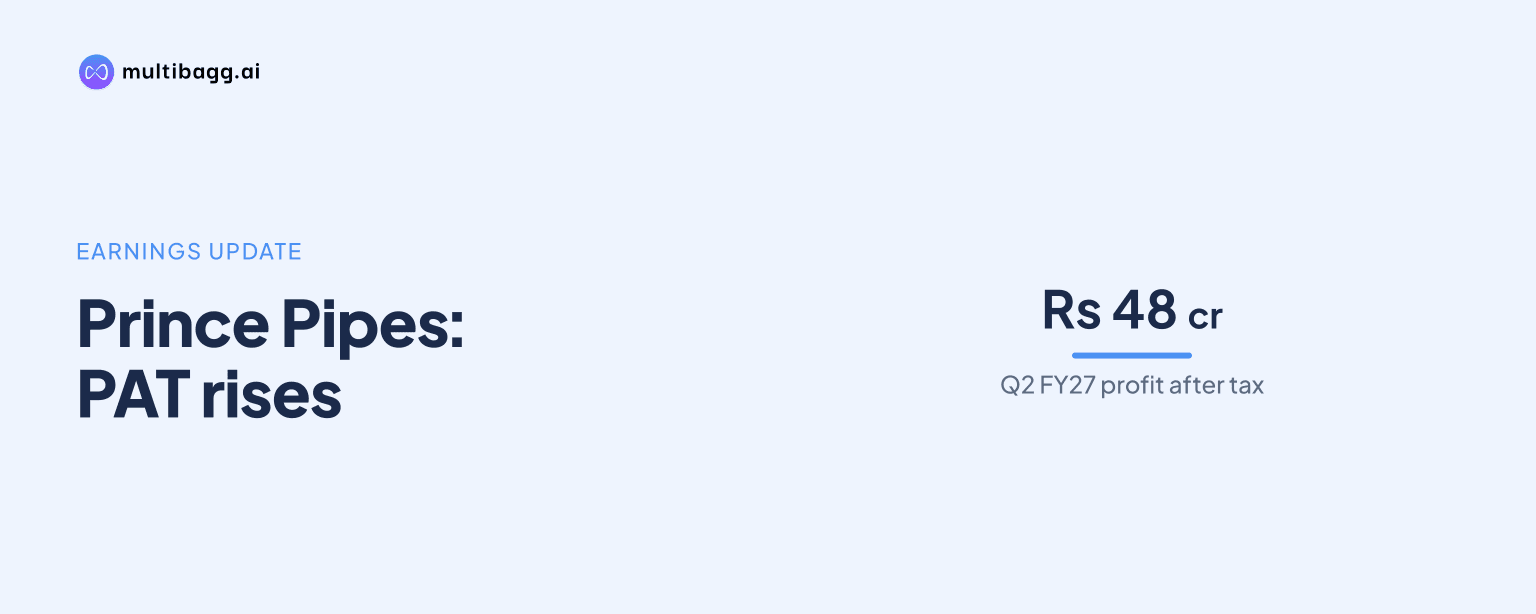
Prince Pipes and Fittings Limited reported Q2 FY27 profit after tax of Rs 48 crore, up 220% year-on-year, as revenue increased 38% to Rs 821 crore and EBITDA rose 82% to Rs 100 crore. The quarter showed higher sales volumes, a 12% EBITDA margin and improved profitability across the business.
Know Prince Pipes & Fittings inside out
Results, valuation, peers and who's buying, in one view.
What did Prince Pipes report for Q2 FY27?
Prince Pipes reported revenue from operations of Rs 821 crore for the quarter ended September 30, 2026, a 38% increase from a year earlier. Sales volume rose 22% year-on-year to 52,080 metric tonnes, indicating that the revenue increase was supported by volume growth rather than price alone.
EBITDA increased 82% year-on-year to Rs 100 crore, and the EBITDA margin improved by 300 basis points to 12%. Profit after tax rose 220% to Rs 48 crore, while the PAT margin expanded by 400 basis points to 6%. The results were discussed in the company's earnings call held on November 4, 2026, following the release of its Q2 and H1 FY27 financial results.
How did the first half of FY27 perform?
For the six months ended September 30, 2026, Prince Pipes reported revenue from operations of Rs 1,430 crore, up 22% year-on-year. H1 volume stood at 92,809 metric tonnes, representing growth of 7% from the corresponding period of the previous financial year.
H1 EBITDA was Rs 177 crore, up 86% year-on-year, with the margin at 12%, an expansion of 400 basis points. Profit after tax for the first half was Rs 82 crore and the PAT margin was 6%, also 400 basis points higher year-on-year. The quarterly result was therefore stronger than the first-half volume growth trend, with Q2 volume growing 22%.
The company reported total installed capacity of 435,000 metric tonnes as of H1 FY27. Its working-capital cycle stood at 55 days at the end of September, while receivable days declined to 34 days and inventory stood at 74 days.
What supported the improvement in margins?
Prince Pipes linked the improved operating performance to stabilised PVC resin prices, better channel discipline and a greater contribution from value-added products. Management also referred to the government's minimum import price on PVC resin as a factor that created more predictable pricing conditions and reduced inventory-related concerns among distributors.
PVC resin is a key input for pipe manufacturers, making its price movements important for gross margins, dealer inventory decisions and competitive pricing. The company's reported 300-basis-point improvement in Q2 EBITDA margin and 400-basis-point improvement in H1 margin show the financial effect of the more stable operating environment described by management.
During the earnings call, management also noted a provisional recommendation for countervailing duty on Chinese PVC alleged to be dumped into India. The company did not quantify the financial impact of this recommendation. Its relevance is that import-related policy measures can affect domestic resin pricing and supply conditions for the piping industry.
Got a follow-up? Ask IRIS
How is Prince Pipes expanding its market reach?
Prince Pipes said it initially operated in North and West India and has subsequently expanded in phases into South and East India. Management described the business as now operating on a pan-India basis after these launches, broadening its addressable market beyond its earlier regional concentration.
The company said the business needs Rs 24 crore to Rs 25 crore of quarterly revenue to break even. The disclosure was made in the context of the company's expansion, although the available call material does not specify the individual segment or initiative to which this break-even figure applies.
A wider sales footprint can require investment in distribution, inventory and brand-building before a new market contributes proportionately to profit. For investors, the reported reduction in receivable days to 34 and working capital at 55 days provides a measurable indication of balance-sheet discipline while the company expands its geographic presence.
What do the results mean for investors and the pipe industry?
The Q2 figures indicate a substantial recovery in Prince Pipes' profitability: EBITDA growth of 82% exceeded revenue growth of 38%, and PAT growth of 220% was faster still. Margin expansion was the central feature of the quarter, with EBITDA margin reaching 12% and PAT margin reaching 6%.
The company has maintained targets of double-digit volume growth for FY27 and an EBITDA margin range of 11% to 13%, according to the earnings-call coverage. These are targets, not reported outcomes. Actual delivery will depend on sales volumes, product mix, PVC resin pricing, distribution execution and working-capital management.
The industry backdrop remains relevant because PVC price stability affects both manufacturers and channel partners. More predictable input pricing can support distributor restocking and reduce abrupt changes in retail pricing, while volatility can create inventory risks across the supply chain. Prince Pipes' Q2 performance provides evidence of improved conditions during the reported quarter but does not establish that those conditions will persist.
Conclusion
Prince Pipes delivered stronger Q2 FY27 financial metrics, led by 38% revenue growth, 22% volume growth and a 220% increase in profit after tax to Rs 48 crore. The result reflected higher operating leverage and improved margins, while H1 data also showed better profitability and a reduction in receivable days.
Investors will watch whether Prince Pipes sustains its stated double-digit FY27 volume-growth target and 11% to 13% EBITDA-margin range. Further developments in PVC resin prices, the provisional countervailing-duty recommendation, expansion in South and East India, and working-capital metrics will remain relevant to the next set of results.