










Prince Pipes to add Silvassa DECILO production by March
Key highlights
- Prince Pipes plans to add DECILO polypropylene piping production at Silvassa by the end of the March quarter.
- DECILO was installed in residential and hospitality projects across multiple states during the September quarter.
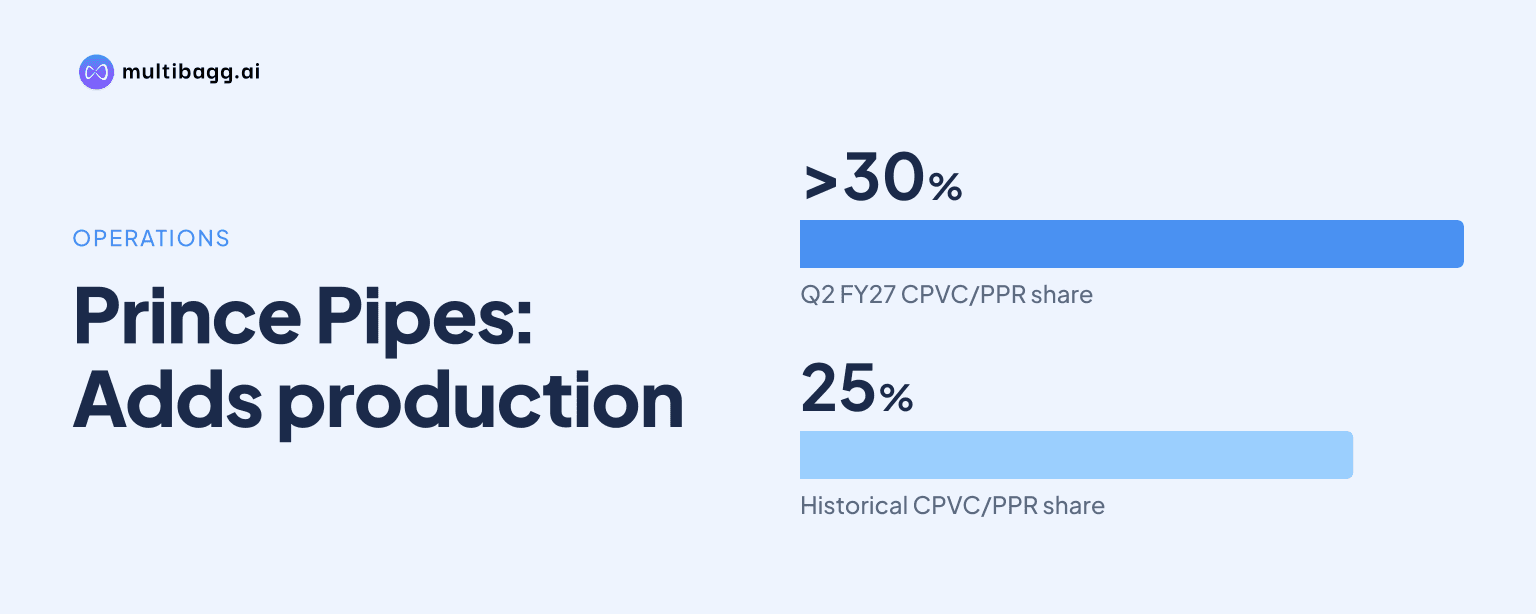
- CPVC and PPR together contribute more than 30% of Prince Pipes revenue, compared with closer to 25% historically.
- Prince Pipes reported Q2 FY27 revenue of Rs 821 crore, up 38% year on year.
powered by IRIS
Prince Pipes and Fittings Limited plans to add production of its DECILO polypropylene low-noise piping system at Silvassa by the end of the March quarter, extending manufacturing beyond Haridwar, with CPVC and PPR together already accounting for more than 30% of revenue.
Know Prince Pipes & Fittings inside out
Results, valuation, peers and who's buying, in one view.
Why is Prince Pipes adding DECILO production at Silvassa?
Prince Pipes is adding DECILO production at Silvassa to extend its value-added product range beyond chlorinated polyvinyl chloride, or CPVC, and polypropylene random copolymer, or PPR, plumbing systems into polypropylene, or PP, piping. Management said on its November 4, 2026, Q2 and H1 FY27 earnings call that DECILO pipes and fittings are currently made at Haridwar, while Silvassa production is planned by the end of the March quarter.
The planned addition follows DECILO installations in residential and hospitality projects across multiple states during the September quarter. Prince Pipes describes DECILO as a polypropylene low-noise piping system rather than a conventional polyvinyl chloride, or PVC, product. The company did not disclose Silvassa capacity, capital expenditure, customer names, project numbers or DECILO revenue, leaving the manufacturing expansion as the stated milestone.
The move forms part of Prince Pipes' two-part strategy for value-added products. The first element is deeper penetration of established CPVC and PPR plumbing systems, while the second is investment in new products including DECILO. CPVC and PPR together now contribute more than 30% of overall revenue, compared with closer to 25% historically, according to management.
How does DECILO fit Prince Pipes' product strategy?
DECILO fits Prince Pipes' stated plan to reduce dependence on its core PVC category through CPVC, PPR and PP product categories. Management said a larger contribution from these polymers could make margins less volatile over the long term because of commodity-price movements. This was management's view of the intended product-mix effect and was not a forecast of a specific margin outcome.
Prince Pipes established a new product innovation and research and development function during the September quarter, with the stated objective of creating additional value-added categories. Management said it intends to launch more piping products over the next few years in which Prince Pipes would be a first mover, but did not provide launch dates, product counts or investment amounts.
Management's stated objective is to replace metal and concrete pipes at construction sites with polymer piping solutions. It cited longer product life cycles, faster installation and lower total cost of ownership for builders and contractors as the proposed benefits. The September-quarter residential and hospitality installations provide the disclosed evidence of DECILO use, while the broader replacement opportunity remains a management intention.
Got a follow-up? Ask IRIS
What were Prince Pipes' Q2 and H1 FY27 financial results?
Prince Pipes reported Q2 FY27 revenue from operations of Rs 821 crore, up 38% year on year, while volume increased 22% to 52,080 metric tonnes. Earnings before interest, tax, depreciation and amortisation, or EBITDA, rose 82% to Rs 100 crore, and the EBITDA margin increased 300 basis points to 12%. Profit after tax rose 220% to Rs 48 crore, with the margin increasing 400 basis points to 6%.
For H1 FY27, Prince Pipes reported revenue from operations of Rs 1,430 crore, up 22% year on year, and volume of 92,809 metric tonnes, up 7%. EBITDA was Rs 177 crore, up 86%, while the EBITDA margin was 12%, a 400-basis-point increase. Profit after tax was Rs 82 crore, and the profit-after-tax margin was 6%, also 400 basis points higher.
The September quarter grew faster than the half year: Q2 revenue growth was 38%, compared with 22% for H1, while volume growth was 22%, compared with 7% for H1. Management attributed Q2 volume growth partly to channel restocking after inventory was low at the quarter's start and PVC prices firmed. It also cited healthy end-product demand and consolidation as smaller players lost market share in the prevailing raw-material environment.
What will determine the Silvassa DECILO expansion's impact?
The first measure of the Silvassa expansion will be whether Prince Pipes completes the planned manufacturing addition by the end of the March quarter and expands use beyond the residential and hospitality installations disclosed for the September quarter. The company has not provided DECILO capacity, utilisation, pricing, revenue or profitability figures. The available disclosure therefore supports a production-footprint expansion but not a numerical estimate of its financial effect.
Prince Pipes had total installed capacity of 435,000 metric tonnes as of H1 FY27. Working-capital days were 55 days in H1 FY27, while receivable days stood at 34 days and inventory days at 74 days as of September 30, 2026. Chief Financial Officer Anand Gupta said the company improved working-capital efficiency through sales-quality measures, faster cash realisation and tighter credit control.
Distribution and branding form part of the market approach management described for the September quarter. Prince Pipes said growth was supported by distribution expansion and digitisation of its value chain to improve connections with retailers and plumbers. It also announced sponsorship of Kon Honar Crorepati, the Marathi-language version of Kaun Banega Crorepati hosted by Madhuri Dixit, as a brand-building initiative during the quarter.
Conclusion
The planned Silvassa DECILO line would extend Prince Pipes' PP low-noise piping manufacturing beyond Haridwar and add another value-added polymer category alongside CPVC and PPR. The expansion follows multi-state residential and hospitality installations, while CPVC and PPR have increased from closer to 25% of revenue historically to more than 30% currently.
The next disclosed milestone is DECILO manufacturing at Silvassa by the end of the March quarter. Investors can watch for management disclosures on capacity, adoption, revenue mix and profitability, none of which were provided on the November 4, 2026 call, as well as progress in receivable days from the 34 days reported on September 30, 2026.