










PTC India Q2 Volume Rises 24% as Standalone Profit Falls
Key highlights
- PTC India’s Q2 FY27 standalone trading volume rose 24% to 32.5 billion units.
- PTC India’s Q2 FY27 standalone profit after tax fell 15% to ₹113 crore.
- PTC India’s H1 FY27 standalone trading volume increased 18% to 58.2 billion units.
- PTC India reported Q2 FY27 consolidated total income of ₹5,958 crore and net profit of ₹159 crore.
powered by IRIS
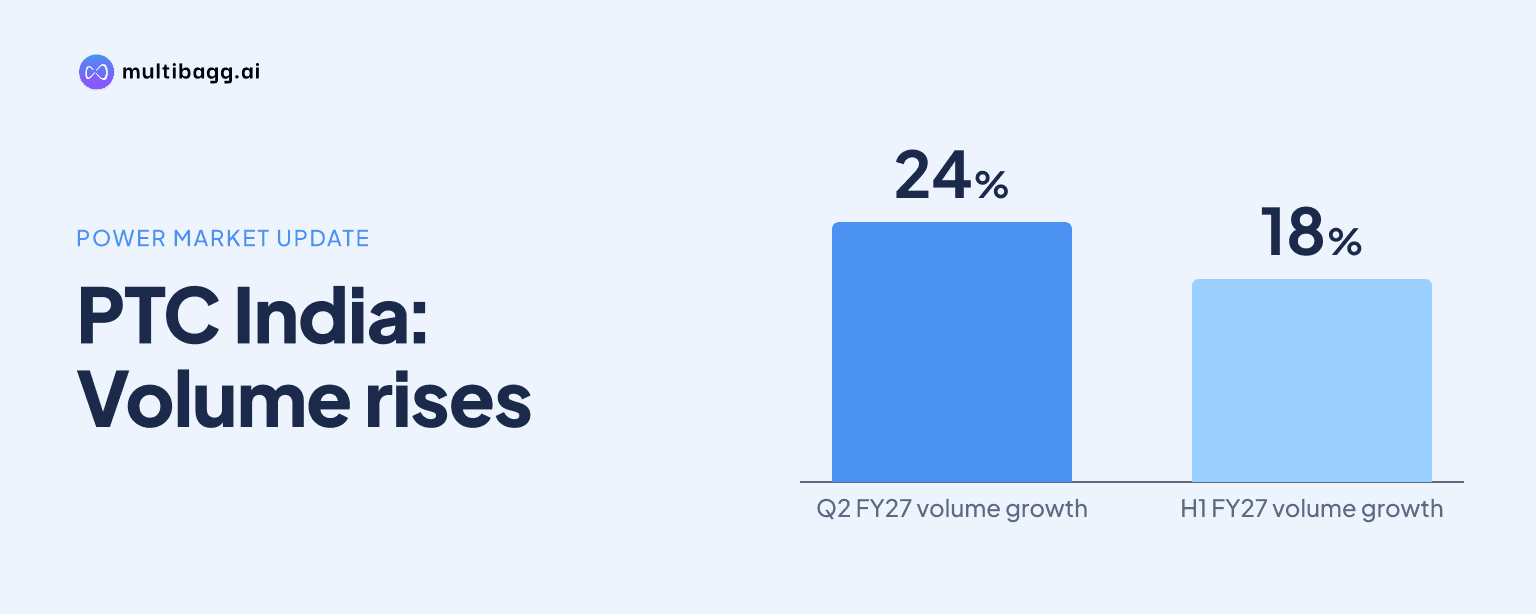
PTC India Limited reported a 24% year-on-year increase in Q2 FY27 trading volume to 32.5 billion units, but standalone profit after tax declined 15% to ₹113 crore as lower cross-border trade and surcharge income affected earnings.
Know PTC India inside out
Results, valuation, peers and who's buying, in one view.
Why did PTC India’s trading volume increase in Q2 FY27?
PTC India said its trading volume rose to 32.5 billion units in the quarter ended September 2026, from 26.2 billion units a year earlier. The increase was led by exchange-based transactions and medium-term trade, according to management’s earnings-call presentation.
The company operates in India’s power-trading market, arranging sales under long-term, medium-term and short-term contracts, as well as transactions on power exchanges. Higher volume therefore indicates increased electricity traded through its platform, although the profitability of each type of transaction can differ materially.
For the first half of FY27, standalone trading volume rose 18% to 58.2 billion units from 49.2 billion units. Consolidated volume was 58.3 billion units. Management also said overall energy generation rose 10.64% in the first half, while its trading volume grew by more than 18%.
The volume growth did not translate into higher standalone operational income because the mix shifted away from cross-border transactions. Management said cross-border trade carries a higher margin than exchange transactions, making the business mix an important factor in quarterly profitability.
What were PTC India’s Q2 FY27 standalone financial results?
PTC India reported standalone total operational income of ₹134 crore for Q2 FY27, down 2% from ₹137 crore in the corresponding quarter of the previous year. Standalone profit before tax fell 16% to ₹152 crore from ₹180 crore, while profit after tax declined 15% to ₹113 crore from ₹134 crore.
Earnings per share for the quarter were ₹3.83, compared with ₹4.52 a year earlier. Total comprehensive income also fell 15% to ₹113 crore. The company linked the fall in operational income to lower cross-border trading activity.
Management attributed the reduction in profit before tax mainly to lower net surcharge income. It said improved liquidity at electricity distribution companies reduced the scope for surcharge-related income. This means a larger trading volume alone was insufficient to offset the lower contribution from higher-margin activities and surcharge income.
How did the first-half performance compare with last year?
PTC India’s standalone operational income for the first half of FY27 was ₹247 crore, marginally below ₹248 crore in the prior-year period. Profit before tax fell 23% to ₹248 crore from ₹321 crore, and profit after tax declined 23% to ₹184 crore from ₹239 crore.
First-half earnings per share were ₹6.21, compared with ₹8.06 a year earlier. Management cited lower net surcharge income and rebate income as the principal reasons for the reduction in first-half profit before tax.
The results show a difference between transaction activity and income generation. The company traded more power during both the quarter and half year, but its income mix was less favourable than a year earlier. Cross-border transactions, surcharge income and rebate income have a greater bearing on profitability than headline volumes alone.
On a consolidated basis, PTC India reported total income of ₹5,958 crore and net profit of ₹159 crore for the quarter ended September 2026. Consolidated revenue was ₹5,812 crore, up 6.5% year on year, while consolidated profit after tax was lower than the ₹222 crore reported in the year-ago quarter.
Got a follow-up? Ask IRIS
What do trading margins and business mix indicate?
PTC India disclosed a short-term trading margin of 0.69 paisa per unit and a medium-term trading margin of 3.17 paisa per unit for the quarter. Its overall trading margin was about 2.89 paisa per unit. These figures underline that the margin realised depends on the category of power trade, not just on aggregate volume.
Exchange trading can support volumes by matching near-term demand and supply, but management’s comments indicate that lower cross-border business reduced the contribution from a higher-margin segment. The Q2 outcome reflects this mix effect: volume increased significantly while standalone operational income declined modestly.
The company also reported that Hindustan Power Exchange, or HPX, generated revenue from operations of ₹18 crore in Q2 FY27, compared with ₹9.89 crore in Q2 FY26. This was a separate operational data point discussed during the call and demonstrates increased activity at the exchange.
PTC India has historically been involved in long-term power trading from large generation projects as well as short-term transactions arising from supply and demand mismatches. It also undertakes techno-commercial consulting work for commercial and industrial consumers, state entities and other institutions. Its results are consequently influenced by power-market liquidity, contract mix and the financial position of counterparties.
What does the quarter mean for investors and the power-trading market?
For investors, the quarter provides evidence of stronger power-trading activity but weaker standalone earnings. The 24% increase in volume is a measure of market participation, while the 15% decline in standalone profit after tax shows the importance of margins, cross-border flows and surcharge income to financial performance.
The financial condition of distribution companies is also relevant. PTC India said good liquidity at discoms reduced net surcharge income. While better liquidity can be positive for payment discipline across the electricity value chain, it also lowered an income component that had supported the company’s profit in the previous period.
The company disclosed a 1,200 MW long-term solar power purchase agreement in its investor presentation, along with cross-border power supply initiatives. These projects form part of its operating pipeline, but the provided results do not quantify their expected financial contribution or specify a timetable for earnings impact.
PTC India’s auditors issued an unmodified limited-review conclusion on the quarterly results. The reported review included an emphasis of matter relating to subsidiary PTC India Financial Services’ NBFC-IFC exposure requirement. This disclosure concerns the consolidated financial statements and should be considered separately from the parent company’s trading-volume and standalone earnings trends.
Conclusion
PTC India delivered higher trading volumes in Q2 FY27, with standalone volume reaching 32.5 billion units, but lower participation in higher-margin cross-border trade and lower surcharge income weighed on profit. Standalone operational income fell to ₹134 crore and profit after tax declined to ₹113 crore despite stronger exchange and medium-term transactions.
Investors will watch whether PTC India can improve its trading mix, particularly cross-border and medium-term activity, while sustaining volume growth. The disclosed 1,200 MW long-term solar power purchase agreement and cross-border supply initiatives are the key operational developments identified by the company, although no financial targets or implementation dates were provided in the results material.