










PTC India trading volume rose 18% as H1 profit fell 23%
Key highlights
- PTC India’s H1 FY27 standalone trading volume increased 18% to 58.2 billion units from 49.2 billion units.
- PTC India’s H1 FY27 standalone profit after tax fell 23% to Rs 184 crore from Rs 239 crore.
- Exchange products represented 60% of PTC India’s 58.25 billion units traded in H1 FY27.
- PTC India’s consolidated H1 FY27 profit before tax declined 45% to Rs 322 crore from Rs 587 crore.
powered by IRIS
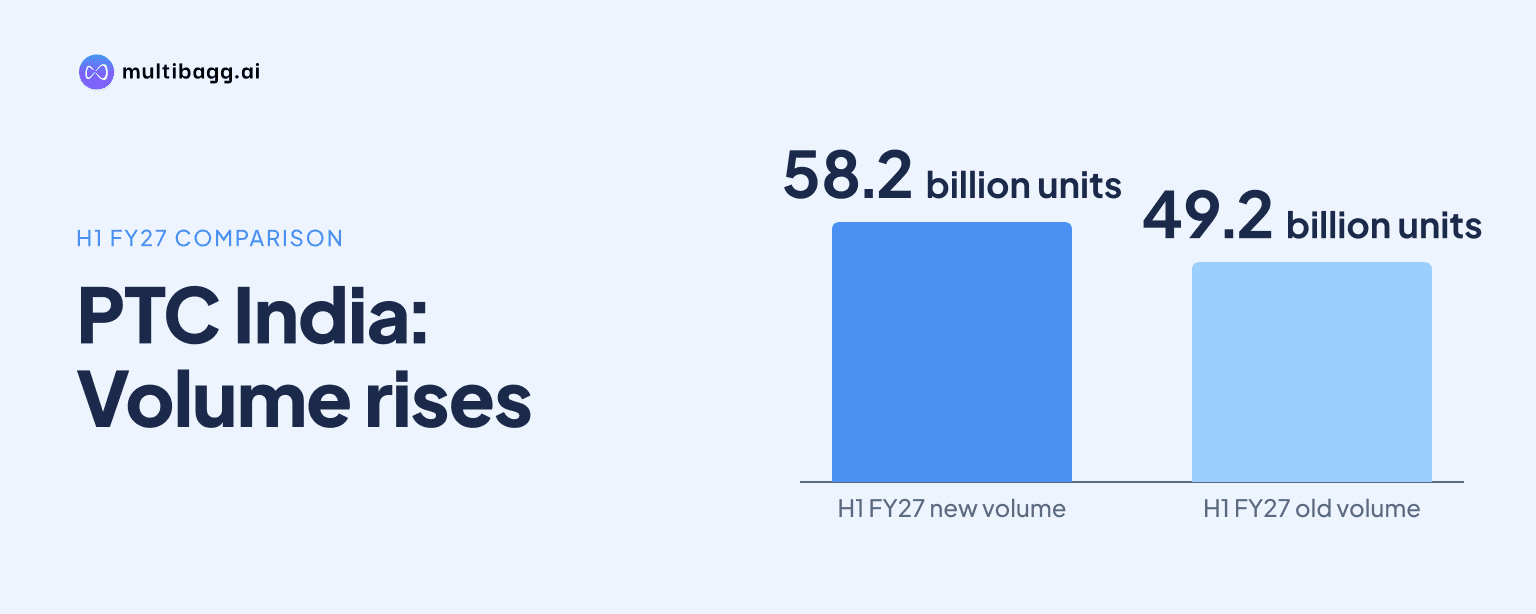
PTC India Limited reported an 18% increase in standalone trading volume to 58.2 billion units in H1 FY27, but standalone profit after tax fell 23% to Rs 184 crore as net surcharge and rebate income declined. Consolidated profit was also affected by an impairment provision at PTC Financial Services.
Know PTC India inside out
Results, valuation, peers and who's buying, in one view.
Why did PTC India’s H1 trading volume rise 18%?
PTC India’s standalone trading volume rose 18% year on year to 58.2 billion units in H1 FY27 from 49.2 billion units in the corresponding half year, driven by exchange trading and medium-term trading. Management said 60% of the 58.25 billion units traded during the first half came from exchange products, with the balance from bilateral long-term, medium-term and short-term transactions.
The volume gain outpaced growth in total energy generation, which management said increased 10.64% during H1 FY27. In the September quarter, PTC India’s standalone volume increased 24% to 32.5 billion units from 26.2 billion units a year earlier, indicating that the first-half expansion included stronger activity in the most recent quarter.
The difference between volume and income growth reflects PTC India’s transaction mix. Management said quarterly operational income fell 2% to Rs 134 crore from Rs 137 crore because cross-border trade declined, and it described cross-border activity as carrying higher margins than exchange business. Higher traded units therefore did not translate directly into higher operational income or profit.
Why did PTC India’s standalone H1 profit decline?
PTC India’s standalone profit before tax declined 23% to Rs 248 crore in H1 FY27 from Rs 321 crore because net surcharge income and rebate income fell. Profit after tax moved in the same direction, declining 23% to Rs 184 crore from Rs 239 crore, while earnings per share fell to Rs 6.21 from Rs 8.06 in the corresponding half year.
Management linked lower surcharge income to improved liquidity at distribution companies, known as DISCOMs. In the September quarter, it said net surcharge income declined to about Rs 26 crore from Rs 42 crore a year earlier. Surcharge is billed when a utility does not pay on time, so management said the reduction also indicated better receivables management and a lower level of credit exposure.
The half-year reduction in profit was larger than the change in operational income. Standalone operational income was nearly unchanged at Rs 247 crore in H1 FY27 versus Rs 248 crore a year earlier, while profit before tax decreased by Rs 73 crore. The disclosed explanation was lower surcharge and rebate income rather than a broad decline in operational income.
In the September quarter, standalone profit before tax fell 16% to Rs 152 crore from Rs 180 crore, and profit after tax fell 15% to Rs 113 crore from Rs 134 crore. Quarterly earnings per share declined to Rs 3.83 from Rs 4.52, showing that the reduction in surcharge income continued into the second quarter.
Got a follow-up? Ask IRIS
How did PTC Financial Services affect consolidated earnings?
PTC India’s consolidated H1 FY27 profit before tax fell 45% to Rs 322 crore from Rs 587 crore, a steeper decline than the 23% decline in standalone profit before tax. Consolidated profit after tax declined 42% to Rs 271 crore from Rs 465 crore, and consolidated earnings per share decreased to Rs 8.16 from Rs 13.05.
Management attributed the consolidated decline to lower standalone profit and reduced profitability at PTC Financial Services, or PFS. In the September quarter, PFS recorded an impairment provision of Rs 51 crore, compared with a reversal of impairment provision of Rs 57 crore in the corresponding quarter ended September 2025. That change affected the year-on-year consolidated comparison.
For the September quarter, consolidated profit before tax fell 43% to Rs 171 crore from Rs 298 crore, while consolidated profit after tax fell 28% to Rs 159 crore from Rs 222 crore. The different percentage movements show that the impairment-related effect was particularly visible above the tax line, alongside the lower standalone contribution.
PTC India said the process to disinvest its stake in PFS remained on track and that it had appointed a transaction advisory consultant. Management gave no completion deadline, saying the transaction requires regulatory approvals and that PFS operational stability is necessary to support value realisation. It said performance stabilisation and disinvestment work were proceeding in parallel.
What is changing in PTC India’s trading mix and pipeline?
PTC India is adding renewable and cross-border opportunities alongside exchange-led trading, with a 1,200-megawatt solar power purchase agreement signed with NTPC Renewable Energy during the last quarter. It has also floated a 500-megawatt, 2,000-megawatt-hour tender for long-term renewable power procurement, linking its pipeline to renewable generation and storage requirements.
Cross-border activity remains active in Bhutan, Nepal and Bangladesh, although management said lower cross-border trading reduced quarterly operational income because it carries higher margins than exchange trading. PTC India said Bangladesh energy flows remained stable under agreed contracts with regular payments, signed a 1,200-megawatt winter supply contract with Bhutan, and began both electricity imports and exports with Nepal based on demand-supply profiles.
Management expects power prices to remain firm in morning and evening peak periods as renewable penetration changes the supply mix. It said installed energy-storage capacity remained below 20 gigawatt-hours and cited intraday prices ranging from less than Rs 1 per unit to the regulatory ceiling of Rs 10 per unit. Management expects policy and regulatory measures to add storage capacity over the next 12 to 18 months.
PTC India said additional storage capacity could moderate peak-price spikes and reduce intraday volatility once facilities become operational. Management described renewable energy and battery energy storage as a business opportunity rather than providing financial guidance. It also gave no volume guidance for the third quarter or full year, saying it did not foresee a dramatic change in current conditions.
Conclusion
The first-half results show that PTC India’s greater trading throughput did not preserve earnings when exchange activity made up 60% of traded volume and surcharge and rebate income decreased. The contrast was more pronounced on a consolidated basis, where profit before tax declined 45% as lower standalone earnings coincided with the PFS impairment impact.
The next items to watch are execution of the 1,200-megawatt solar agreement, the 500-megawatt and 2,000-megawatt-hour renewable procurement process, and management’s expectation that additional storage capacity could be added within 12 to 18 months. PTC India has also said PFS disinvestment work continues, but the timing remains unresolved because regulatory approvals and operational stabilisation are still required.