










PVR INOX says F&B margins can rise on 60% popcorn sales mix
Key highlights
- PVR INOX said popcorn and Pepsi account for 60% of total F&B sales.
- An analyst cited PVR INOX F&B gross-margin expansion from about 74% to 77%-78%.
- PVR INOX said 40% of F&B growth came from volume and about 60% of SPH growth came from value.
- PVR INOX said close to 85% of cinema visitors consume food or beverages.
powered by IRIS
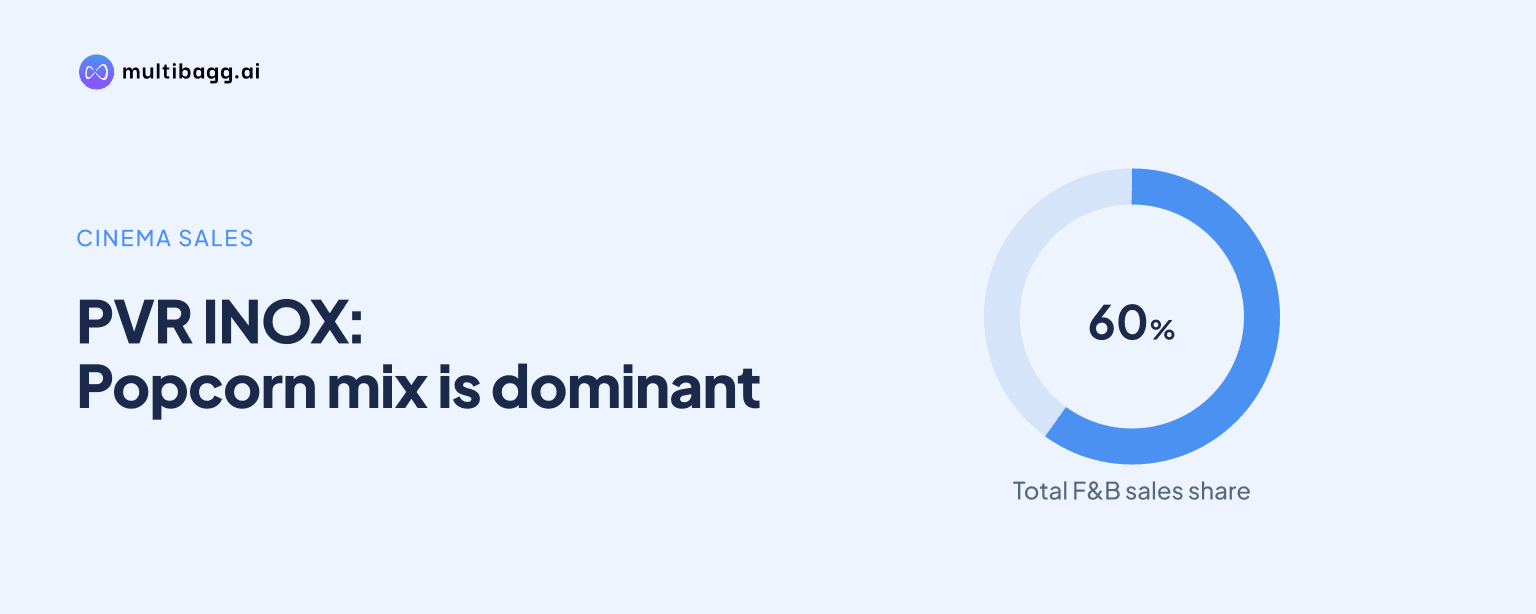
PVR INOX said in its Q2 FY27 earnings call that F&B gross margins can continue rising because popcorn and Pepsi account for 60% of food sales, while vendor renegotiations, logistics automation and lower wastage reduce costs. An analyst said the segment’s gross margin had improved from about 74% to 77%-78%.
Know PVR Inox inside out
Results, valuation, peers and who's buying, in one view.
Why are PVR INOX F&B margins expanding?
PVR INOX said F&B margins are expanding through product mix, volume growth, value growth and supply-chain savings, rather than through pricing alone. Responding to an analyst who cited gross-margin improvement from about 74% to 77%-78%, management said hero products such as popcorn and Pepsi carry high gross margins and remain central to the sales mix.
Management said 40% of F&B growth had come through higher volumes, while about 60% of spend per head, or SPH, growth had come through value. This indicates that the company’s F&B growth was not solely linked to higher selling prices. PVR INOX also said it is testing food delivery and counters that can serve cinema patrons as well as mall visitors, although these initiatives remain very small.
How important are popcorn and Pepsi to PVR INOX food sales?
Popcorn and Pepsi are important because they account for 60% of PVR INOX’s total F&B sales and are low-cost-of-goods-sold, or low-COGS, products, according to management. Gautam Dutta said these products operate at high margins and that maintaining their 60% contribution is central to retaining their role as the company’s hero cinema-food products.
The 60% mix is why management stressed package innovation alongside menu expansion. PVR INOX said new packages are intended to sustain the contribution from popcorn and Pepsi while keeping those products relevant to cinema customers. It said its food range is extensive, but did not disclose category-level sales figures beyond the 60% share from the two products.
Management compared current food spending with mature Western cinema markets. PVR INOX said its SPH is about 60% of average ticket price, or ATP, while food sales or SPH can equal ATP in mature markets. Management presented that comparison as an indication of room to increase food spending, rather than as a formal target with a stated timeframe.
Do PVR INOX discounts increase food sales?
PVR INOX said its discounted F&B offers are intended to increase consumption and encourage customers to choose larger packs, rather than simply cut the selling price. Its weekend offer provides free refills on large popcorn and Pepsi, an initiative management said has operated for the past two years and has helped customers upgrade from small or medium packs.
The company also runs Tuesday offers and other targeted F&B promotions to stimulate weekday demand. Management said it has data for just about all cinema footfalls and tracks visit timing, movie choice, seat type, cinema experience and food purchases. This information supports personalised offers aimed at increasing consumption among customers who had not previously bought food.
PVR INOX said close to 85% of people entering its cinemas now consume something at the venue. Management linked volume growth to targeted promotions, while value accounted for about 60% of SPH growth. The disclosed approach is therefore aimed at raising both participation and average basket size, including through larger refill-eligible packs.
Got a follow-up? Ask IRIS
What cost actions can raise PVR INOX F&B margins further?
PVR INOX said supply-chain changes can support further F&B gross-margin improvement by reducing wastage and spillage. Management said it continues to renegotiate supply terms with vendors and is migrating cinema logistics to a fourth-party logistics, or 4PL, model, which is intended to streamline supply-chain operations through automation.
The mechanism is inventory management. PVR INOX said automation can help cinemas use products that are near expiry before they expire, reducing waste and the related cost. Management identified these savings and vendor-term renegotiations as margin contributors alongside the high-margin popcorn-and-Pepsi mix, which accounts for 60% of F&B sales.
The company is also pursuing small food-related initiatives outside auditorium sales. PVR INOX said food delivery remains very small and that it is subleasing spaces where a counter could serve customers inside the cinema and in the mall. Management said these activities add to growth, but did not quantify their revenue, margin contribution or rollout scale in Q2 FY27.
How does F&B growth fit PVR INOX’s wider Q2 FY27 plan?
PVR INOX is pairing F&B initiatives with network investment in Q2 FY27. Management said capital expenditure for the current fiscal year would be about Rs 300 crore to Rs 320 crore, after approximately Rs 132 crore was spent in the first half. It expects new screen additions to accelerate in the second half, increasing capital payouts before the fiscal year-end.
Management said next year’s capital expenditure is likely to exceed Rs 350 crore, subject to the pipeline, fit-outs and execution progress. The company expects more screen additions than in the current year and said the bulk of SMART screens will open next year, although it did not give a precise number of SMART screens.
PVR INOX said it was hopeful that first-half performance would continue into the second half, while cautioning that consumer and audience response cannot be predicted. Its disclosed F&B strategy does not rely on one pricing lever: it combines volume-led growth, value-led SPH growth, personalised promotions, the 60% popcorn-and-Pepsi mix, vendor negotiations and lower wastage.
Conclusion
PVR INOX’s stated basis for further F&B margin expansion combines sales mix and cost control. Popcorn and Pepsi represent 60% of food sales, while management said 40% of F&B growth came from higher volumes and about 60% of SPH growth came from value. The gross-margin change from about 74% to 77%-78%, cited by an analyst, occurred while the company continued its discounted refill offers.
The next points to watch are the execution of the 4PL migration and whether automation reduces wastage and spillage as management expects. Management also said weekend refill offers have operated for two years, personalised promotions use data from just about all cinema footfalls, and close to 85% of visitors consume something, making participation and food-sales mix relevant measures of progress.