










PVR INOX says roughly 500 screens feasible in three years
Key highlights
- PVR INOX agreed that roughly 500 new screens over three years is a fair expectation.
- SMART Cinema capital expenditure is about 25% to 30% lower, and operating expenditure about 25% lower, than normal larger-city cinemas.
- PVR INOX has signed about 100 SMART Cinema sites expected to open over the next 12 to 18 months.
- PVR INOX had 1,797 screens at September 30, 2026 and plans 90 to 100 openings in FY27.
powered by IRIS
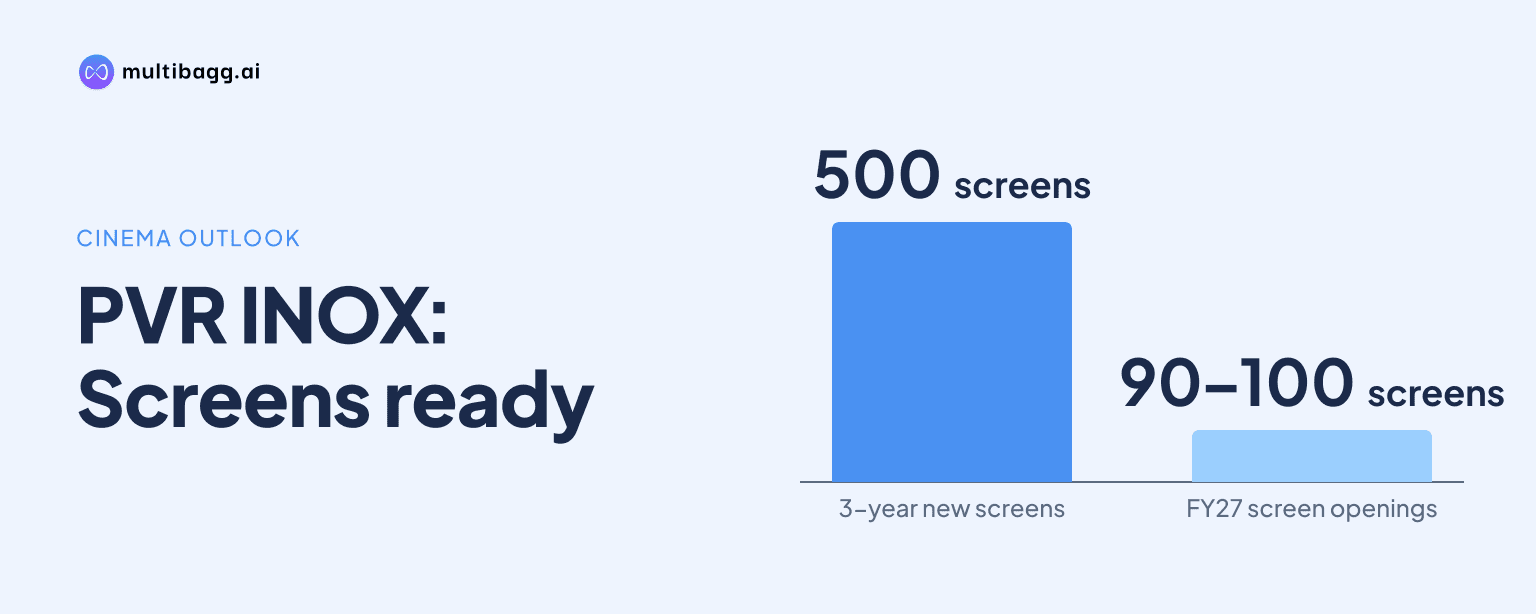
PVR INOX Limited said on October 28, 2026 that roughly 500 new screens over the next three years was a fair expectation, after its September SMART Cinema pilot in Muzaffarpur showed capital expenditure 25% to 30% below a normal screen. Management has identified 300 Tier-3 and Tier-4 cities for the format.
Know PVR Inox inside out
Results, valuation, peers and who's buying, in one view.
How quickly could PVR INOX add new screens?
PVR INOX indicated that roughly 500 new screens over three years could be feasible, with management answering “Yes” to an analyst’s proposed expectation. The company had 1,797 screens across 114 cities in India and Sri Lanka at September 30, 2026, after opening 24 screens across six cinemas and exiting 25 screens in H1 FY27.
The roughly 500-screen figure was not presented as standalone formal guidance. The analyst framed it after suggesting additions of 150 to 175 screens a year from the next fiscal year, and management agreed. For FY27, PVR INOX remains on track to open 90 to 100 screens, with most openings expected in the second half under capital-light formats.
PVR INOX said net additions had been muted in recent years because it closed cinemas in obsolete first-generation malls, including properties with deteriorated infrastructure or weaker tenant ecosystems. Management said much of that circuit clean-up is now behind it, following the 25 exits in H1 FY27, and expects net screen additions to accelerate.
What makes PVR INOX SMART Cinema cheaper to build?
PVR INOX said the SMART Cinema format requires capital expenditure about 25% to 30% lower than a normal screen and operating expenditure about 25% lower than its cinemas in larger cities. Its first SMART Cinema opened in Muzaffarpur, Bihar, in September 2026 as a pilot aimed at Tier-3 and Tier-4 markets.
Management said the format adjusts seat quality, legroom, seat width, audio-visual provision and square footage per seat to local demographics and expected visit frequency. It also limits food and beverage choices to fast-selling “hero items,” which reduces the range of products offered compared with the wider circuit.
Ticket pricing at Muzaffarpur is also lower than the company average. PVR INOX reported a Q2 FY27 average ticket price of Rs 298 across its circuit, while management said the Muzaffarpur SMART Cinema was running at about Rs 190; food and beverage prices are also lower there. Management called the first two months above expectations but did not disclose the pilot’s footfall, occupancy, revenue or margin.
PVR INOX said it would retain its new-unit economics discipline even if openings reached 200 screens annually. Management’s stated objective is a maximum payback period of three to four years for every unit, although it did not provide a payback forecast for Muzaffarpur or the signed SMART pipeline.
Got a follow-up? Ask IRIS
Where will PVR INOX roll out SMART Cinemas?
PVR INOX has identified 300 Tier-3 and Tier-4 cities for SMART Cinemas and signed about 100 sites that management expects to come up in the next 12 to 18 months. Management described SMART as an additional growth engine alongside the company’s wider FY27 plan for 90 to 100 new screens.
The next locations already under fit-out were Rampur and Bharatpur as of the October 28 call. PVR INOX expects to open two or three more SMART Cinemas in FY27, while management said the bulk of the format’s openings should occur in the following year, potentially from the summer, without giving a specific screen target.
PVR INOX plans to use a mix of commercial structures rather than require one ownership model. Chief Executive Officer Gautam Dutta said developers in smaller towns had shown willingness to contribute where terms work for both parties, while PVR INOX could also invest itself rather than limit growth to asset-light or franchise arrangements.
The structure affects reported revenue and costs. In an asset-light cinema, PVR INOX records the full revenue and operating cost in its profit and loss account; in a franchise arrangement, it records management fees that are a share of property revenue, while the franchise owner bears operating costs.
How does PVR INOX intend to fund the expansion?
PVR INOX said growth investment remains the first priority in its capital-allocation policy, before shareholder distributions. It ended September 2026 with net cash of Rs 141 crore, compared with Rs 81 crore in June, after generating Rs 604 crore of free cash flow and repaying Rs 259 crore of debt during H1 FY27.
The company completed a Rs 300 crore maiden share buyback in September 2026. Its policy requires net debt to earnings before interest, tax, depreciation and amortisation, or EBITDA, to remain within 0.5 times after any distribution; management expects around 30% of annual surplus cash flow to be returned through dividends, buybacks or both, at the Board’s discretion.
Capital expenditure is expected to rise as screen additions increase. PVR INOX spent about Rs 132 crore in H1 FY27 and expects total FY27 capital expenditure of about Rs 300 crore to Rs 330 crore, while next year’s spending is likely to exceed Rs 350 crore depending on pipeline conversion, fit-outs and execution.
The expansion plan follows higher reported earnings in Q2 FY27. On an Ind AS 116-adjusted basis, PVR INOX reported total income of Rs 2,133 crore, up 17% year on year, EBITDA of Rs 475 crore, up 44%, and profit after tax of Rs 273 crore, more than double the prior-year quarter.
Conclusion
PVR INOX is shifting from a period in which exits held back net screen growth to a larger rollout supported by its lower-cost SMART format. The Muzaffarpur pilot, with a ticket price of about Rs 190 against the company’s Rs 298 Q2 average, has given management confidence to pursue 300 smaller-city opportunities and a signed pipeline of about 100 sites.
The next disclosures to watch are the Rampur and Bharatpur openings, the two or three further SMART Cinemas planned in FY27, and progress in converting the 100-site pipeline over 12 to 18 months. Management’s FY27 target of 90 to 100 openings, capital-expenditure range of Rs 300 crore to Rs 330 crore, and three-to-four-year unit-payback objective will indicate how the rollout is progressing.