










Quasar India enters CIRP after NCLT admits Rs 6.145 crore claim
Key highlights
- The NCLT admitted CIRP against Quasar India on October 31, 2026, in CP (IB) No. 697/ND/2025.
- Bikit's admitted claim totals Rs 6.1452745 crore, including Rs 5.395 crore of principal.
- The advance was linked to a Rs 15 crore agricultural and allied goods purchase order dated June 25, 2024.
- Raghunath Bhandari was appointed IRP, and the Section 14 moratorium began on October 31, 2026.
powered by IRIS
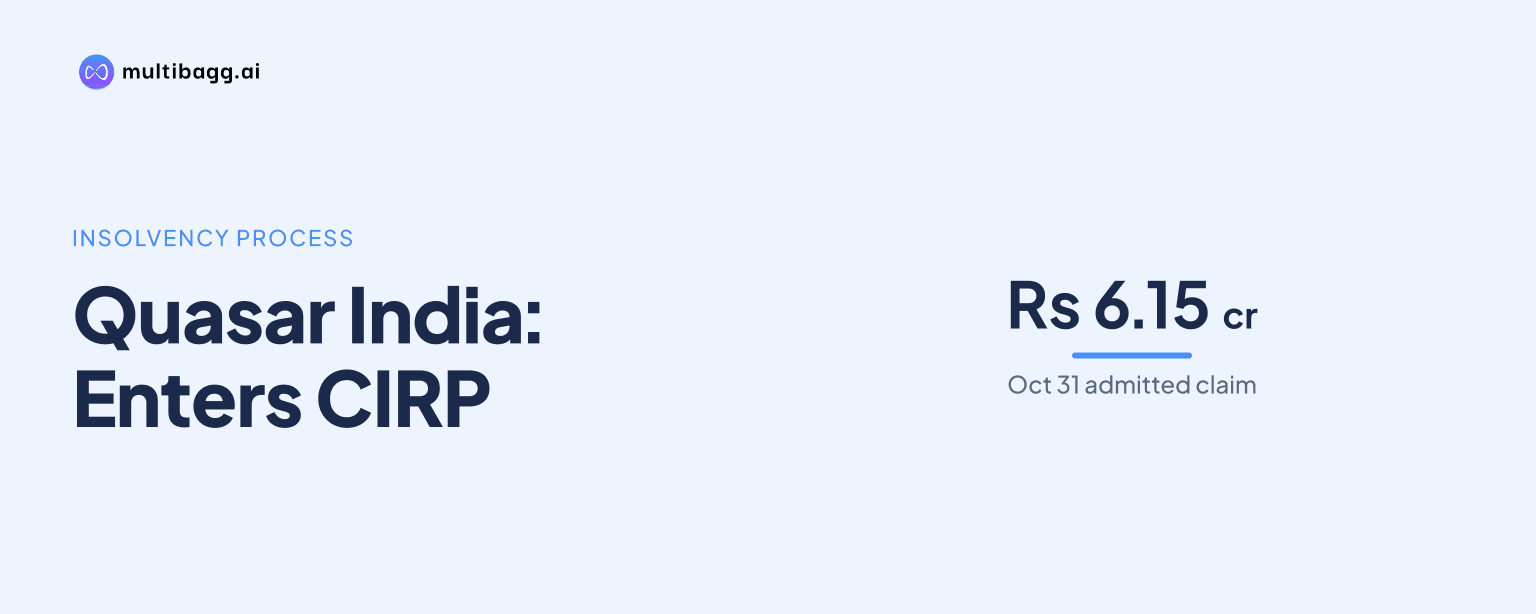
Quasar India Limited entered the Corporate Insolvency Resolution Process on October 31, 2026, after the NCLT admitted a Rs 6.1452745 crore claim by Bikit Private Limited, including Rs 5.395 crore advanced for agricultural goods that were neither delivered nor refunded.
Know Quasar India inside out
Results, valuation, peers and who's buying, in one view.
Why did Quasar India enter CIRP?
Quasar India entered CIRP after the National Company Law Tribunal's New Delhi Bench admitted Bikit's application under Section 9 of the Insolvency and Bankruptcy Code, 2016. The case, registered as CP (IB) No. 697/ND/2025, was admitted on October 31, 2026, moving the company from the application stage into the statutory insolvency-resolution framework.
Bikit was identified as the operational creditor in the proceedings. Its claim arose from a memorandum of understanding dated June 25, 2024, under which Quasar India was to supply agricultural and allied trading goods against a purchase order valued at Rs 15 crore. Bikit paid an advance of Rs 5.395 crore under this arrangement.
The NCLT found that the first delivery was due by August 30, 2024. According to the disclosed order details, Quasar India did not establish that it had delivered the contracted goods or repaid the advance. The tribunal also found that the unpaid principal was independently established and exceeded the threshold applicable for a Section 9 petition.
What is the amount admitted by the NCLT?
The admitted claim totals Rs 6.1452745 crore, comprising Rs 5.395 crore in principal and Rs 0.7502745 crore in contractual simple interest. The interest component was calculated at 12% a year, according to the information disclosed with the NCLT proceeding.
The principal amount relates to the advance paid by Bikit for the proposed supply of agricultural and allied goods. The tribunal's finding focused on the absence of evidence of delivery or repayment, rather than treating the case solely as a contractual recovery action.
What did Quasar India argue before the tribunal?
Quasar India disputed the creditor's claim and contended that there was a pre-existing dispute between the parties. The company also alleged non-performance by Bikit, including non-payment of a first tranche described in the disclosures as about 20% of the transaction value.
The company further argued that the insolvency petition was being used as a recovery mechanism and maintained that it was a profit-making entity rather than an insolvent one. It also raised an issue regarding the timing of the creditor's default record from an Information Utility, which it said was produced at the rejoinder stage.
However, the NCLT admitted the petition after finding no genuine pre-existing dispute that prevented admission under Section 9. It also recorded that payment had not been made within the statutory period. Admission does not decide every commercial contention between the parties, but it triggers the process prescribed under the IBC.
Got a follow-up? Ask IRIS
Who is managing Quasar India during CIRP?
Raghunath Bhandari has been appointed as the interim resolution professional, and Quasar India's board powers stand suspended during CIRP. The IRP is responsible for managing the company's day-to-day affairs and carrying out the statutory functions assigned under the IBC.
The NCLT order places the IRP's role within the framework of Sections 15, 17, 18, 19, 20 and 21 of the Code. These provisions cover public announcement requirements, management of the corporate debtor, collection and verification of claims, cooperation from personnel, preservation of value and formation of the committee of creditors.
This change is material for shareholders and other stakeholders because the board no longer exercises its usual management powers during the process. The IRP will take custody and control of the company's affairs in accordance with the statutory framework, while claims from creditors are assessed through the CIRP process.
How does the moratorium affect Quasar India and its creditors?
The Section 14 moratorium took effect on October 31, 2026, restricting the institution or continuation of suits and proceedings against Quasar India. The restriction includes execution of judgments, decrees and orders before courts, tribunals, arbitration panels and other authorities.
The order was uploaded to the NCLT website on November 3, 2026, while the company disclosed the admission on November 4, 2026. The moratorium remains effective until the completion of CIRP, approval of a resolution plan, or an order for liquidation, as applicable under the IBC.
For creditors, the moratorium consolidates the process for pursuing claims through the IRP rather than through separate recovery actions. For the company, it provides a legally defined period in which its assets and operations are handled within the insolvency process. The supplied disclosures do not provide financial or operating metrics that would quantify the immediate business impact.
Conclusion
Quasar India's CIRP admission places the company under formal insolvency administration after the NCLT found documentary support for an unpaid Rs 5.395 crore advance and admitted a total Rs 6.1452745 crore claim. The suspension of board powers, appointment of Raghunath Bhandari as IRP and commencement of the moratorium are the immediate consequences of the October 31 order.
The next steps will depend on the IRP's statutory actions, including collection and verification of creditor claims and the formation of a committee of creditors. The disclosed process may lead to a resolution plan, while liquidation remains a possible outcome if a resolution is not achieved under the IBC framework.