










Quess says higher EPF ceiling can expand formal workforce
Key highlights
- Quess completed 96.5% of EPF payroll compliance between the September and October payrolls.
- The EPF wage ceiling increased from Rs 15,000 to Rs 25,000, lifting affected monthly contributions from Rs 1,800 to about Rs 3,000.
- Quess reported stable General Staffing open mandates of 30,000 to 35,000 positions.
- Newer higher-margin staffing businesses contributed nearly 18% to 20% of mix, versus 80% to 82% for traditional businesses.
powered by IRIS
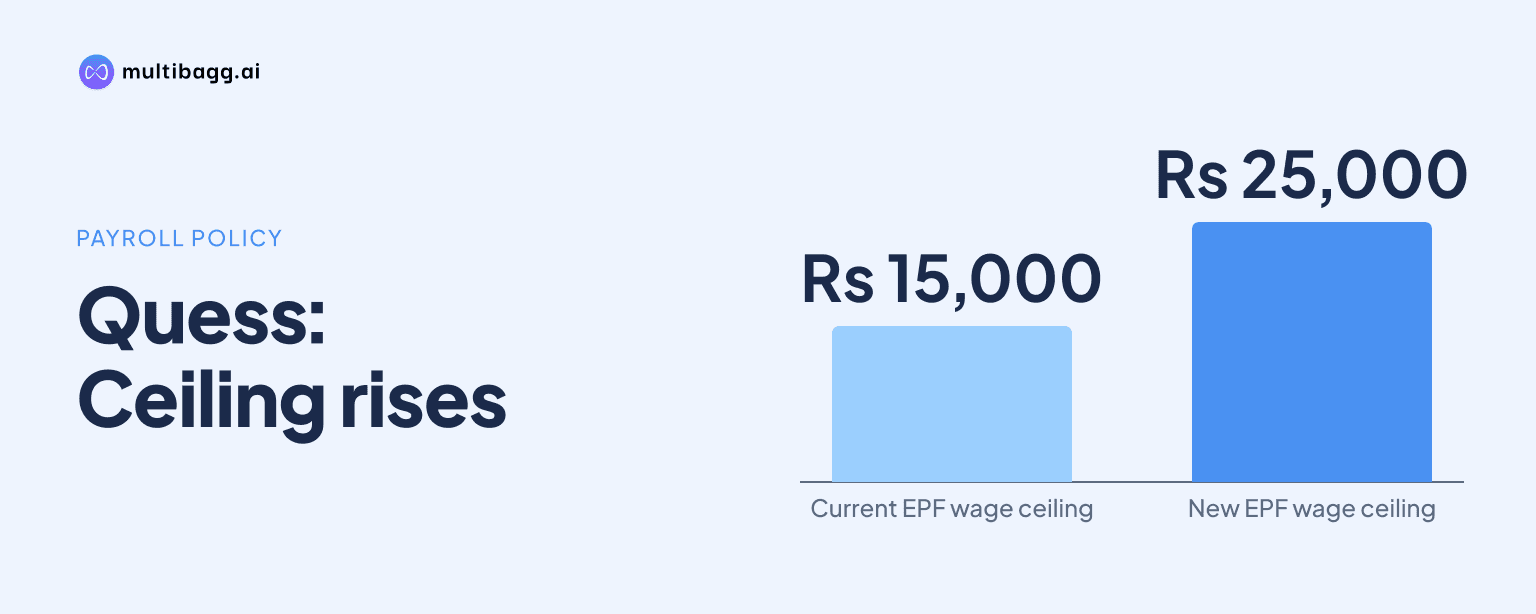
Between the September and October payrolls, Quess Corp completed 96.5% compliance with the higher Rs 25,000 Employees’ Provident Fund wage ceiling, which takes contributions for affected workers from Rs 1,800 to about Rs 3,000 a month. Management said the immediate revenue effect would be modest, while broader formalisation could support Quess over the medium to long term.
Know Quess Corp inside out
Results, valuation, peers and who's buying, in one view.
How much EPF compliance has Quess completed?
Quess completed 96.5% of the relevant payroll and pay-sheet changes between the September and October payrolls. Management said it had worked with customers and made the necessary changes for associates affected by the increase in the Employees’ Provident Fund, or EPF, wage ceiling from Rs 15,000 to Rs 25,000.
The remaining 3.5% was a timing issue rather than a compliance obstacle, according to management. Some global accounts require purchase orders, or POs, that take longer to be finalised, but Quess said it and its customers would ensure compliance with applicable laws.
The EPF work follows a broader Labour Code exercise that was almost 95% to 96% complete at the first-half level, according to Chief Financial Officer Neeraj Jain. Jain said he did not expect a material residual one-time Labour Code impact to flow into the second half, indicating that the payroll implementation process was substantially completed.
How does the higher EPF ceiling affect Quess revenue?
The higher ceiling should increase Quess’s revenue line slightly for workers previously contributing at the ceiling, because the higher statutory contribution is reflected through payroll. Management said an associate contributing Rs 1,800 a month at 12% would move to about Rs 3,000 a month under the Rs 25,000 ceiling.
Quess did not disclose the number of affected associates, incremental revenue, customer recoveries, operating-margin effect or cash-flow impact. Management characterised the revenue increase as “a tad bit”, so the transcript identifies a pass-through mechanism but does not provide a financial sensitivity for the Rs 1,200 monthly contribution difference.
The company distinguished that statutory payroll pass-through from changes in its operating mix. Construction, manufacturing and value-added services, or VAS, generally have credit terms of 15 to 30 days, while traditional staffing operations are typically collect-and-pay businesses. That difference can affect working-capital timing, but management did not say the EPF revision itself would expand margins.
Why does Quess see formalisation as a longer-term tailwind?
Quess expects higher social-security contributions to encourage workers to shift from informal work into formal jobs over the medium to long term. Management said that increases in minimum wages, social-security contributions and other embedded employment benefits tend to raise the appeal of formal employment, including when the EPF ceiling rises from Rs 15,000 to Rs 25,000.
Management linked formal employment to pension access, maternity benefits, minimum wages, on-the-job skilling and career growth. This was a management assessment of how the labour market may respond, not a forecast for the number of workers Quess will add or revenue it will generate from the policy change.
The opportunity is relevant to Quess’s General Staffing pipeline, where open mandates were stable at 30,000 to 35,000 positions. Management guided for 10,000 to 15,000 General Staffing additions in the coming quarter and said it would pursue opportunities beyond that range where economic conditions and client demand permit.
Got a follow-up? Ask IRIS
Which Quess staffing segments could gain from a formal workforce?
Manufacturing, construction and VAS are the segments Quess identifies as higher-margin growth areas, although they remain smaller than its traditional staffing operations. These newer businesses represented nearly 18% to 20% of the relevant mix, compared with about 80% to 82% for traditional businesses such as customer relationship teams, banking and e-commerce logistics.
Manufacturing is a particular focus: Quess serves about 10 car manufacturers and is pursuing automotive component suppliers. Management also expects retail and logistics activity within customer relationship teams to grow, while the 116 customers added in the second quarter provide an additional base for future mandates.
Quess said its per-associate-per-month, or PAPM, measure remained in the Rs 650 to Rs 700 range. Management expects PAPM and the company’s margin profile to move upwards over the medium to long term as manufacturing, construction and VAS expand, but it noted that construction and VAS are still small relative to the overall business.
What remains uncertain after Quess reached 96.5% compliance?
The main operational uncertainty is when the remaining 3.5% of payroll changes will be completed, because some global customers must first issue POs. Management said there was no challenge in resolving those cases, but it did not give a date for 100% compliance or disclose how many associates are represented by the balance.
The size of the financial pass-through also remains undisclosed. Although Quess specified the move from Rs 1,800 to about Rs 3,000 per affected employee per month, it did not quantify the resulting revenue, profit or working-capital effect across the General Staffing business.
Collections provide some context for Quess’s ability to manage payroll-linked flows. General Staffing recorded Rs 4,300 crore of cash collection in the latest quarter, contributing to more than Rs 5,000 crore collected by Quess in a single quarter, while management said days sales outstanding, or DSO, remained stable.
Conclusion
The EPF change creates two different effects for Quess. The near-term effect is a limited payroll pass-through for workers previously at the statutory ceiling, while the longer-term opportunity depends on management’s view that social-security coverage can bring more people into formal employment. The relative scale of newer higher-margin businesses, at 18% to 20% of mix, also remains far below the 80% to 82% contribution from traditional operations.
Investors can watch whether the remaining 3.5% of payrolls move to completion and whether the stable 30,000 to 35,000 General Staffing mandates convert into the 10,000 to 15,000 additions targeted for the coming quarter. Management said it expects to speak with investors again in January 2027, which may provide an update on staffing growth, compliance completion and customer implementation.