










Quess IT Solutions holds FY27 11%-12% margin target despite investment
Key highlights
- PS retained FY27 EBITDA margin guidance of 11%-12% and is targeting an exit near 12%.
- PS signed 62 new MSAs in the first six months, more than in the preceding full year.
- PS added 437 net employees in the quarter, its highest quarterly addition since FY22.
- PS revenue grew 13% year on year while gross margin grew 12%, according to management.
powered by IRIS
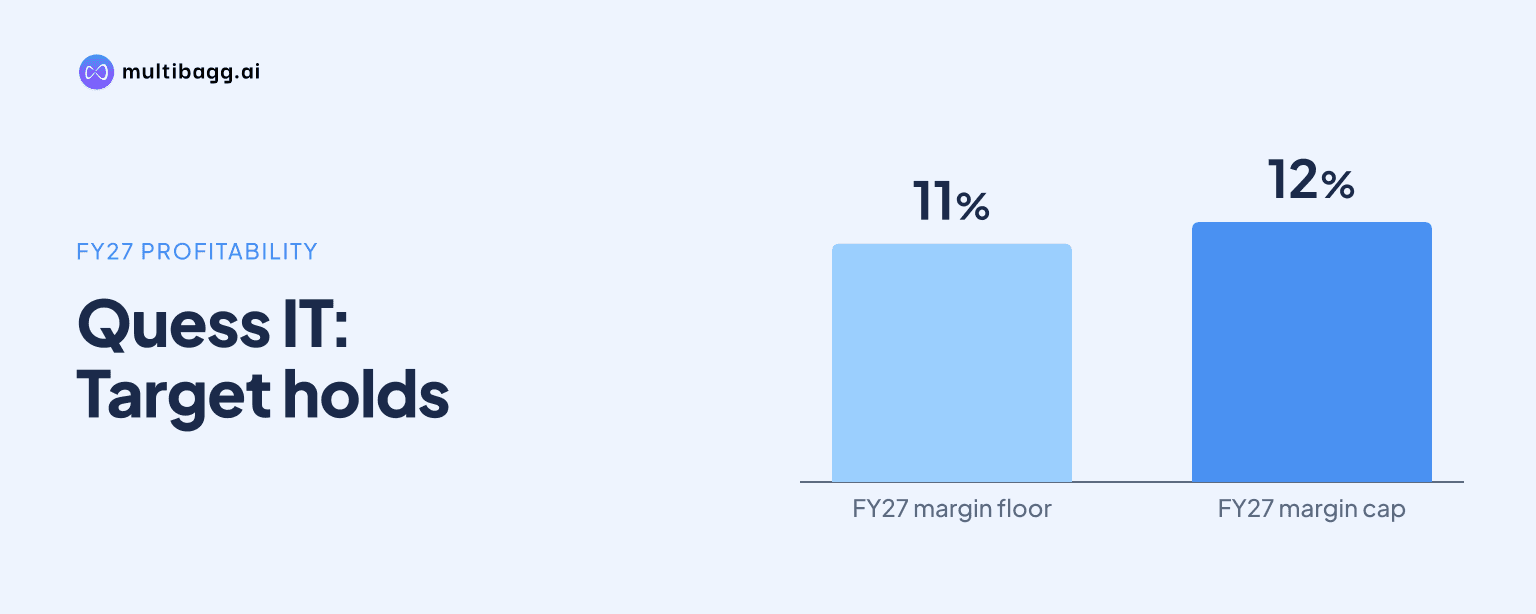
During the first half of FY27, Quess IT Solutions retained its 11%-12% Professional Staffing (PS) EBITDA margin guidance and targeted an exit near 12%, despite upfront investment in leadership, sales, delivery and new practices. Management cited 62 new master service agreements, or MSAs, signed in six months as evidence supporting future growth.
Know Quess Corp inside out
Results, valuation, peers and who's buying, in one view.
Why is PS retaining its 11%-12% FY27 margin target?
PS is retaining its 11%-12% FY27 EBITDA margin target because management expects the current investment cycle to produce growth over the next three to four financial years, with an exit margin near 12%. Management said PS margin would have been 11.7% without investments made in the first and second quarters, indicating that added expenditure, rather than a disclosed deterioration in gross-margin performance, reduced reported EBITDA margin.
The investment has gone into leadership, sales capacity, delivery capacity, account management and new practices. Management compared the plan with its FY21 and FY22 investment period, when PS generated roughly Rs 31 crore of EBITDA for a full financial year at a 6%-6.5% margin. At the current run rate, management said EBITDA is nearly Rs 110 crore and margin is about 11%.
Management distinguished between gross margin and EBITDA margin in explaining the outlook. PS revenue rose 13% year on year and gross margin rose 12%, according to management, while incremental operating investment affected EBITDA. The stated FY27 target therefore depends on growth in revenue and gross profit covering costs that were brought forward into the first half.
What changed in PS customer mix and sales activity?
PS customer concentration increased among its largest accounts while its new-client funnel expanded in the first six months. Management said the top 10 customers' contribution rose from 40% to 46%, primarily because all 10 accounts grew. It also said strategic relationships had broadened beyond the earlier concentration among four or five clients.
Management attributed growth at larger customers partly to expansion of global capability centres, or GCCs, in India. It also said one managed service provider, or MSP, account recorded a slight decline that was visible in the quarter's numbers. Management cited that movement in response to an analyst's question on mix, but did not change its 11%-12% FY27 margin guidance.
New-client acquisition is the other side of the mix change. PS signed 62 MSAs in the first six months, exceeding the number signed in the preceding full year, management said. It described the acquisition pace as having doubled, while cautioning that a longer tail of new accounts does not immediately appear in headcount, revenue or EBITDA.
Got a follow-up? Ask IRIS
When could PS's 62 agreements contribute to earnings?
PS expects the 62 agreements signed in the first six months to begin contributing over the next one to two quarters as customers activate mandates. Management explicitly linked this activation lag to the portfolio mix: new agreements expand the account base, but hiring and deployment must occur before they contribute to headcount, revenue and EBITDA.
The first operational evidence cited by management was 437 net additions in the quarter. Management said this was PS's highest quarterly net addition since FY22, when post-Covid demand created a talent war, and that the quarter's additions exceeded PS's net additions for the entire previous year. It presented the addition as an early return from investment in sales and account coverage.
The timing remains material to the FY27 margin outcome. Management said the benefits of the investment are intended to extend for three to four years rather than only the current financial year. Its expectation of a speedy recovery therefore relies on the 62 MSAs moving from signature to billable deployment in coming quarters, rather than on a disclosed revenue target for those accounts.
What operating factors could affect PS margins next?
PS's near-term margin outcome will depend on whether revenue growth and account activation absorb the added leadership, sales, delivery and practice costs. Management said the top 10 customers accounted for 46% of contribution after rising from 40%. Continued expansion within those accounts could increase use of the capacity added during the investment phase before newer accounts mature.
MSP performance is another disclosed variable. One MSP had a slight decline in the quarter, while larger customers' GCC expansion supported the top 10 accounts. The transcript does not quantify that MSP's revenue contribution or disclose separate profitability for it, so it does not establish the size of any continuing margin effect from that account.
The broader Quess staffing portfolio provides context for management's focus on client activation. General Staffing signed 116 new contracts in the quarter and had 30,000 to 35,000 open mandates, while management guided for 10,000 to 15,000 net additions in coming quarters. Those figures apply to General Staffing, not PS, but show management using sales activity and mandate conversion across staffing operations.
Conclusion
PS is maintaining its FY27 11%-12% EBITDA margin guidance because management views first-half spending as an intentional investment rather than a permanent change in profitability. The comparison with the FY21-FY22 expansion cycle, 13% revenue growth, 12% gross-margin growth and 437 quarterly net additions underpin management's assessment that commercial activity is advancing while EBITDA absorbs added costs.
The next measures to watch are activation of the 62 MSAs over the stated one-to-two-quarter period, the pace of net additions after the 437 reported in the quarter, and progress toward management's targeted exit margin near 12%. Management has not disclosed a revenue value for the new agreements, making their conversion into billable headcount, revenue and EBITDA central to the planned recovery.