










Quess auditor keeps qualified conclusion on tax deductions
Key highlights
- Deloitte maintained a qualified conclusion on Quess’s 30 September 2026 consolidated results because disputed tax deductions remain unresolved.
- Quess reported half-year consolidated profit of Rs 156.785 crore, up from Rs 102.758 crore a year earlier.
- Total provisions increased by Rs 297.928 crore to Rs 637.020 crore between 31 March 2026 and 30 September 2026.
- Quess’s September 2026 quarter revenue rose to Rs 4,396.485 crore, while quarterly profit reached Rs 74.661 crore.
powered by IRIS
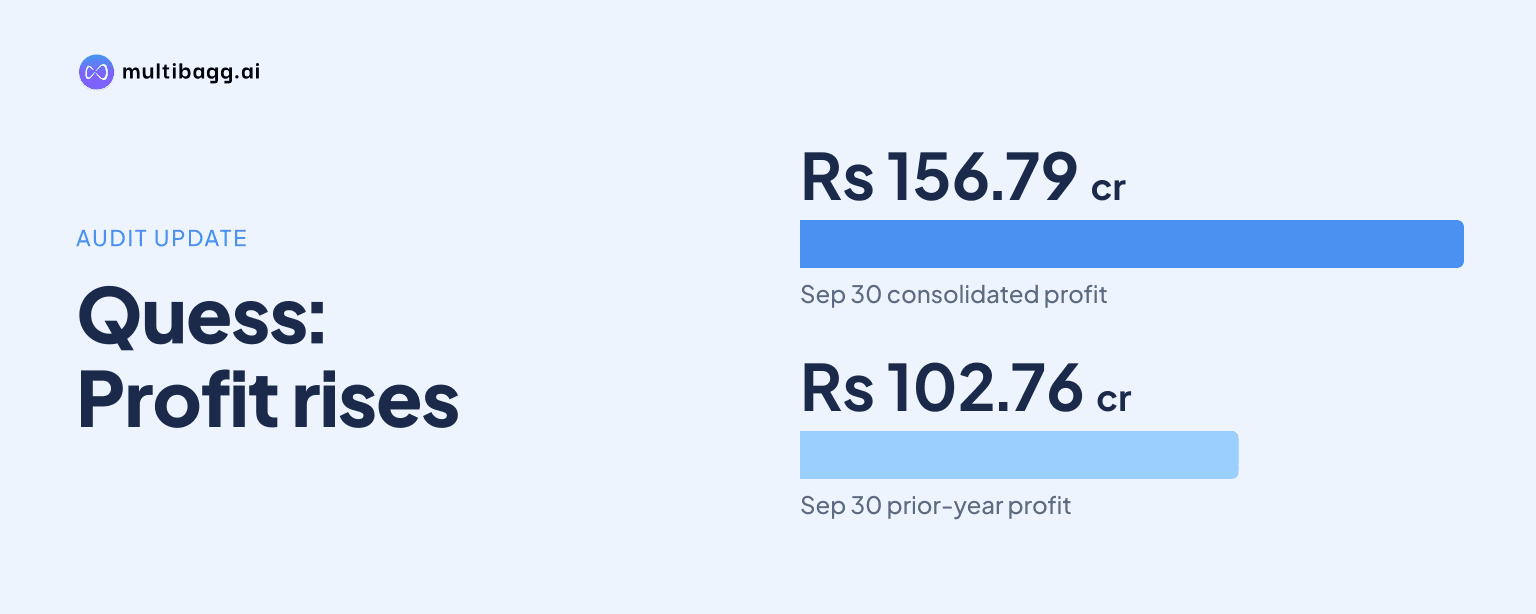
Quess Corp Limited received a continuing qualified conclusion on its consolidated results for the quarter and half year ended 30 September 2026 because deductions used in income-tax expense remain disputed. Deloitte Haskins & Sells LLP said it could not determine whether adjustments were necessary, even as Quess reported half-year consolidated profit of Rs 156.785 crore.
Know Quess Corp inside out
Results, valuation, peers and who's buying, in one view.
Why did Quess receive a qualified conclusion?
Quess received a qualified conclusion because certain tax deductions claimed by the parent company and recognised in income-tax expense for current and prior periods were disallowed by the Income Tax Authority. Deloitte said Quess has challenged those disallowances in a judicial forum, but the unresolved outcome prevents the auditor from commenting on whether adjustments to the 30 September 2026 consolidated results are necessary.
Quess management concluded that acceptance of the deductions upon ultimate resolution is probable, supported by opinions from legal counsel and other tax experts. Deloitte did not endorse or reject that assessment. Instead, it identified the uncertainty over the deductions as the basis for its qualified conclusion for the quarter and half year ended 30 September 2026.
The report was a limited review rather than a statutory audit. Deloitte said its work followed Standard on Review Engagements 2410, issued by the Institute of Chartered Accountants of India, involving inquiries and analytical procedures. It said this scope is substantially less than an audit under Section 143(10) of the Companies Act, 2013, and therefore it did not express an audit opinion.
Is Quess’s tax qualification new in September 2026?
No, the tax qualification was not new in September 2026. Deloitte said it had also qualified its reports for the quarter ended 30 June 2026, the quarter and half year ended 30 September 2025, and the year ended 31 March 2026. The latest report therefore records a continuing issue rather than a new qualification arising in the September quarter.
The dispute includes observations made by another regulatory authority in January 2024. Deloitte described these observations as “new information” about the applicability of certain deductions under the Income Tax Act and related reports that had been submitted to the Income Tax Authority. Quess considered that information and continued to believe ultimate acceptance of the deductions is probable.
Deloitte’s conclusion did not state that the deductions will be rejected, and it did not quantify any potential tax, profit or balance-sheet adjustment. It said that, except for the possible effects of the tax matter, nothing came to its attention to suggest the consolidated statement was not prepared in accordance with Indian Accounting Standard 34, or Ind AS 34, and the applicable listing requirements.
What did Deloitte say about Quess’s provident-fund litigation?
Deloitte separately drew attention to provident-fund demands received by Quess and the related pending litigation, referring readers to note 4 of the financial statements. This was an emphasis-of-matter paragraph, not the basis for the qualified conclusion issued on 30 October 2026.
The auditor explicitly said its conclusion was not modified in respect of the provident-fund litigation. That treatment differs from the tax deductions, for which Deloitte said it could not comment on whether accounting adjustments were required pending ultimate resolution and acceptance by the Income Tax Authority.
The supplied filing does not provide the amount of the provident-fund contingency or say that Quess has paid, settled or recognised a final liability for it. It also gives no hearing date, settlement timetable or other date for resolution. The available disclosure supports only that demands and litigation existed as of the review report dated 30 October 2026.
Got a follow-up? Ask IRIS
How did Quess’s balance sheet change by September 2026?
Quess reported total assets of Rs 3,650.357 crore at 30 September 2026, compared with Rs 3,039.112 crore at 31 March 2026. Total liabilities increased to Rs 2,464.943 crore from Rs 1,870.886 crore, while total equity rose to Rs 1,185.414 crore from Rs 1,168.226 crore over the same period.
Total provisions rose to Rs 637.020 crore at 30 September 2026 from Rs 339.092 crore at 31 March 2026. Non-current provisions accounted for Rs 626.403 crore at the September date, compared with Rs 321.898 crore at the March date, while current provisions fell to Rs 10.617 crore from Rs 17.194 crore.
The filing does not allocate the movement in provisions between provident-fund litigation, tax matters or other items. It therefore does not establish a direct link between the Rs 297.928 crore increase in total provisions and either matter discussed in Deloitte’s review report. Income-tax assets fell to Rs 168.983 crore from Rs 380.854 crore, while deferred-tax assets rose to Rs 163.213 crore from Rs 144.295 crore.
What were Quess’s September 2026 financial results?
Quess reported consolidated profit of Rs 74.661 crore for the quarter ended 30 September 2026, compared with Rs 51.772 crore for the quarter ended 30 September 2025. For the half year ended 30 September 2026, profit was Rs 156.785 crore, versus Rs 102.758 crore for the corresponding half year a year earlier.
Revenue from operations increased by Rs 564.877 crore year on year in the September 2026 quarter, while profit before tax rose by Rs 7.176 crore. The quarter included a total tax credit of Rs 10.022 crore, compared with tax expense of Rs 5.691 crore in the September 2025 quarter. Deloitte did not attribute that change in tax expense to the disputed deductions.
Deloitte also relied on review reports from other auditors for six subsidiaries with assets of Rs 647.068 crore at 30 September 2026 and half-year revenue of Rs 579.259 crore. Separately, 16 subsidiaries not reviewed by their auditors had assets of Rs 129.969 crore and half-year revenue of Rs 131.517 crore; management told Deloitte those entities were not material to the group, and the auditor did not modify its conclusion on that basis.
Conclusion
Quess’s latest limited-review report shows that the tax-deduction matter remains the key accounting uncertainty: management maintains that acceptance is probable, while Deloitte cannot assess whether an adjustment is needed until the dispute is resolved. The provident-fund litigation is separately highlighted but did not change the auditor’s conclusion, and provisions increased by Rs 297.928 crore between 31 March 2026 and 30 September 2026 without a disclosed allocation.
The filing does not disclose a court date, tax-assessment deadline or resolution timetable for the disputed deductions or provident-fund litigation. The next disclosed corporate date is 6 November 2026, the record date for Quess’s Rs 5 per-share interim dividend for financial year 2026-27; Quess said payment would be made on or before 20 November 2026.