










Quess cash flow rose as net tax refunds offset receivables
Key highlights
- Quess reported Rs 366.150 crore of net cash from operating activities for the half year ended 30 September 2026, up from Rs 158.337 crore a year earlier.
- Net tax refunds contributed Rs 229.079 crore to operating cash flow, while cash generated from operations fell to Rs 137.071 crore from Rs 198.703 crore.
- Unbilled trade receivables rose by Rs 537.204 crore to Rs 1,311.465 crore at 30 September 2026.
- Quess disclosed Rs 387.994 crore of contingent tax liabilities for fiscal 2017 through fiscal 2023, with related appeals and objections pending.
powered by IRIS
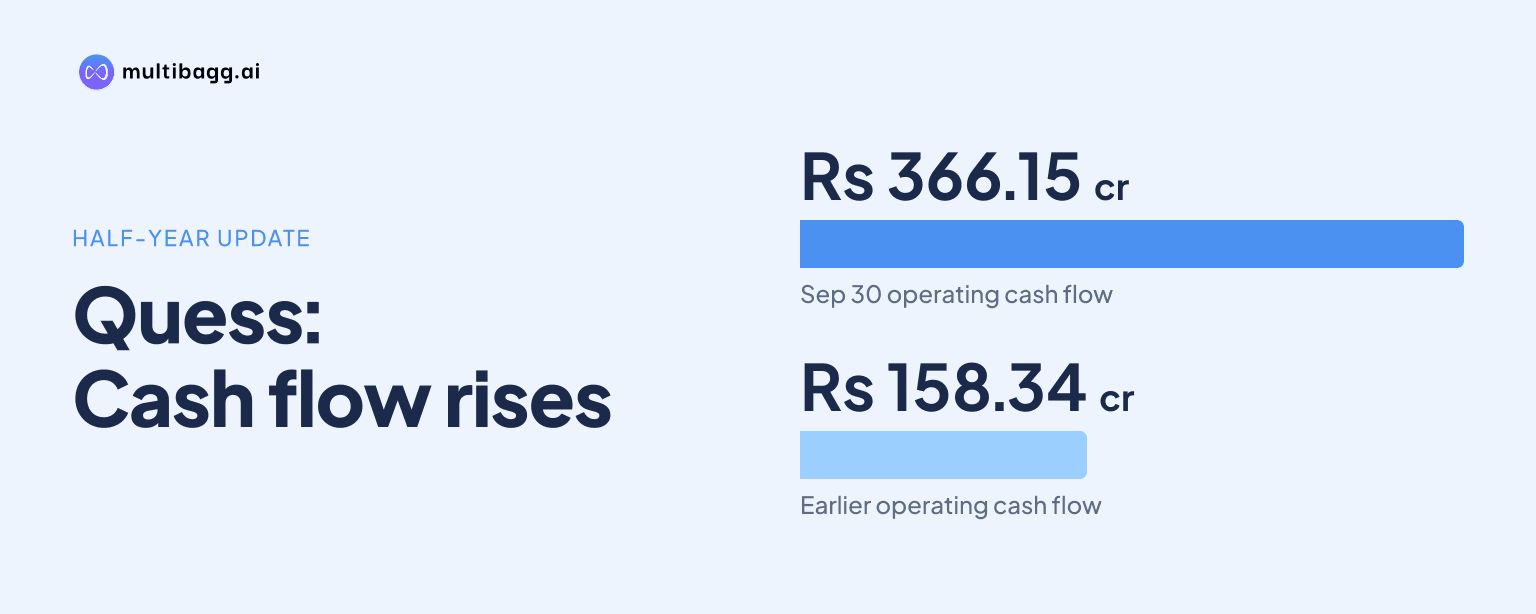
Quess Corp Limited reported Rs 366.150 crore of net cash from operating activities for the half year ended 30 September 2026, versus Rs 158.337 crore a year earlier. The increase followed Rs 229.079 crore of net tax refunds, while unbilled trade receivables rose to Rs 1,311.465 crore from Rs 774.261 crore at 31 March 2026.
Know Quess Corp inside out
Results, valuation, peers and who's buying, in one view.
Why did Quess operating cash flow rise?
Quess’s operating cash flow rose because the company received net tax refunds, despite lower cash generated from operations before tax. Net cash from operating activities was Rs 366.150 crore in the half year ended 30 September 2026, up from Rs 158.337 crore in the corresponding half of 2025. The cash-flow statement recorded Rs 229.079 crore of net refunds received or income taxes paid, compared with net tax paid of Rs 40.366 crore a year earlier.
Cash generated from operations was Rs 137.071 crore, down from Rs 198.703 crore in the prior-year half. Profit after tax increased to Rs 156.785 crore from Rs 102.758 crore, while operating cash flow before working-capital changes rose to Rs 187.368 crore from Rs 140.539 crore. The Rs 269.445 crore year-on-year movement in the net tax line was larger than the Rs 207.813 crore increase in reported operating cash flow.
How much did Quess unbilled receivables increase?
Quess’s unbilled trade receivables increased by Rs 537.204 crore during the six months to 30 September 2026. The balance reached Rs 1,311.465 crore, compared with Rs 774.261 crore at 31 March 2026. It was the largest individual current-asset category at the reporting date, exceeding billed trade receivables of Rs 838.747 crore and cash and cash equivalents of Rs 416.795 crore.
Billed trade receivables rose by Rs 30.767 crore from Rs 807.980 crore at 31 March 2026. Combined billed and unbilled receivables therefore increased to Rs 2,150.212 crore from Rs 1,582.241 crore, a rise of Rs 567.971 crore. The cash-flow statement separately recorded a Rs 571.551 crore outflow from changes in trade receivables and unbilled revenue in the latest half year.
The filing does not allocate the Rs 1,311.465 crore unbilled balance by customer, contract or operating segment. It reports General Staffing as the largest revenue segment, with Rs 7,419.191 crore of revenue for the half year ended 30 September 2026, followed by Overseas business at Rs 650.906 crore and Professional Staffing at Rs 506.191 crore. These segment disclosures do not identify the source of the receivables build-up.
What caused Quess working-capital cash movements?
Quess’s working-capital movements reduced cash in the latest half year, principally because receivables and unbilled revenue consumed Rs 571.551 crore. This compared with an outflow of Rs 59.545 crore from that line in the half year ended 30 September 2025. Loans, other financial assets and other assets used a further Rs 29.613 crore, compared with Rs 78.941 crore a year earlier.
The receivables-related outflow was partly offset by Rs 550.280 crore generated from changes in other financial liabilities, other liabilities and provisions. That cash contribution was more than double the Rs 226.054 crore recorded in the comparable half of 2025. Trade payables provided Rs 0.587 crore in the latest period, whereas they used Rs 29.404 crore in the earlier period.
The combined working-capital movement took cash generated from operations to Rs 137.071 crore from Rs 187.368 crore before such movements in the latest half year. In the prior-year half, it lifted cash generated from operations to Rs 198.703 crore from Rs 140.539 crore, as liability-related inflows outweighed asset-related outflows. The shift reflects the substantially larger receivables and unbilled-revenue cash requirement in the latest period.
Got a follow-up? Ask IRIS
Which Quess balance-sheet items changed with cash flow?
Quess’s cash and cash equivalents increased to Rs 416.795 crore at 30 September 2026 from Rs 178.128 crore at the start of the financial year. The cash-flow statement shows a Rs 237.921 crore net increase in cash and cash equivalents, plus a Rs 0.746 crore positive exchange-rate effect. Cash in current accounts accounted for Rs 416.610 crore of the closing cash balance, while cash in hand was Rs 0.185 crore.
Total current assets rose to Rs 2,801.484 crore from Rs 2,000.241 crore at 31 March 2026. Alongside the increase in receivables and cash, other current assets grew to Rs 109.195 crore from Rs 82.898 crore. Investments declined to Rs 19.994 crore from Rs 51.206 crore, after Rs 2,252.225 crore of mutual-fund and other investments and Rs 2,284.380 crore of related sale proceeds during the half year.
Current liabilities increased to Rs 1,741.997 crore from Rs 1,447.684 crore. Other financial liabilities rose to Rs 1,297.194 crore from Rs 989.352 crore, while other current liabilities declined to Rs 364.021 crore from Rs 381.873 crore. Total liabilities reached Rs 2,464.943 crore, compared with Rs 1,870.886 crore at 31 March 2026, including non-current provisions of Rs 626.403 crore.
What tax matters could affect Quess cash flows?
Quess has disclosed income-tax disputes alongside the Rs 229.079 crore net tax refund reported for the half year ended 30 September 2026. The disputes relate principally to deductions under Section 80JJAA of the Income Tax Act and depreciation on goodwill in assessment orders for fiscal 2017 through fiscal 2023. Quess assessed contingent liabilities, including interest, of Rs 387.994 crore for demands relating to those fiscal years.
Quess said it has appealed fiscal 2018 to fiscal 2022 assessment orders before the Income Tax Appellate Tribunal, appealed the fiscal 2017 order before the Commissioner of Income Tax (Appeals), and filed objections for fiscal 2023 with the Dispute Resolution Panel. Management said it believes its tax treatment is valid, citing external legal and tax opinions. Income-tax assets fell to Rs 168.983 crore at 30 September 2026 from Rs 380.854 crore at 31 March 2026.
Quess also disclosed Section 80JJAA deductions of Rs 144.700 crore for the quarter ended 30 September 2026 and Rs 215.263 crore for the half year. It said deductions claimed for fiscal 2024, fiscal 2025 and fiscal 2026 totalled Rs 1,003.050 crore, with assessments yet to be completed. These matters remain unresolved and are distinct from the cash refund recorded in the half-year cash-flow statement.
Conclusion
Quess reported higher operating cash flow in the half year ended 30 September 2026, but the increase to Rs 366.150 crore depended materially on Rs 229.079 crore of net tax refunds. Meanwhile, unbilled receivables rose by Rs 537.204 crore and combined billed and unbilled receivables increased by Rs 567.971 crore, producing a Rs 571.551 crore cash outflow from the related working-capital line.
The next results should show whether Quess’s Rs 1,311.465 crore unbilled-receivables balance converts into collections and whether tax-related cash movements recur. Quess has also disclosed Rs 387.994 crore of tax contingent liabilities, while its tax appeals and objections remain pending. Separately, the company said it will evaluate any differential impact from the new Labour Codes after remaining state rules, government clarifications and customer contractual confirmations are available.