










Raconteur Global Resources reports ₹230.7 crore Q2 FY27 loss
Key highlights
- Raconteur Global Resources Ltd.'s results summary reported a Q2 FY27 net loss of ₹230.70 crore.
- Detailed filing text separately cited a ₹20.55 crore consolidated loss for the half year ended 30 September 2026.
- Dhull Trading exposure represented 57.41% of Raconteur's group loans, according to the filing.
- Depreciation was not provided on ₹1.21 crore of subsidiary assets, the filing stated.
powered by IRIS
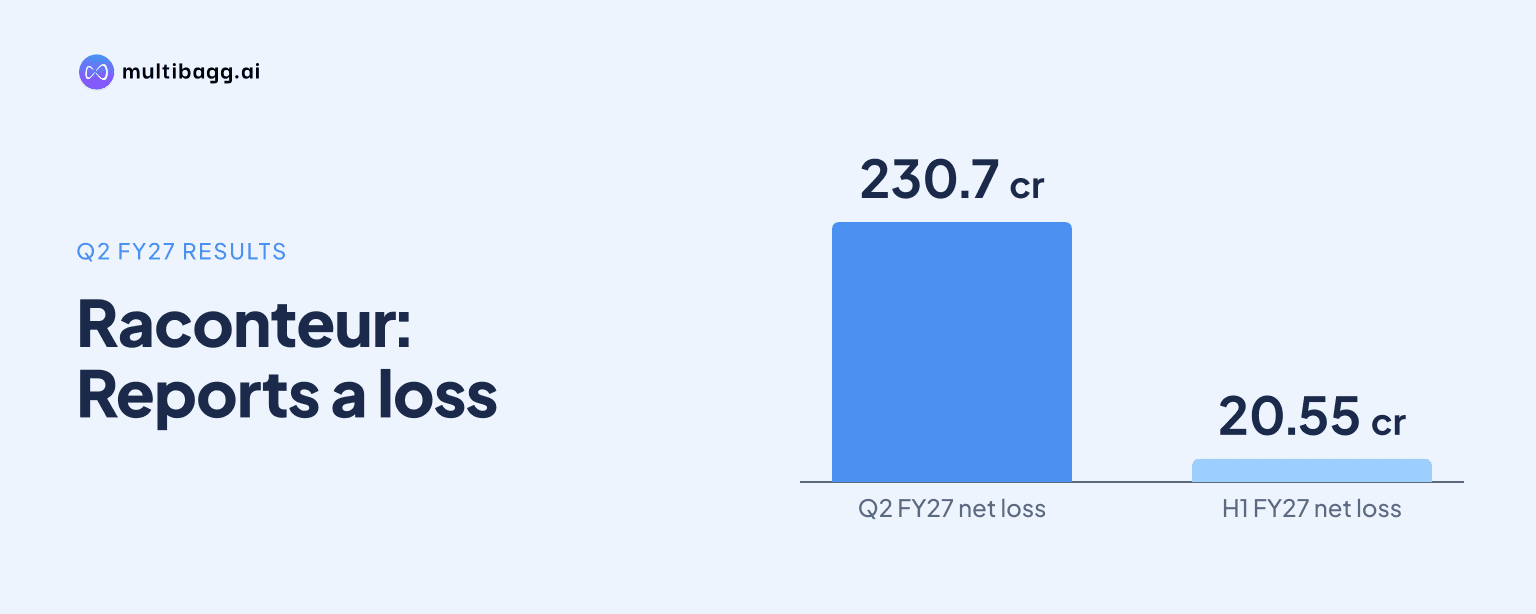
Raconteur Global Resources Ltd. reported a net loss of ₹230.7 crore for Q2 FY27 in the provided results summary, while accompanying filing details cite a consolidated loss of ₹20.55 crore for the half year ended 30 September 2026. The difference between these disclosed figures is material and requires clarification from the company.
Know Raconteur Global Resources inside out
Results, valuation, peers and who's buying, in one view.
What did Raconteur Global Resources report for Q2 FY27?
Raconteur Global Resources Ltd. said its board approved unaudited standalone and consolidated financial results for the half year ended 30 September 2026, together with the statutory auditor's limited review reports. The supplied results headline identifies net profit after tax as negative ₹230.7 crore, indicating a loss for the reported period.
However, the detailed text accompanying the same update states that consolidated net loss widened to ₹2,054.75 lakh, equivalent to ₹20.55 crore. It also refers to the period as the half year ended 30 September 2026 rather than a standalone quarterly reporting period. Investors should therefore distinguish between the headline figure and the detailed loss figure until Raconteur provides a reconciliation or clarification through an exchange filing.
The board meeting to consider the unaudited results was scheduled for 14 November 2026 through video conference. Before the result declaration, the company had closed its trading window for designated persons and their immediate relatives from 1 October 2026 until 48 hours after the announcement, in line with its insider-trading compliance process.
Why did the limited review report raise concerns?
The limited review report cited in the provided material contains a qualified conclusion concerning related-party loans and depreciation treatment at a subsidiary. The filing states that loan exposure to Dhull Trading represented 57.41% of the group's loans, creating a significant concentration in related-party exposure.
The filing also said depreciation had not been provided on assets worth ₹1.21 crore at a subsidiary. Depreciation is an accounting charge that allocates an asset's cost over its useful life. When it is not recorded as required, reported asset values and expenses may not fully reflect the underlying accounting position.
A qualified audit or review conclusion does not by itself establish wrongdoing. It means the auditor has identified specific areas where it could not provide an unmodified conclusion under the applicable reporting framework. In Raconteur's case, the disclosed issues make the loan exposure and subsidiary accounting treatment important areas for shareholders to monitor.
What are the key figures disclosed in the filing?
Raconteur disclosed a loss in the current filing, but the source material contains conflicting figures for the result. The table below sets out the figures as stated in the supplied information, with lakh-denominated amounts converted to crore for consistency.
The supplied historical data also show that Raconteur's FY26 standalone revenue from operations rose to ₹3.00 crore. Yet the company reported a standalone net loss of ₹6.75 crore for the year, compared with a net profit of ₹0.16 crore in FY25. This demonstrates that the prior year's reported revenue level did not translate into profitability.
Another disclosed FY26 comparison put consolidated net loss at ₹21.33 crore, while a separate historical results table referred to a full-year loss of ₹21.34 crore. These are broadly similar after rounding, unlike the much larger difference between the current headline loss and the detailed half-year loss. The latest filing's presentation will therefore be important for interpreting the current period accurately.
Got a follow-up? Ask IRIS
How does the result affect investors and operations?
The disclosed loss and the review qualifications are relevant to investors because they raise questions about the quality and comparability of reported financial data. The immediate financial impact that can be established from the provided material is a continuing loss position, alongside concentrated related-party loan exposure and an identified depreciation gap at a subsidiary.
The source material does not provide a share-price movement, market-capitalisation change, cash-flow figure, or management forecast following the result. It would therefore be unsupported to quantify the market reaction or project the company's future financial performance. What is clear is that investors have both the reported loss and the limited-review qualifications to assess when reviewing Raconteur's disclosures.
For operations, the absence of depreciation provision on ₹1.21 crore of assets may require accounting attention, depending on the company's response and the final treatment in subsequent financial statements. Similarly, the 57.41% exposure to Dhull Trading within group loans makes recoverability, terms and related-party governance central issues in the group's financial reporting.
What is the financial background before the September 2026 results?
Raconteur's recent financial history shows a shift from a small profit to losses. For FY25, the company reported total income of ₹0.51 crore and net profit after tax of ₹0.16 crore. In FY26, disclosed standalone revenue from operations was ₹3.00 crore, but standalone net loss rose to ₹6.75 crore.
The supplied data also refer to a ₹6.0 crore net loss in the half year ended March 2026, compared with a loss of ₹0.80 crore in the preceding half-year comparison. The same table showed a negative operating margin of 107.5% and a negative net margin of 198.4% for that period. These figures indicate that losses had already been reported before the September 2026 results.
Raconteur was formerly known as Ganesh Films India Limited. The company is listed on the SME exchange, and the provided disclosures state that it was exempt from related-party transaction disclosures for the half year ended 31 March 2026 under the cited SME-exchange framework. That context makes the specific related-party loan observations in the current limited review particularly relevant.
Conclusion
The September 2026 results update confirms that Raconteur remained loss-making, while the limited review highlighted related-party loan concentration and missing depreciation on subsidiary assets. The central issue for readers is the inconsistency in the supplied current-period loss figures: the headline states a ₹230.7 crore loss, whereas detailed filing text states a ₹20.55 crore consolidated loss for the half year.
Investors should watch for Raconteur's exchange-filed financial statements, limited review report and any clarification that reconciles the two loss figures. Further disclosures on the 57.41% related-party loan exposure, the treatment of ₹1.21 crore of assets without depreciation, and the company's response to the qualified conclusion will be key next items to monitor.