










Rain Industries’ adjusted EBITDA rises 32% to Rs 857 crore
Key highlights
- Rain Industries reported adjusted EBITDA of Rs 857 crore in Q3 CY26, up 32% from Rs 648 crore in Q3 CY25.
- Carbon adjusted EBITDA rose 38% to Rs 742 crore, while revenue increased 22% to Rs 3,979 crore.
- Advanced materials adjusted EBITDA increased 42% to Rs 126 crore on revenue of Rs 1,136 crore.
- Cement recorded an adjusted EBITDA loss of Rs 11 crore after earning Rs 20 crore in Q3 CY25.
powered by IRIS
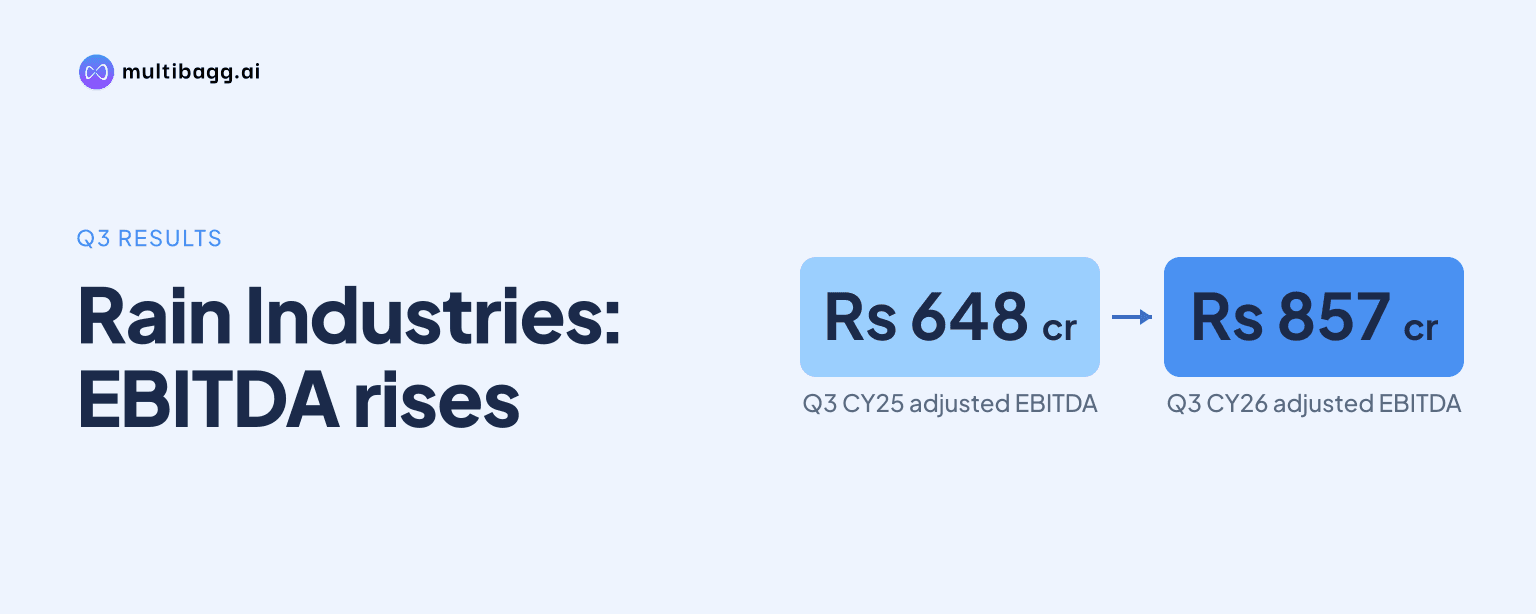
Rain Industries Limited reported adjusted earnings before interest, tax, depreciation and amortisation (EBITDA) of Rs 857 crore in Q3 CY26, 32% above Q3 CY25, with carbon adding Rs 203 crore and advanced materials Rs 37 crore to the year-on-year bridge, more than offsetting a Rs 31 crore cement decline.
Know Rain Industries inside out
Results, valuation, peers and who's buying, in one view.
How did Rain Industries deliver 32% EBITDA growth in Q3 CY26?
Rain Industries delivered the increase through higher earnings in its carbon and advanced materials businesses, while cement moved from a profit contribution to a loss. Consolidated adjusted EBITDA rose from Rs 648 crore in Q3 CY25 to Rs 857 crore in Q3 CY26. Carbon accounted for Rs 203 crore of the increase, advanced materials added Rs 37 crore, and cement reduced the bridge by Rs 31 crore.
Revenue excluding other operating income increased from Rs 4,435 crore in Q3 CY25 to Rs 5,424 crore in Q3 CY26, a gain of Rs 989 crore. The key-highlights page separately reports revenue from operations of Rs 5,486 crore, up 23%, while the consolidated revenue bridge is explicitly presented excluding other operating income. Adjusted profit after tax was Rs 204 crore and adjusted earnings per share, not annualised, was Rs 6.05.
The presentation attributes part of the consolidated improvement to currency translation. The US dollar appreciated 9.5% and the euro appreciated 7.8% against the Indian rupee year on year, benefiting both revenue and EBITDA. Those movements supported the year-on-year comparison alongside operating drivers in calcination, distillation, chemical intermediates and cement.
Which Rain Industries segment contributed most to Q3 EBITDA growth?
Rain Industries’ carbon segment contributed the most, with adjusted EBITDA rising Rs 203 crore year on year to Rs 742 crore in Q3 CY26. Carbon represented about 87% of consolidated adjusted EBITDA of Rs 857 crore for the quarter, before considering the Rs 11 crore EBITDA loss in cement. Its revenue also increased by Rs 711 crore from Q3 CY25.
Carbon revenue rose 22% to Rs 3,979 crore, even as volumes fell to 619,000 metric tonnes from 673,000 metric tonnes in Q3 CY25. The presentation attributes revenue growth to higher realisations in calcination and distillation, supported by the appreciation of the US dollar and euro against the rupee. It says lower calcination volumes reflected shipment timing, showing that the sales increase was not volume-led across all carbon products.
Carbon adjusted EBITDA rose 38% from Rs 539 crore to Rs 742 crore. The presentation cites margin contribution from lower-cost inventory carried over from earlier periods, disciplined cost management and favourable foreign-exchange movements. Sequentially, however, carbon EBITDA declined from Rs 811 crore in Q2 CY26 to Rs 742 crore in Q3 CY26, despite revenue rising from Rs 3,770 crore to Rs 3,979 crore and volumes increasing from 594,000 to 619,000 metric tonnes.
Got a follow-up? Ask IRIS
What drove Rain Industries advanced materials earnings higher?
Rain Industries’ advanced materials segment increased adjusted EBITDA 42% year on year to Rs 126 crore in Q3 CY26, as pricing, cost discipline and currency movements offset volatile raw-material and energy costs. Segment revenue increased 28% to Rs 1,136 crore from Rs 891 crore, while volumes rose modestly to 76,000 metric tonnes from 75,000 metric tonnes.
The presentation attributes the revenue increase to supply-driven price increases and euro appreciation of about 7.8% against the rupee. It also cites higher chemical intermediates volumes, linked to improved demand and customer engagement. The combination of pricing and higher chemical-intermediate activity produced a Rs 37 crore year-on-year increase in adjusted EBITDA, the second-largest contribution in the consolidated earnings bridge.
The sequential comparison was less favourable for margins. Advanced materials adjusted EBITDA was Rs 168 crore in Q2 CY26, compared with Rs 126 crore in Q3 CY26, although Q3 revenue increased from Rs 1,073 crore to Rs 1,136 crore and volumes rose from 71,000 to 76,000 metric tonnes. The presentation does not quantify the specific quarter-on-quarter cost or pricing factors behind that Rs 42 crore EBITDA reduction.
Why did Rain Industries cement report an EBITDA loss?
Rain Industries’ cement business reported an adjusted EBITDA loss of Rs 11 crore in Q3 CY26 because higher energy and freight costs outweighed the benefit of higher volumes and realisations. This compared with adjusted EBITDA of Rs 20 crore in Q3 CY25 and Rs 15 crore in Q2 CY26, making cement the only reported segment with negative EBITDA in the quarter.
Cement revenue still increased 12% year on year, from Rs 276 crore to Rs 309 crore, as volumes grew from 603,000 to 670,000 metric tonnes. The business also grew sequentially, with Q3 revenue of Rs 309 crore versus Rs 297 crore in Q2 CY26 and volumes of 670,000 versus 651,000 metric tonnes. The presentation says heightened competition in South India followed acquisitions by pan-India players.
The cost reversal has also affected capital-expansion timing. Rain Industries says its Telangana Expansion Project remains on hold until pricing improves sufficiently to recover higher energy and freight costs. That condition is important because the presentation does not give a restart date, capacity figure or project cost for the Telangana plan.
Conclusion
Rain Industries’ Q3 CY26 result was driven primarily by carbon, where revenue rose 22% and adjusted EBITDA rose 38%, with advanced materials adding a further 42% EBITDA increase. These gains lifted consolidated adjusted EBITDA by Rs 209 crore year on year to Rs 857 crore, despite cement shifting from Rs 20 crore of EBITDA to an Rs 11 crore loss as energy and freight costs increased.
Next, investors can watch the effect of planned annual maintenance outages, which the presentation says will temporarily reduce production at several sites. Rain Industries also plans to normalise working capital, evaluate refinancing of high-yield bonds around March 2027, and keep the Telangana project on hold until cement pricing can cover elevated energy and freight costs.