










RAIN says logistics disruption cut Calcination shipments in 2026
Key highlights
- RAIN Adjusted EBITDA rose 32% year on year to Rs 857 crore in the third quarter of 2026.
- RAIN Calcination sales volumes fell year on year as Persian Gulf hostilities made traditional shipment routes unavailable.
- RAIN Advanced Materials volumes increased modestly year on year to 76 thousand tons despite constrained European waterways.
- RAIN Cement volumes rose 11% to 670 thousand tons, while segment EBITDA declined Rs 31 crore on higher operating costs.
powered by IRIS
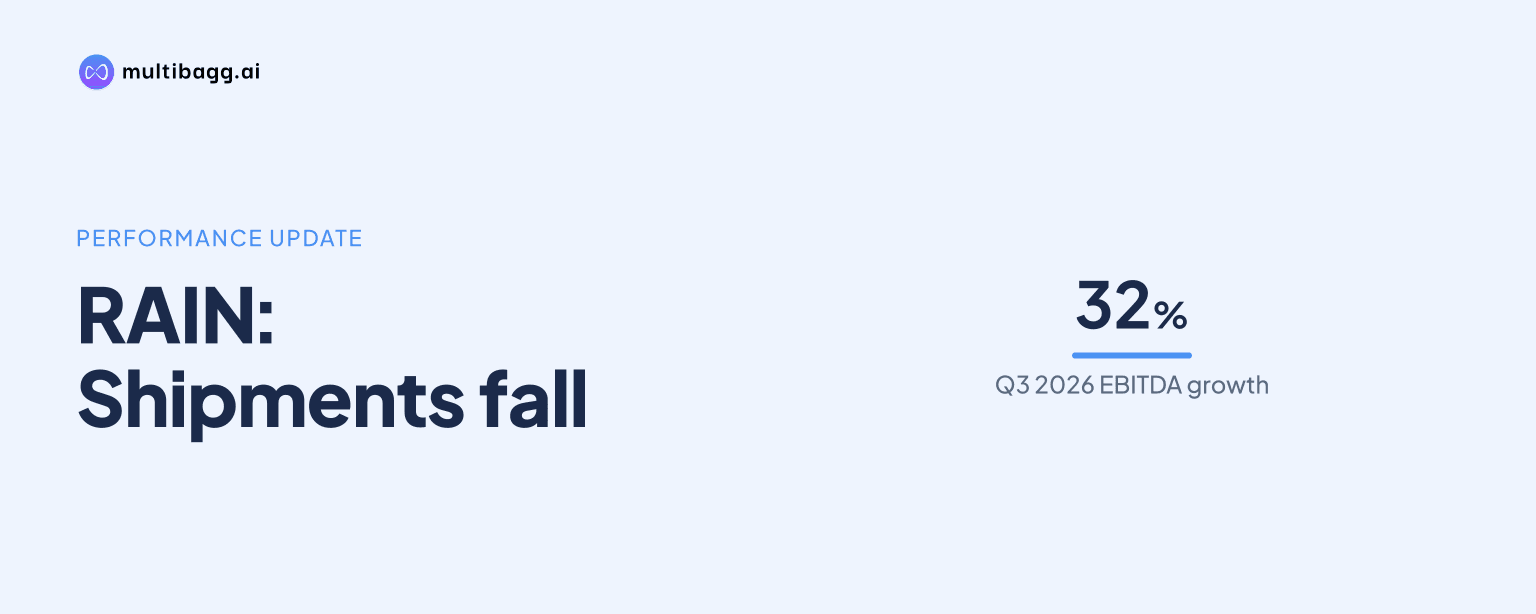
Rain Industries Limited said Persian Gulf hostilities and low European river levels disrupted third-quarter 2026 transport, reduced Calcination sales volumes through shipment timing and raised freight costs, although Adjusted EBITDA increased 32% year on year to Rs 857 crore. Lower-cost raw-material inventory early in the quarter partly protected margins.
Know Rain Industries inside out
Results, valuation, peers and who's buying, in one view.
What caused RAIN's logistics disruption in the third quarter of 2026?
RAIN faced overlapping geopolitical and climate-related transport pressures in the third quarter of 2026. The Persian Gulf conflict, the war in Ukraine and an exceptionally dry European summer increased energy and logistics costs, while lower river levels limited capacity on inland waterways, normally Europe’s lowest-cost freight mode.
Higher oil prices linked to the Persian Gulf conflict raised transport-fuel costs worldwide, with the greatest effect on RAIN’s movements into, out of and within Europe. Management said Europe already had the highest fuel costs in its portfolio, while the Ukraine war remained a major driver of high natural-gas and coal-tar costs, particularly in the region.
How did Persian Gulf hostilities affect RAIN Calcination shipments?
Persian Gulf hostilities reduced RAIN Calcination sales volumes year on year because certain traditional raw-material supply and sales routes were unavailable during the third quarter of 2026. Management described the decline as mainly the timing of shipments, while saying it redirected volumes through alternative locations and regions to continue serving customers.
The exposure matters because the global aluminium industry represents approximately 50% of RAIN revenue. Restricted flows through the Strait of Hormuz and Bab al-Mandab remained well below pre-conflict levels despite periodic lulls, and several Middle Eastern aluminium smelters were at least partly offline because of damage or supply-chain constraints.
Calcination has a different cost exposure from Carbon Distillation and Advanced Materials, according to management, because its input costs are not directly linked to commodity pricing. The disrupted aluminium chain includes green petroleum coke, or GPC, produced by refineries, calcined petroleum coke, or CPC, made by calciners, and coal tar pitch, or CTP, used by aluminium smelters.
How did RAIN manage low European river levels?
Low European river levels forced RAIN to shift freight from inland waterways to alternative transport modes at higher cost. Its European sites could make that change because of prior investment in flexible, multi-modal logistics infrastructure, which maintained operational continuity but did not remove the additional expense.
Carbon Distillation volumes were broadly in line with the third quarter of 2025, with only minor product-mix changes, despite the altered freight routes. Advanced Materials volumes increased modestly year on year to 76 thousand tons, which management attributed to flexible sourcing, logistics options and cost management amid volatile raw-material and energy costs.
RAIN said the pressure could continue through the fourth quarter if the conflicts and constrained transport conditions were not resolved. Management also noted that rising demand for some raw materials lifted costs faster than finished-goods prices in parts of the business, including Cement, adding a separate margin pressure.
Got a follow-up? Ask IRIS
What was the financial effect of the disruption on RAIN?
RAIN reported higher third-quarter 2026 earnings despite costlier logistics and lower Calcination volumes, supported by higher selling prices, lower-cost inventory early in the quarter, cost control and currency movements. Adjusted EBITDA, meaning adjusted earnings before interest, taxes, depreciation and amortisation, rose 32% year on year to Rs 857 crore.
Carbon net revenue rose 21.8% to Rs 3,979 crore, driven by improved realisations in Calcination and Distillation, partly offset by lower Calcination volumes. Carbon Adjusted EBITDA increased 38%, and its margin rose to 18.7% from 16.5%, aided by lower-cost inventory, cost management and favourable currency movements.
Advanced Materials net revenue increased 27.5% to Rs 1,136 crore and its Adjusted EBITDA margin rose to 11.1% from 10.0%. Cement provided a contrasting result: revenue increased 12.0% to Rs 309 crore and volumes rose 11% to 670 thousand tons from 603 thousand tons, but segment EBITDA declined Rs 31 crore because of higher operating costs.
What should readers watch next at RAIN?
RAIN has deferred its proposed Cement expansion in Telangana until pricing improves enough to recover higher energy and freight costs. The decision followed a third quarter in which higher diesel prices increased the freight cost of raw materials and finished cement, absorbing margins despite a 67-thousand-ton year-on-year increase in Cement volumes.
Management said a full return of Middle East trade flows depends on de-escalation and the time needed to restore production assets and supply routes. It cited expert expectations that this process could take several months after hostilities cease, while also pointing to accelerated ramp-ups of idle smelting capacity in the United States and Europe as a potential demand support if sustained.
Conclusion
RAIN’s third-quarter results show that its logistics flexibility limited, but did not eliminate, the impact of Persian Gulf disruption and constrained European waterways. Calcination volumes fell as traditional routes became unavailable, while Carbon Distillation volumes held broadly steady and Advanced Materials volumes reached 76 thousand tons. Higher prices, inventory benefits and cost controls supported the Rs 857 crore Adjusted EBITDA result.
Next, management’s stated priority is to protect performance through disciplined execution while geopolitical, energy, raw-material and shipping conditions remain uncertain into the fourth quarter. The disclosed markers are the restoration of Middle East trade routes, the availability of European river transport, aluminium smelter activity and whether Cement pricing improves enough for RAIN to reconsider the deferred Telangana expansion.