










Rain cuts leverage to 2.53 times as LTM EBITDA rises in 2026
Key highlights
- Rain’s net debt to EBITDA fell to 2.53 times in September 2026 from 3.21 times in December 2025.
- Rain prepaid €3.2 crore of German Term Loan B during 9M 2026.
- Operating cash inflow rose to Rs 1,492.7 crore in 9M 2026 from Rs 959.7 crore in 9M 2025.
- Working-capital debt increased to US$21.7 crore in September 2026 from US$19 crore in December 2025.
powered by IRIS
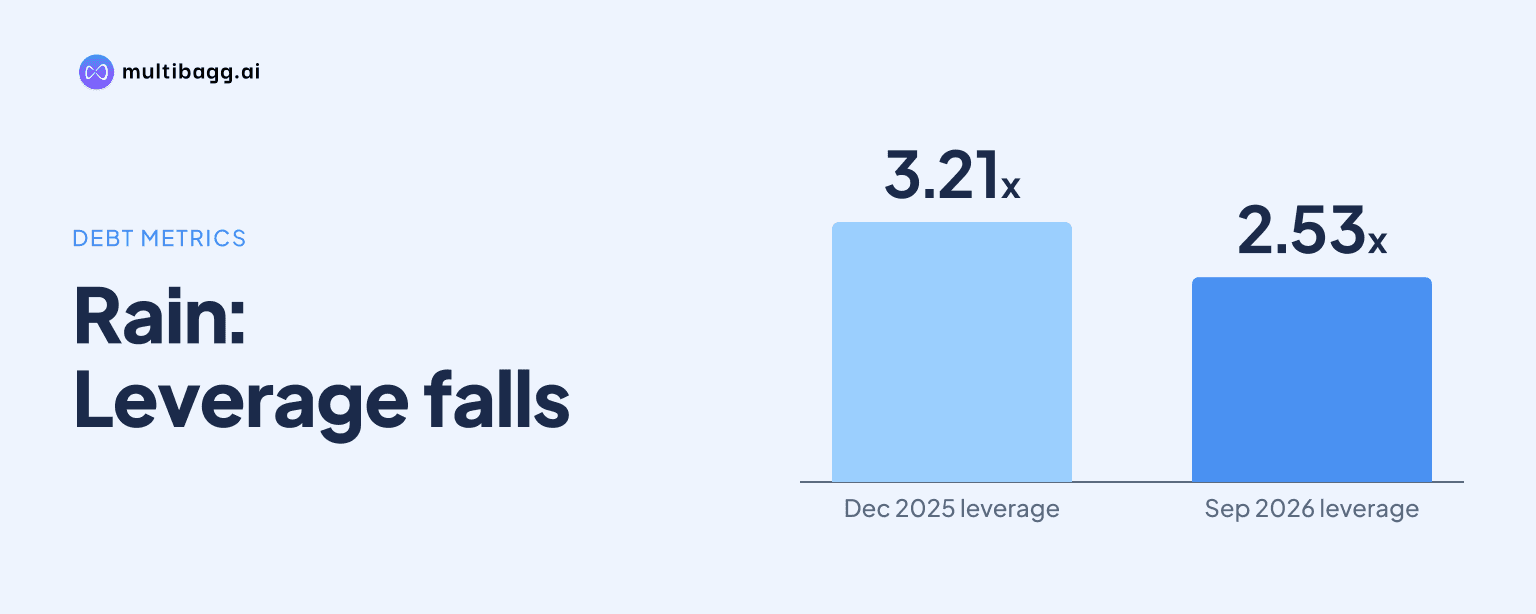
Rain Industries Limited reduced net debt to EBITDA to 2.53 times in September 2026 from 3.21 times in December 2025, as last-twelve-month adjusted EBITDA rose to US$33.7 crore from US$26.1 crore and the company prepaid €3.2 crore of German Term Loan B. Rain’s net debt nevertheless increased to US$85.1 crore as working-capital debt rose.
Know Rain Industries inside out
Results, valuation, peers and who's buying, in one view.
How did Rain reduce leverage in September 2026?
Rain reduced its net-debt-to-EBITDA ratio by 0.68 times to 2.53 times in September 2026 from 3.21 times in December 2025. Last-twelve-month, or LTM, adjusted EBITDA increased to US$33.7 crore from US$26.1 crore, while gross term debt declined to US$80.7 crore from US$82.9 crore. The presentation indicates that higher LTM EBITDA was the main factor behind the lower ratio because net debt did not decline.
Rain’s euro-denominated senior secured term loan, due by October 2028, decreased by US$4.9 crore in the presentation’s US-dollar reporting currency between December 2025 and September 2026. Rain separately reported prepayment of €3.2 crore of Term Loan B in Germany during 9M 2026. The presentation notes a euro loan balance of €27.83 crore translated at 1.14 in September 2026, compared with €31.06 crore translated at 1.18 on December 31, 2025. The US dollar-denominated senior secured notes, due in September 2029, remained at US$44.5 crore.
What cash flows supported Rain’s debt repayment?
Rain generated Rs 1,492.7 crore of net cash from operating activities in 9M 2026, up from Rs 959.7 crore in 9M 2025. The Rs 533 crore increase reflected improved profitability, partly offset by higher working capital, according to the presentation. The increase in operating cash generation occurred during the nine-month period in which Rain prepaid €3.2 crore of German Term Loan B.
Financing activities used Rs 872.2 crore in 9M 2026, compared with an outflow of Rs 1,079.2 crore in 9M 2025. Rain said the 2026 financing outflow reflected the Term Loan B prepayment, interest payments and lease obligations. Investing activities used Rs 73.5 crore, compared with Rs 105.5 crore a year earlier. The investing outflow mainly reflected Rs 440 crore of maintenance capital expenditure, partly offset by Rs 360 crore from net fixed-deposit maturities and interest income.
Rain’s Q3 2026 operating performance provides context for the higher LTM EBITDA used in the leverage calculation. Revenue from operations was Rs 5,485.9 crore, compared with Rs 4,475.7 crore in Q3 2025, while adjusted EBITDA rose to Rs 856.6 crore from Rs 648.1 crore. Adjusted EBITDA margin was 15.6% in Q3 2026, above 14.5% a year earlier but below 19.2% in Q2 2026. The LTM figure of US$33.7 crore covers a longer period than the Q3 result.
Got a follow-up? Ask IRIS
Why did Rain’s net debt rise while its leverage ratio fell?
Rain’s net debt increased by US$1.4 crore to US$85.1 crore in September 2026 even as its leverage ratio fell because total debt and cash moved differently from LTM adjusted EBITDA. Total debt increased to US$101.6 crore from US$100.7 crore, while cash and cash equivalents declined to US$16.5 crore from US$17 crore. Meanwhile, LTM adjusted EBITDA increased by US$7.6 crore to US$33.7 crore, reducing net debt relative to EBITDA.
Working-capital debt increased to US$21.7 crore in September 2026 from US$19 crore in December 2025, a US$2.7 crore increase that exceeded the US$2.2 crore reduction in gross term debt. Rain also reported working capital of US$58.8 crore in September 2026, up from US$49.3 crore in December 2025. The presentation identifies the higher working-capital requirement as a partial offset to the improvement in operating cash flow during 9M 2026.
Rain’s segments reported mixed Q3 2026 earnings trends despite the consolidated year-on-year EBITDA increase. Carbon adjusted EBITDA rose to Rs 742 crore from Rs 539 crore in Q3 2025, while Advanced Materials adjusted EBITDA increased to Rs 126 crore from Rs 89 crore. Cement recorded an adjusted EBITDA loss of Rs 11 crore, compared with a Rs 20 crore profit a year earlier, as higher energy and freight costs offset higher volumes and realisations. This segment movement coincided with consolidated adjusted EBITDA margin declining from 19.2% in Q2 2026 to 15.6% in Q3 2026.
When could Rain refinance its High Yield Bonds?
Rain plans to evaluate refinancing of its High Yield Bonds around March 2027 as part of management’s effort to reduce interest costs. The presentation does not disclose a refinancing amount, coupon, replacement instrument or completed transaction. It places the potential review alongside an aim to normalise working capital, which stood at US$58.8 crore in September 2026.
The disclosed maturity schedule provides the timing context for management’s review. Rain’s US dollar-denominated senior secured notes are due in September 2029 and stood at US$44.5 crore in both September 2026 and December 2025. Its euro-denominated senior secured term loan is due by October 2028 and was US$31.6 crore in September 2026. The proposed March 2027 assessment therefore comes before both disclosed maturity dates.
Rain’s outlook identifies operating matters that could affect production and cash generation before a refinancing assessment. Management plans to manage geopolitical risks and low water levels on European riverways, while annual outages at several sites are expected to temporarily reduce production. It also plans to use supply-chain investments and alternative raw materials, advance battery-anode and energy-storage materials, and optimise costs and raw materials. The Telangana cement expansion remains on hold until pricing improves enough to recover higher energy and freight costs.
Conclusion
Rain’s September 2026 balance-sheet data show lower leverage despite a modest increase in net debt. Net debt rose to US$85.1 crore from US$83.7 crore, but LTM adjusted EBITDA increased to US$33.7 crore from US$26.1 crore, reducing the net-debt-to-EBITDA ratio to 2.53 times. The €3.2 crore Term Loan B prepayment and Rs 1,492.7 crore of 9M operating cash inflow accompanied the reduction in gross term debt.
The next disclosed financial milestone is management’s planned assessment of High Yield Bond refinancing around March 2027, alongside its aim to normalise working capital. Investors can also watch the effects of planned maintenance outages, European riverway water levels and geopolitical risks on production and cash generation, as well as the US$44.5 crore notes due in September 2029 and the US$31.6 crore euro term loan due by October 2028.