










Rajesh Power Sets HKRP FY27 Revenue Target of Rs 150 Crore
Key highlights
- Rajesh Power targets around Rs 150 crore of FY27 standalone revenue from HKRP.
- Management expects HKRP to report a 20% PAT margin in FY27.
- HKRP is executing 3 smart-grid projects for Gujarat’s UGVCL, DGVCL and PGVCL.
- Rajesh Power estimates the relevant pan-India smart-grid opportunity at more than Rs 3,000 crore.
powered by IRIS
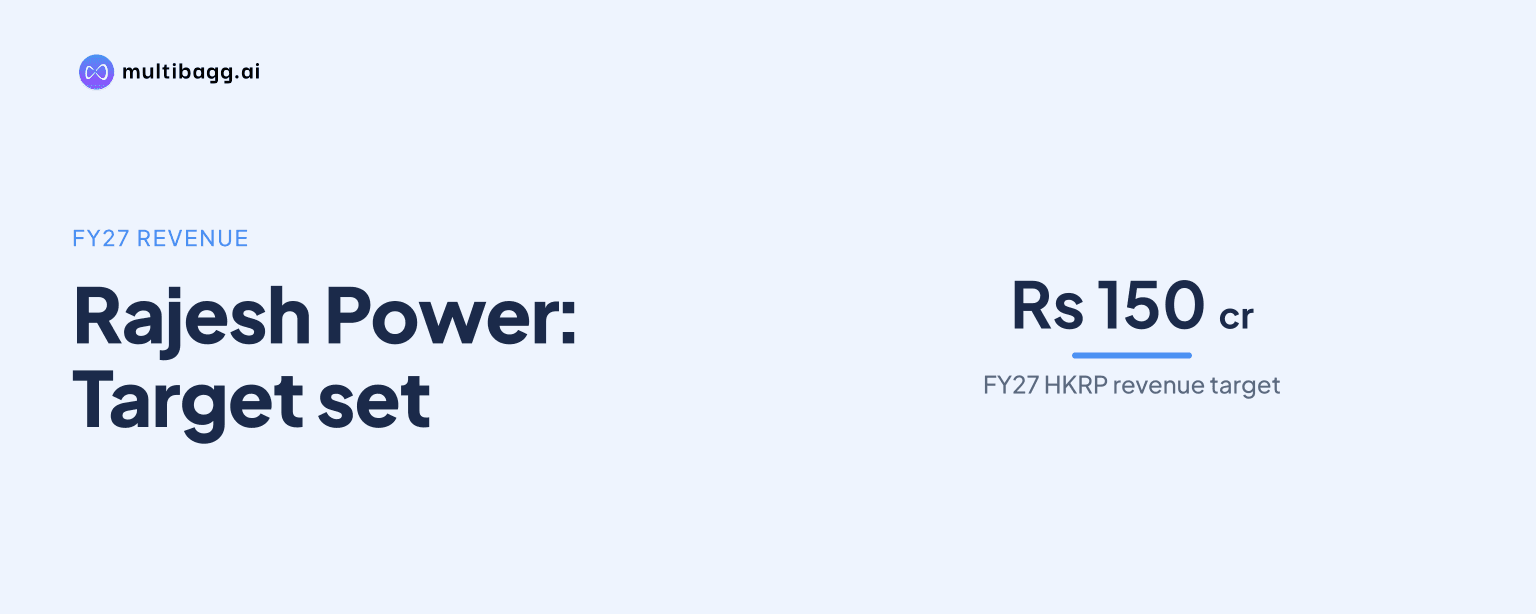
Rajesh Power is targeting about Rs 150 crore of standalone revenue from HKRP in FY27 with a 20% profit after tax, or PAT, margin, management said, citing three smart-grid projects under execution across Gujarat and a pan-India opportunity it estimates at more than Rs 3,000 crore.
Know Rajesh Power Services inside out
Results, valuation, peers and who's buying, in one view.
What is Rajesh Power’s FY27 target for HKRP?
Rajesh Power’s FY27 target for HKRP is around Rs 150 crore of standalone revenue and a PAT margin of 20%. Management presented the target while describing HKRP’s work in smart-grid technology, including supervisory control and data acquisition, or SCADA, systems and distribution management systems, or DMS.
The target gives a financial benchmark for a unit that an investor said was not yet considerable in Rajesh Power’s overall revenue and profit. Rajesh Power did not disclose HKRP’s current revenue, current PAT margin, order book or historical financial contribution during the call, so the change required to reach the FY27 target cannot be calculated from the disclosed information.
Rajesh Power specified that the Rs 150 crore and 20% margin targets apply to HKRP on a standalone basis rather than to the consolidated company. PAT margin measures profit after tax as a percentage of revenue, and management gave no comparable current PAT margin for HKRP or for Rajesh Power in this part of the call.
What smart-grid work is HKRP executing in Gujarat?
HKRP is executing three projects across Gujarat’s UGVCL, DGVCL and PGVCL distribution utilities, covering SCADA and DMS systems as well as greenfield command-and-control centres. Management said the projects are being executed at a large scale under the Revamped Distribution Sector Scheme, or RDSS, framework.
Rajesh Power described two project categories: SCADA/DMS projects and Smart Feeder Monitoring System, or SFMS, projects. The SCADA/DMS work covers monitoring and management of electricity distribution systems, while SFMS projects concern feeder monitoring; management said both categories are being undertaken by state distribution utilities and transmission utilities.
The projects being executed are in the range of Rs 100 crore to Rs 150 crore, according to management. That range is close to HKRP’s Rs 150 crore FY27 revenue target, although a project’s contract value and annual revenue are different measures because revenue depends on execution and recognition over the project period.
Rajesh Power said the Gujarat work reflects a need to make utility infrastructure smarter and to move grids toward more unified platforms. Management cited the adoption of smart technologies at the distribution level as the reason for pursuing the business, but it did not disclose project start dates, completion schedules or revenue booked from the three Gujarat contracts.
How large is Rajesh Power’s HKRP opportunity beyond Gujarat?
Rajesh Power estimates the addressable opportunity for the specified smart-grid categories at more than Rs 3,000 crore across India, rather than only in Gujarat. Management said a tender for even one small zone or segment within a state could have an approximate value of Rs 100 crore to Rs 150 crore.
The comparison between a Rs 100 crore to Rs 150 crore zonal opportunity and the more than Rs 3,000 crore national estimate explains why management’s Rs 150 crore FY27 target relies on expansion beyond the three Gujarat projects. Rajesh Power did not state its expected market share, the number of contracts required to meet the target, or the likely timing of revenue from states outside Gujarat.
Management identified Maharashtra, Assam, Kerala, Uttar Pradesh, Bihar and Uttarakhand as states where tenders were being floated or finalised. Rajesh Power said it was approaching opportunities in these markets, reviewing contracts and assessing tender requirements after building experience through the three Gujarat implementations.
The more than Rs 3,000 crore HKRP opportunity is separate from Rajesh Power’s broader bid pipeline of around Rs 3,000 crore to Rs 4,000 crore. Management discussed the broader pipeline elsewhere in the call, while the HKRP estimate specifically covered SCADA/DMS and SFMS smart-grid opportunities.
Got a follow-up? Ask IRIS
What needs to happen for Rajesh Power to meet the HKRP target?
Rajesh Power needs to execute its three Gujarat projects and convert state-level tender activity into further contracts to pursue the Rs 150 crore FY27 HKRP revenue target. Management said it was reviewing requirements in six named states beyond Gujarat, but it did not disclose submitted bids, awarded contracts or contract values in those markets.
Execution is material because the Gujarat scope includes greenfield command-and-control centres alongside SCADA and DMS systems. Rajesh Power said more states were adopting this model, but the call did not provide commissioning dates, customer-acceptance milestones or confirmation that the three Gujarat projects would be completed before FY27.
Project cash conversion is also relevant because Rajesh Power said 80% of a utility billing is normally received within 45 days. Management said a further 10% is received after equipment is installed on site, with the final 10% received when the full project is commissioned.
Rajesh Power said it was improving collection controls and obtaining longer trade terms from traders and suppliers, and expected better or similar working-capital management in the second half. It also said other current assets had included roughly Rs 38 crore of unbilled revenue, but gave no HKRP-specific receivables balance, cash-flow target or collection timeline.
How does HKRP fit with Rajesh Power’s wider power-infrastructure plans?
Rajesh Power is positioning HKRP as a technology-led complement to its wider power transmission and distribution activity, with the smart-grid unit focused on SCADA/DMS and SFMS projects. Management described the grid-modernisation requirement as a reason that utility infrastructure would need increasingly smart systems in coming years.
The company also said it was executing 400 kilovolt, or kV, substations and expected to qualify to bid for 765 kV substation work after commissioning a 400 kV project in the coming months. That transmission plan is separate from HKRP’s Rs 150 crore FY27 target, but both initiatives depend on Rajesh Power converting technical capability into orders.
Management said it was not yet executing 765 kV projects and would not enter that segment immediately during the year discussed on the call. It nevertheless said it was targeting entry soon after the 400 kV commissioning, while identifying a wider opportunity from relatively fewer participants capable of executing complex higher-voltage projects.
Rajesh Power also discussed data-centre and battery energy storage system, or BESS, opportunities, but both remain separate from the HKRP plan. Management said data-centre work was at a preliminary stage and that BESS bids were being pursued only on an engineering, procurement and construction, or EPC, basis rather than a build-operate-transfer, or BOT, model.
Conclusion
Rajesh Power has set a defined FY27 objective for HKRP of about Rs 150 crore in standalone revenue and a 20% PAT margin. The disclosed foundation is three smart-grid projects across Gujarat’s UGVCL, DGVCL and PGVCL, alongside management’s estimate of more than Rs 3,000 crore of national SCADA/DMS and SFMS opportunity.
The next developments to watch are tender and contract progress in Maharashtra, Assam, Kerala, Uttar Pradesh, Bihar and Uttarakhand, where management said opportunities were being floated or finalised. Rajesh Power’s planned commissioning of a 400 kV project in the coming months, plus any disclosure on HKRP order wins, project milestones, revenue contribution and working-capital outcomes, will show how the FY27 plan is progressing.