










Ratnamani Finow order book tops ₹3,000 crore after export win
Key highlights
- Ratnamani Finow received a ₹2,700 crore export order and reported an order book above ₹3,000 crore in Q2 2026-27.
- Ratnamani Finow's Q2 2026-27 revenue rose to ₹156.96 crore from ₹110.37 crore a year earlier.
- Ratnamani Finow's Q2 2026-27 profit after tax increased to ₹64.74 crore from ₹25.45 crore.
- Ratnamani Finow plans to begin induction-bend production in Q3 2026-27, with post-expansion capacity of 7,000 metric tonnes annually.
powered by IRIS
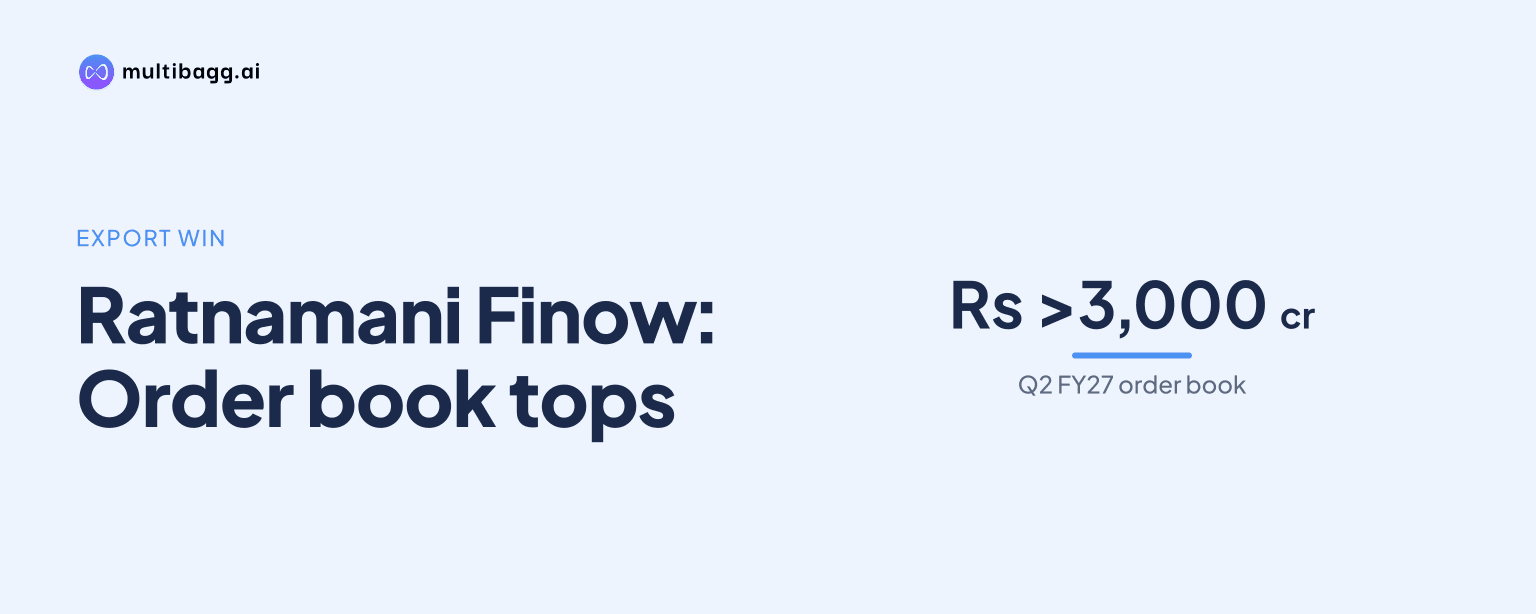
Ratnamani Finow Spooling Solutions Private Limited received a ₹2,700 crore export order in Q2 2026-27, taking its order book above ₹3,000 crore, while profit after tax rose to ₹64.74 crore from ₹25.45 crore a year earlier. Ratnamani Finow plans to start induction-bend production in Q3 2026-27.
Know Ratnamani Metals & Tubes inside out
Results, valuation, peers and who's buying, in one view.
What export order did Ratnamani Finow receive?
Ratnamani Finow received an export order valued at ₹2,700 crore, and reported that its order book stood above ₹3,000 crore in the Q2 2026-27 investor presentation. The presentation does not identify the customer, destination, product mix, delivery schedule or payment terms. It therefore confirms the size and export nature of the award, but not the quarters in which it may translate into revenue.
The ₹2,700 crore order forms at least ₹2,700 crore of the reported backlog above ₹3,000 crore. Ratnamani Finow supplies three product categories: pipe spools, induction bends, and hangers and supports. It serves nuclear and thermal power, oil and gas, petrochemicals, and data centres, although the presentation does not assign the export order to any product or end market.
How did Ratnamani Finow perform in Q2 2026-27?
Ratnamani Finow reported revenue from operations of ₹156.96 crore in Q2 2026-27, compared with ₹110.37 crore in Q2 2025-26. Earnings before interest, tax, depreciation and amortisation, or EBITDA, increased to ₹85.9 crore from ₹36.05 crore, while the EBITDA margin rose to 54.7% from 32.7%.
Profit before tax rose to ₹78.77 crore from ₹30.75 crore, and profit after tax increased to ₹64.74 crore from ₹25.45 crore across the two Q2 periods. The presentation gives no separate explanation for the higher margin, such as product mix, pricing, project execution, foreign exchange, tax or cost changes.
Ratnamani Finow's profit growth differed from Ratnamani Metals & Tubes Ltd.'s consolidated result. The parent reported consolidated revenue of ₹1,347.51 crore in Q2 2026-27, up from ₹1,191.69 crore, but profit after tax declined to ₹133.34 crore from ₹156.04 crore. Ratnamani Finow's ₹64.74 crore profit after tax was about 49% of the parent's consolidated profit after tax for the quarter.
What does Ratnamani Finow's order book indicate?
Ratnamani Finow's order book above ₹3,000 crore was more than 19 times its Q2 2026-27 revenue of ₹156.96 crore. This comparison shows the backlog's scale relative to one three-month revenue period, but it does not establish annual revenue because the presentation gives no execution schedule or conversion rate for the order book.
Ratnamani Metals & Tubes Ltd. separately reported a standalone order book of more than ₹2,600 crore in Q2 2026-27, up 30% from the preceding quarter. Ratnamani Finow's disclosed backlog was therefore higher than the parent's standalone backlog. The presentation does not state whether the two figures overlap, are comparable, or include work supplied between group entities.
Ratnamani Finow operates an 80,000 square metre facility at Anjar, Kutch, with seven production shops and more than 450 skilled workers. The facility supports pipe spools, induction bends, and hangers and supports, but the presentation does not disclose its current utilisation, production rate, or the portion of the above-₹3,000 crore order book that depends on the expansion.
Got a follow-up? Ask IRIS
When will Ratnamani Finow begin induction-bend production?
Ratnamani Finow expects to start induction-bend production in Q3 2026-27 after commissioning part of its expansion project. The balance equipment is expected over the next two quarters, while the presentation notes that the plant building and induction-bend equipment were commissioned during 2026.
Post-expansion annual capacity is stated at 7,000 metric tonnes, including 4,000 metric tonnes of pipe spools, 2,500 metric tonnes of induction bends and 500 metric tonnes of hangers and supports. The induction-bend operation will use two Schäfer hot induction bending machines. Induction bends represent about 36% of the disclosed post-expansion capacity by volume.
The Q3 2026-27 start target was disclosed alongside the ₹2,700 crore export award and the order book above ₹3,000 crore. Ratnamani Finow does not say how much of that export order contains induction bends, whether the new capacity is required to fulfil it, or what capital expenditure remains for the balance equipment.
How is Ratnamani Finow structured within Ratnamani Metals & Tubes?
Ratnamani Finow is a manufacturing joint venture formed in 2023, with Ratnamani Metals & Tubes Ltd. holding a 51% stake. Its other partner is Technoenergy AG of Switzerland, the holding entity of FINOW GmbH in Germany. The joint venture adds pipe-spool, induction-bend, and hanger-and-support manufacturing to the parent's welded and seamless pipes and tubes operations.
Ratnamani Finow is an approved vendor of Nuclear Power Corporation of India and is authorised by the Turkish Nuclear Regulatory Authority. Its 80,000 square metre Anjar facility is ISO 9001:2015 certified by TÜV NORD, and its bank borrowings carry a CRISIL AA- rating. These approvals and certifications relate to its work across nuclear power, thermal power, oil and gas, petrochemicals, and data centres.
Ratnamani Metals & Tubes Ltd. reported four manufacturing facilities across Gujarat and Odisha and a market capitalisation of ₹19,000 crore as of September 30, 2026. Its presentation describes subsidiaries and joint ventures as part of product-depth and forward-integration efforts, but does not disclose Ratnamani Finow's separate debt balance, capital employed, order-book margin, or valuation.
Conclusion
Ratnamani Finow combined a ₹2,700 crore export award with an order book above ₹3,000 crore and a rise in Q2 2026-27 profit after tax to ₹64.74 crore. Revenue increased to ₹156.96 crore and EBITDA margin reached 54.7%, while the parent group's consolidated profit after tax declined to ₹133.34 crore from ₹156.04 crore a year earlier.
The next disclosed operating milestone is the planned start of induction-bend production in Q3 2026-27. Ratnamani Finow also expects the balance of expansion equipment over the following two quarters; the presentation sets out 7,000 metric tonnes of post-expansion annual capacity but leaves the export order's execution timetable, product mix and margin undisclosed.