










Ratnamani Q2 revenue rises 13% but EBITDA margin falls
Key highlights
- Ratnamani's Q2 2026-27 consolidated revenue rose 13% to Rs 1,347.51 crore.
- Consolidated EBITDA margin fell to 16.3% from 20.0% in Q2 2025-26.
- Standalone EBITDA declined to Rs 138.77 crore from Rs 173.69 crore despite 18% revenue growth.
- RFSS reported Q2 EBITDA of Rs 85.90 crore and a 54.7% margin.
powered by IRIS
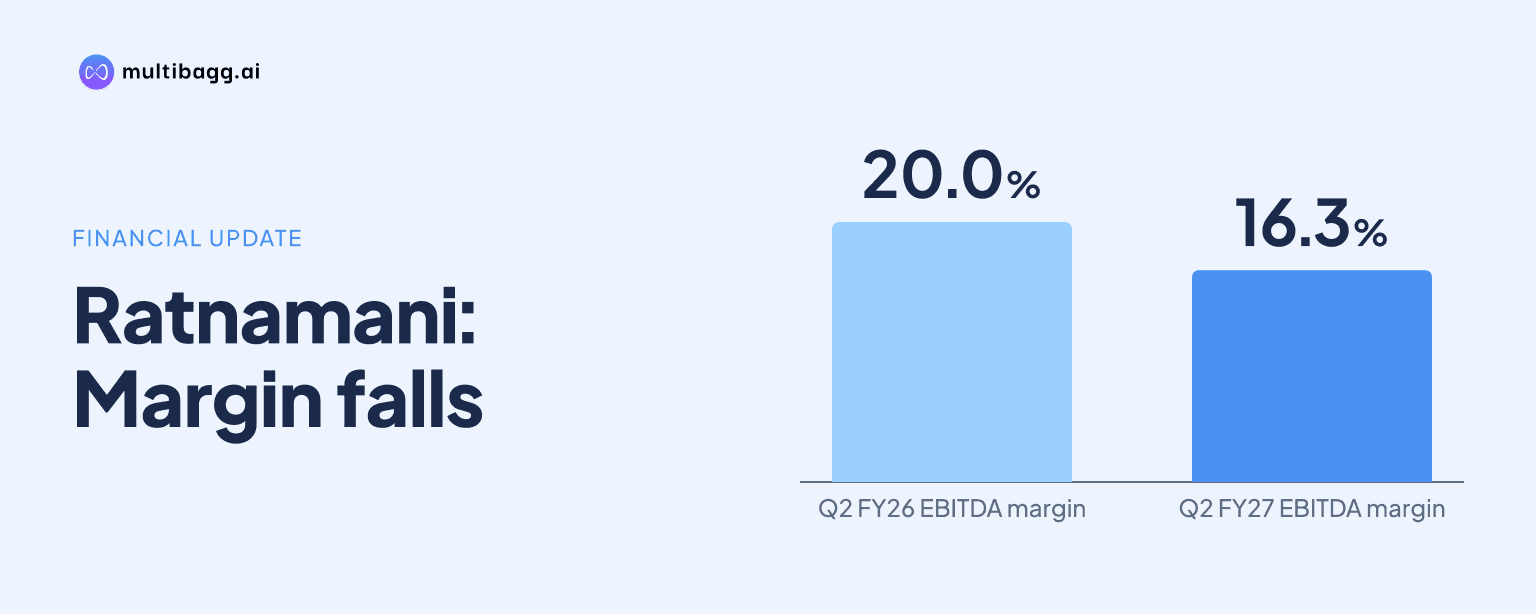
Ratnamani Metals and Tubes Limited reported 13% consolidated revenue growth to Rs 1,347.51 crore in Q2 2026-27, but earnings before interest, tax, depreciation and amortisation (EBITDA) fell to Rs 219.85 crore and its EBITDA margin declined to 16.3% from 20.0% a year earlier.
Know Ratnamani Metals & Tubes inside out
Results, valuation, peers and who's buying, in one view.
What happened to Ratnamani's consolidated profit in Q2 2026-27?
Ratnamani's higher Q2 2026-27 sales did not translate into higher consolidated operating profit: revenue rose by Rs 155.82 crore from Rs 1,191.69 crore, while EBITDA fell by Rs 18.30 crore from Rs 238.15 crore. The presentation said all group entities contributed to the 13% sales increase, but EBITDA margin contracted by 3.7 percentage points.
The decline extended below EBITDA in Q2 2026-27. Profit before tax (PBT) fell by Rs 25.62 crore to Rs 173.82 crore and profit after tax (PAT) decreased by Rs 22.70 crore to Rs 133.34 crore; PBT margin was 12.9% versus 16.7%, while PAT margin was 9.9% versus 13.1% in Q2 2025-26.
Consolidated cost movements included material cost of Rs 782.46 crore, up from Rs 727.04 crore, and other expenses of Rs 283.10 crore, up from Rs 163.00 crore. Employee benefit expense increased to Rs 93.12 crore from Rs 90.41 crore, while depreciation and amortisation rose to Rs 37.02 crore from Rs 32.04 crore.
Why did Ratnamani's standalone margin decline?
Ratnamani said it maintained standalone gross margins, but higher freight costs and overheads linked to uncertain global factors affected net margins. Standalone revenue increased 18% to Rs 1,104.40 crore in Q2 2026-27 from Rs 939.56 crore, although EBITDA declined to Rs 138.77 crore from Rs 173.69 crore.
Standalone EBITDA margin fell by 5.9 percentage points to 12.6% from 18.5%, a larger contraction than the 3.7-percentage-point movement in the consolidated margin. Standalone other expenses were Rs 235.15 crore versus Rs 121.28 crore, while material cost increased to Rs 693.03 crore from Rs 604.29 crore.
Standalone PBT declined to Rs 106.32 crore from Rs 144.18 crore and PAT decreased to Rs 79.57 crore from Rs 108.19 crore. Ratnamani reported standalone finance cost of Rs 1.68 crore, below Rs 2.59 crore a year earlier, and said it remained debt-free on a standalone basis.
How did Ratnamani's subsidiaries perform in Q2 2026-27?
Ratnamani Finow Spooling Solutions Private Limited (RFSS) recorded higher Q2 2026-27 revenue and profit, while Ravi Technoforge Private Limited (RTL) reported modest sales growth and lower earnings. RFSS revenue rose to Rs 156.96 crore from Rs 110.37 crore, whereas RTL revenue rose to Rs 98.61 crore from Rs 95.60 crore.
RFSS EBITDA increased to Rs 85.90 crore from Rs 36.05 crore and its EBITDA margin rose to 54.7% from 32.7%. Its PBT was Rs 78.77 crore versus Rs 30.75 crore, and PAT increased to Rs 64.74 crore from Rs 25.45 crore.
RTL EBITDA decreased to Rs 11.61 crore from Rs 12.62 crore, reducing its margin to 11.8% from 13.2%. RTL PBT fell to Rs 3.83 crore from Rs 7.05 crore, while PAT declined to Rs 2.78 crore from Rs 4.84 crore.
Got a follow-up? Ask IRIS
What does Ratnamani's H1 2026-27 performance show?
Ratnamani's first-half results were lower year on year despite the Q2 rise in consolidated revenue. Consolidated revenue for H1 2026-27 was Rs 2,319.14 crore, compared with Rs 2,343.31 crore in H1 2025-26, while EBITDA declined to Rs 399.64 crore from Rs 456.59 crore.
Consolidated H1 EBITDA margin moved to 17.2% from 19.5%, PBT declined to Rs 311.23 crore from Rs 375.23 crore, and PAT fell to Rs 240.37 crore from Rs 283.18 crore. PAT margin was 10.4%, compared with 12.1% in the preceding-year period.
Standalone H1 revenue was Rs 1,845.18 crore, compared with Rs 2,001.96 crore, and EBITDA declined to Rs 243.95 crore from Rs 400.31 crore. Standalone EBITDA margin was 13.2% against 20.0%, while PAT was Rs 133.64 crore versus Rs 253.15 crore.
What orders and capacity additions does Ratnamani report?
Ratnamani reported a standalone order book above Rs 2,600 crore, which it said was 30% higher than the previous quarter. RFSS separately reported an export order of Rs 2,700 crore and an order book above Rs 3,000 crore, although the presentation did not disclose delivery schedules or revenue-recognition timing.
During Q2 2026-27, Ratnamani received fertiliser approval for stainless steel seamless U-tubes used in carbamate condensers, secured nuclear-project orders for HP heater cold-finished tubes and hairpin heat-exchanger seamless tubes, and signed a global supply agreement with SAFRAN for aerospace tubes. It also supplied a 138 × 1 mm seamless tube size for an aerospace project.
Ratnamani upgraded Spiral Mill-3 in Kutch to manufacture pipes up to 18 metres long, with stated capacity of 1 lakh metric tonnes per annum. It also commissioned an external three-layer polyethylene (3LPE) coating plant in Odisha with capacity of 25 lakh square metres per annum.
Conclusion
The Q2 comparison shows a gap between Ratnamani's sales growth and its profitability: all entities contributed to revenue growth, but consolidated EBITDA, PBT and PAT were each below their Q2 2025-26 levels. The standalone business reported the most explicit explanation, citing freight costs and overheads, while RFSS delivered higher revenue, EBITDA and PAT.
The next results will show whether the standalone order book above Rs 2,600 crore, RFSS's order book above Rs 3,000 crore, and newly commissioned capacity convert into revenue and margins. RTL's greenfield project is targeted for commissioning in 2026-27, while RFSS said induction-bend production is to commence after part of its expansion project was commissioned.