










Ravi Technoforge’s EV-bearing project reaches 60% completion
Key highlights
- Ravi Technoforge’s Jayva Project was 60% complete in the 2026-27 Q2 presentation.
- The Jayva Project is targeted for commissioning in 2026-27, and its mother forging machine is installed and commissioned.
- Ravi Technoforge has 40,000 MT of annual forging capacity and completed a 20% Pipaliya-unit capacity expansion.
- Exports account for 40% of Ravi Technoforge’s portfolio across 15 countries.
powered by IRIS
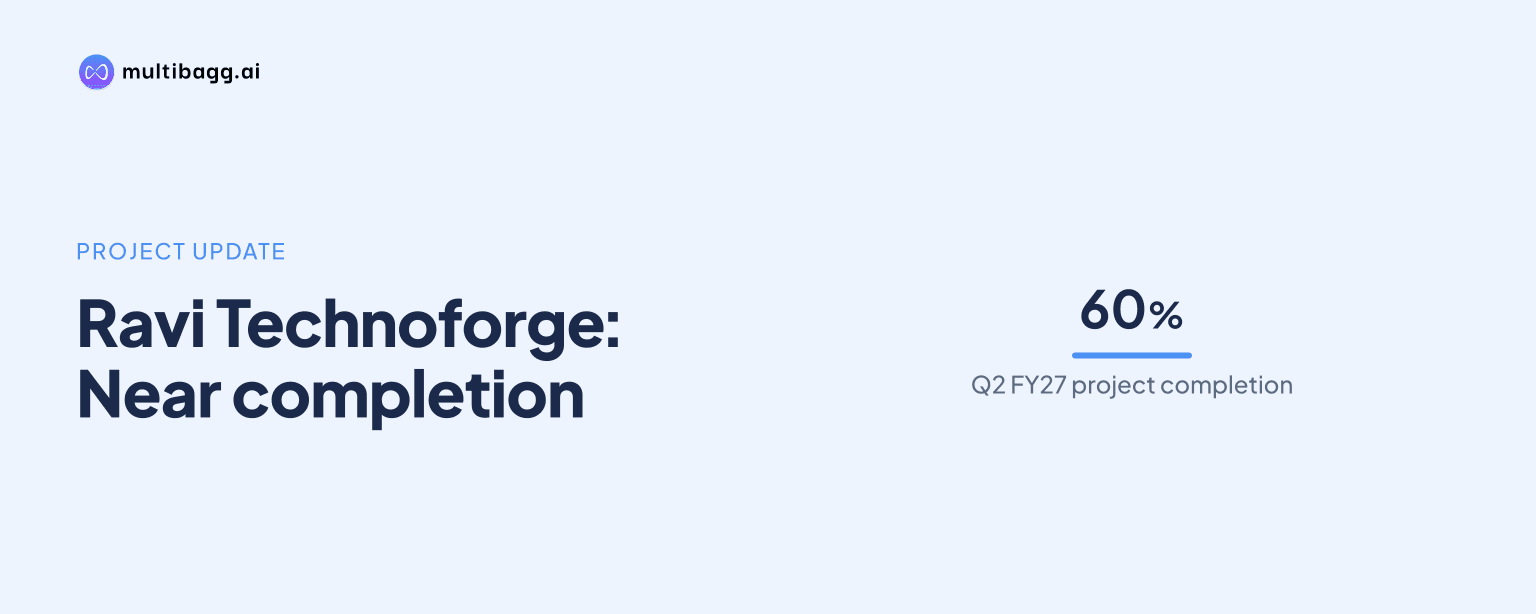
Ravi Technoforge Private Limited said its Jayva Project for high-volume, mid-sized bearing production was 60% complete in the 2026-27 Q2 presentation, with the mother forging machine installed and commissioned; the greenfield project is targeted for commissioning in 2026-27 and is linked to electric-vehicle adoption.
Know Ratnamani Metals & Tubes inside out
Results, valuation, peers and who's buying, in one view.
What is Ravi Technoforge building at the Jayva Project?
Ravi Technoforge is building a greenfield manufacturing project centred on an automatic hot former for high-volume, mid-sized bearings. Ravi Technoforge says the Jayva Project is intended to address demand associated with electric-vehicle adoption and India’s role as an alternate sourcing hub, while its target commissioning period is 2026-27.
The project was 60% complete at the time of the 2026-27 Q2 presentation. Ravi Technoforge said the mother forging machine, the core machine identified in the update, had already been installed and commissioned in record time, although the presentation does not state the project’s eventual annual capacity, investment cost or expected revenue contribution.
The Jayva initiative adds a new production line to a business that already makes forged and turned bearing rings, gear blanks and auto components. Ravi Technoforge’s existing product range spans components from 40 millimetres to 400 millimetres, making it a one-stop solution for customers across a range of bearing and component sizes, according to the presentation.
How does the Jayva Project support Ravi Technoforge’s EV strategy?
Ravi Technoforge has developed hubs for third-generation wheel bearings used in electric vehicles and the latest passenger vehicles. This product development gives Ravi Technoforge an identified offering for EV and passenger-vehicle applications, while the Jayva Project is being built for high-volume mid-sized bearings that Ravi Technoforge says are being driven by EV adoption.
Third-generation wheel-bearing hubs are distinct from the bearing rings and gear blanks that form part of Ravi Technoforge’s established range. The presentation therefore shows two related developments: successful hub development for EVs and newer passenger vehicles, and a 60%-complete automatic-hot-former project for bearing volumes. It does not specify whether Jayva will manufacture the third-generation hubs themselves.
Ravi Technoforge operates cold rolling, high-precision computer numerical control, or CNC, machines and automation-driven processes alongside its forging operations. The new automatic hot former extends this automation emphasis into the proposed high-volume mid-sized bearing line, but the presentation provides no customer orders, contracted volumes or named EV-platform awards for the Jayva Project.
How diversified is Ravi Technoforge’s current business?
Ravi Technoforge’s portfolio is equally divided between automotive and non-automotive sectors, according to the presentation. Its non-automotive end markets include heavy industry, railways, agriculture and off-highway applications, while automotive products include bearing rings, gear blanks, auto components and newly developed third-generation wheel-bearing hubs.
That 50-50 portfolio split contrasts with the narrower EV-led rationale stated for Jayva. The expansion is positioned around EV adoption and high-volume bearings, but the existing business remains exposed to four named non-automotive categories as well as automotive demand. The presentation does not give revenue, volume or margin data for either half of the portfolio.
Exports account for 40% of Ravi Technoforge’s portfolio and reach 15 countries. Ravi Technoforge describes itself as one of the few Indian suppliers with global supplies and says it has more than 20 years of association with leading bearing manufacturers, while also retaining a strong presence in India.
Ravi Technoforge says its scaling plans are supported by synergies with Ratnamani’s global network. That stated link is relevant alongside the 40% export share, but the presentation does not quantify the export sales routed through that network or identify how Jayva’s output will be allocated between India and the 15 export markets.
Got a follow-up? Ask IRIS
What capacity and operational upgrades does Ravi Technoforge already have?
Ravi Technoforge has forging capacity of 40,000 metric tonnes, or MT, per annum, supported by cold rolling, CNC machining and automation-led processes. Its 40-to-400-millimetre product range covers bearing rings, gear blanks and auto components within the same manufacturing offering.
Ravi Technoforge has completed the expansion of its Pipaliya unit, enhancing capacity by 20% through mechanisation and automation. This completed upgrade differs from Jayva’s 60% construction status: Pipaliya has already enhanced existing capacity, whereas Jayva remains under construction for a separate automatic-hot-former capability and a 2026-27 commissioning target.
Ravi Technoforge also reports in-house research and development, or R&D, and tooling capability. The third-generation hub development is the specific R&D result disclosed in the presentation, while Ravi Technoforge does not disclose a separate spending figure for R&D, a unit capacity for hubs, or the production capacity that Jayva will add after commissioning.
What do energy use and credit ratings indicate about Ravi Technoforge’s operations?
Ravi Technoforge has commissioned 11 megawatts of solar-power plants, which it says supply about 50% of its energy needs from green energy. Ravi Technoforge also says SKF India awarded it for best-in-class environmental, social and governance, or ESG, practices, though the presentation provides no date or award criteria.
Ravi Technoforge’s long-term bank-facility credit rating was upgraded from CARE A to CARE A+. This rating change and the 11-megawatt solar installation are reported alongside the manufacturing expansion, but the presentation does not disclose Jayva’s financing structure, borrowing amount or the impact of the project on debt.
The operating picture combines a completed 20% Pipaliya capacity increase, an in-progress Jayva project and existing 40,000-MT annual forging capacity. The presentation establishes progress on equipment installation and solar generation, but does not provide production utilisation, operating profit, order backlog or a date within 2026-27 for commercial output from Jayva.
Conclusion
Ravi Technoforge’s disclosed strategy combines an established 40,000-MT forging base, a portfolio split equally between automotive and non-automotive sectors, and a 40% export share across 15 countries. The 60%-complete Jayva Project is the main additional capacity initiative, while third-generation wheel-bearing hubs provide a stated product link to electric vehicles and newer passenger vehicles.
The next disclosed milestone is Jayva’s targeted commissioning in 2026-27, following installation and commissioning of its mother forging machine. What to watch is completion of the remaining 40%, a commercial-production date, and any disclosure of the project’s capacity, customer demand, investment cost or contribution to the existing 40,000-MT annual forging base.